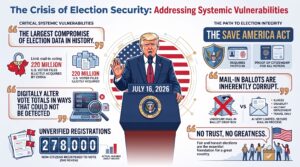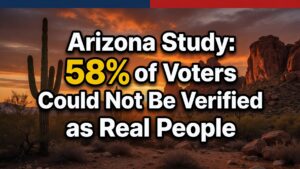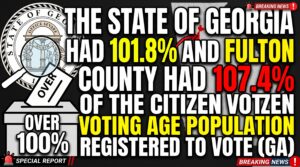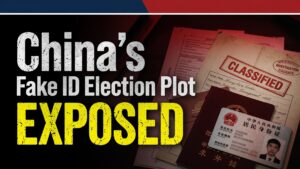
A voter roll is the gate every ballot has to pass through; a certified total is authoritative only to the degree that the name on each ballot belongs to a real, eligible, living citizen residing where the roll says they reside. In 2020, that gate was open in multiple directions at once across five states. Between July 3 and September 4, 2021, the State of Arizona cross-referenced 673,560 registered voters against the Motor Vehicle Division database and the Social Security Administration and could not positively identify 58 percent — 393,017 registrants — as real human beings through either system; a separate, longstanding MVD automated-registration defect allowed roughly 98,000 registrations to be processed without the documentary proof of citizenship required by Arizona law. Fulton County, Georgia, posted a registration rate of 113.8 percent of its citizen voting-age population — a mathematical impossibility — and 211,958 Georgia ballots were recorded from addresses that are legally ineligible as residences, including commercial warehouses, vacant lots, and UPS Store mailboxes. Wisconsin’s WisVote database contained 569,277 active voter registrations sharing the identical placeholder registration date January 1, 1918, and the state saw a 287 percent surge in voters claiming “indefinitely confined” status, which waives photo-ID requirements, reaching 220,404 — with 48,554 of those voters having no photo identification on file at all. Michigan’s rolls held 25,709 deceased registrants, 333 “active” Wayne County voters aged 115 or older, and a single October 2020 delivery of 8,000 to 10,000 fraudulent registration forms to the Muskegon City Clerk from a national registration operation. The Director of National Intelligence has publicly confirmed that the Chinese government manufactured and imported counterfeit U.S. driver’s licenses into the United States before the 2020 election for use in absentee-ballot voting. The gate did not fail in one place; it was open everywhere at once.
The 23 findings consolidate into five structural patterns; the ones below carry most of the national-security weight.
- State-run verification could not confirm a majority of registrants as real people. The State of Arizona’s 2021 cross-reference of 673,560 registered voters against MVD driver’s license data and federal Social Security records could not positively identify 393,017 of them — 58 percent — as real human beings through either database. A separate two-decade MVD defect permitted approximately 98,000 voter registrations to be validated without the documentary proof of citizenship required by Arizona law. In Georgia, Fulton County’s registration rate reached 113.8 percent of its citizen voting-age population, a statistical impossibility, while the state as a whole stood at 103.6 percent. In Michigan, 333 Wayne County registrants were listed as “active” voters aged 115 or older, and ballots were cast in the names of specific individuals deceased for decades, including Ardis Barnes (died 1968) and Selma Steel (died 1992).
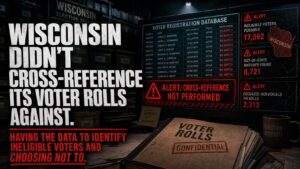
- The rolls were dressed with placeholders, ineligible addresses, and untracked status expansions. Wisconsin’s WisVote database contained 569,277 active voter registrations sharing the identical placeholder application date of January 1, 1918 — the standard value assigned in many systems when the true registration date is unknown or missing — and 115,252 of those records are credited with casting a ballot in 2020. Wisconsin also saw a 287 percent surge in voters claiming “indefinitely confined” status, which waives photo-identification requirements, reaching 220,404 voters, of whom 48,554 had no photo ID on file. Georgia recorded 211,958 voters casting ballots from addresses that are legally ineligible as residences, including commercial warehouses, vacant lots, and UPS Store mailboxes. In Michigan, an operative employed by a national voter-registration organization delivered 8,000 to 10,000 fraudulent registration forms to the Muskegon City Clerk, exhibiting identical handwriting, non-existent addresses, and telephone numbers belonging to unrelated parties.
- List-maintenance controls were demonstrably not enforced. The Wisconsin Elections Commission did not record in WisVote available ineligibility information for persons under court-ordered guardianship prohibited from voting, non-citizens ineligible under state law, or adjudicated incompetent individuals — meaning known ineligible records were retained as active on the roll. The Public Interest Legal Foundation identified 25,709 deceased registrants on Michigan’s rolls, more than 23,663 of them dead for five years or more. The Electronic Registration Information Center — the interstate consortium in which Arizona, Georgia, Michigan, Pennsylvania, and Wisconsin all held membership in 2020 — maintains live API connections to state voter databases and is designed to flag duplicates, deceased voters, and out-of-state movers, yet known ineligibles were not removed pre-election. Michigan’s former Secretary of State estimated that, conservatively, more than 800,000 absentee-ballot applications were mailed to individuals likely not eligible to vote in Michigan.
- A foreign-ID pipeline for counterfeit U.S. driver’s licenses was publicly confirmed. The Director of National Intelligence has publicly confirmed that the Chinese government manufactured and imported counterfeit U.S. driver’s licenses into the United States in the months before the 2020 election, reportedly for use in absentee-ballot casting by Chinese nationals residing in the country. U.S. Customs and Border Protection interdicted roughly 20,000 such counterfeit driver’s licenses in a single Chicago seizure in the summer of 2020. Because several states permit automated or online voter registration through a driver’s license number, a state-manufactured counterfeit license pipeline does not have to defeat the voter roll — it can be used to populate it. No public post-mortem has established what share of those counterfeits, if any, made it into state registration systems before interdiction.
- Downstream, the ledgers did not balance. Pennsylvania’s own Statewide Uniform Registry of Electors recorded 121,240 fewer voters as having voted than the number of ballots the Secretary of State certified, after official post-hoc revisions; federal EAVS data as analyzed by the Public Interest Legal Foundation shows 440,781 Pennsylvania mail ballots whose disposition could not be accounted for. Arizona’s statewide canvass estimated 96,389 ghost votes cast under the names of registered voters who were either unknown to current residents at the listed address or verified as having moved away before October 2020, and up to 173,000 Maricopa residents who stated they voted but for whom no vote was recorded. A voter roll whose integrity cannot be defended at the front end produces counts whose integrity cannot be defended at the back end.
Read as a national-security question, the Voter Roll Integrity record describes the decay of the authentication layer that every other election control relies on. Elections are a federally designated critical-infrastructure component, and the integrity of that component begins with the list itself: each registered name has to correspond to a real, eligible, living citizen residing at the listed address, and the controls that decide who gets onto and off of the list have to be enforced. In the cycle described above, a state of Arizona review could not identify a majority of registrants as real people; a swing-state’s database carried more than half a million active voters sharing a single placeholder date; hundreds of thousands of ballots were recorded from addresses that are not residences under state law; organized-fraud registration drives were documented; list-maintenance obligations were not performed; and a foreign state confirmed to have manufactured counterfeit U.S. driver’s licenses for use in the election was not publicly disclosed until after the fact. A foreign or domestic actor planning around a close federal contest does not need to cast a single fraudulent ballot if it can populate, retain, and dress the roll with identities the state cannot verify, and if the jurisdictions responsible for the list have neither the authority nor the inclination to clean it. That is the attack surface this record describes, and it is the posture any future adversary will plan around whether the United States chooses to address it or not.
Supporting Evidence