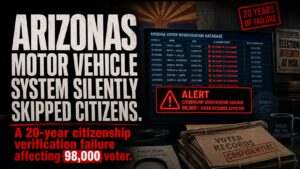
Voter registration databases are the foundation of election administration, because every subsequent record—poll book entries, ballot issuance, and voter history—depends on who appears on the rolls, in which status, and at which address. Under the Help America Vote Act (HAVA), each state (other than North Dakota) must maintain a single, centralized, computerized statewide voter registration list that serves as the official list for all federal elections, includes every legally registered voter with a unique identifier, is accessible in real time to local officials, and is regularly maintained by coordinating with other state databases to remove ineligible and duplicate registrants while protecting eligible voters from erroneous removal. If the voter rolls maintained in this statewide system are inaccurate, inflated, or manipulated, the entire downstream record chain becomes unreliable, and post‑election audits cannot distinguish between legitimate and illegitimate participation.
This subsection examines evidence of registration anomalies such as deceased or duplicate registrants, unexplained spikes and deletions, and improper list‑maintenance practices in light of HAVA’s statewide‑list and list‑maintenance standards, with particular attention to how those anomalies affect the ability to reconcile poll books, ballots, and voter history files.
Subtopic Analysis
Voter Roll Integrity
Every debate about 2020 focuses on ballots — who cast them, how they were counted, where they ended up. But the ballot starts with the roll. If the roll contains people who don't exist, have moved, are not citizens, or are registered twice — the ballot problem is already baked in before a single vote is cast. In 2020, the roll was broken in every state where the margin was close enough to matter.