
Reasonable Inference
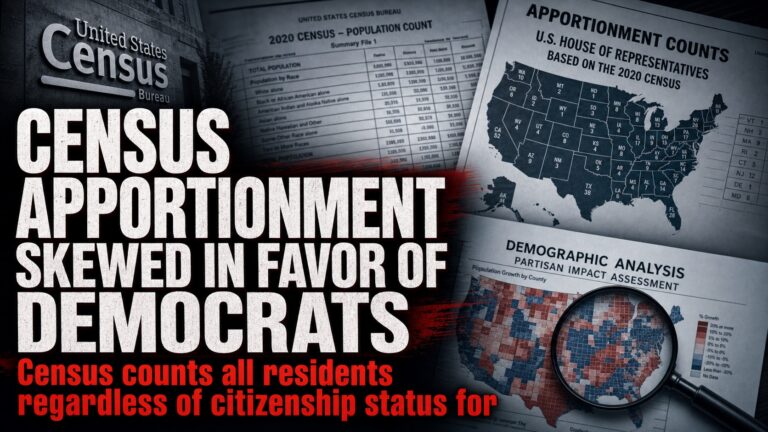
[Reasonable Inference] The U.S. Census counts all residents regardless of citizenship status for apportionment of U.S. House seats and Electoral College votes. Rep. Wesley Hunt (TX) has cited analysis suggesting this methodology may affect allocation of up to 18 congressional seats. The shift of additional congressional seats and corresponding Electoral College votes in states with higher non-citizen populations alters baseline political representation before any ballots are cast. Note: the 18-seat figure is the high end of advocacy estimates; independent academic and Pew Research analysis places the effect at approximately 2–5 seats; Evenwel v. Abbott (2016) unanimously upheld total-population apportionment under existing constitutional text.
Citations
Rep. Wesley Hunt (TX), Testimony Before House Judiciary Committee (Nov. 2025), cited at hunt.house.gov (claiming inclusion of non-citizens in apportionment base may affect allocation of up to 18 congressional seats; note: this is a political claim by a single Member of Congress; independent academic analysis places the effect at 2–5 seats).
U.S. Const. art. I, § 2, cl. 3; U.S. Const. amend. XIV, § 2 (apportionment based on “persons” in each state, not citizens; settled constitutional interpretation confirmed in Evenwel v. Abbott, 578 U.S. 54 (2016)).
[1]Evenwel v. Abbott, 578 U.S. 54 (2016) (unanimously upholding total-population apportionment for state legislative districts).
Election Crime Bureau, Redistricting Reform Analysis (advocacy analysis of apportionment effects of non-citizen population; note: advocacy source; agent treats as supporting citation for the framing, not for numerical claims).
Note: Reasonable Inference classification is appropriate; the 18-seat figure cited by Rep. Hunt is the high end of advocacy estimates and is not confirmed by peer-reviewed academic research; Pew Research and academic sources estimate a smaller effect of 2–5 seats.