
Current State of the US House of Representatives
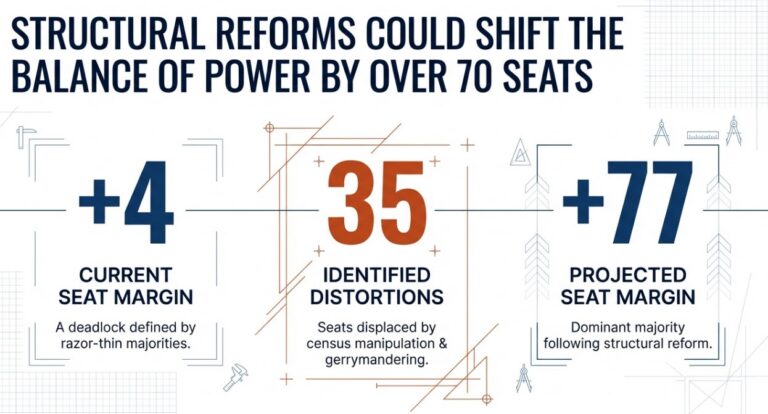
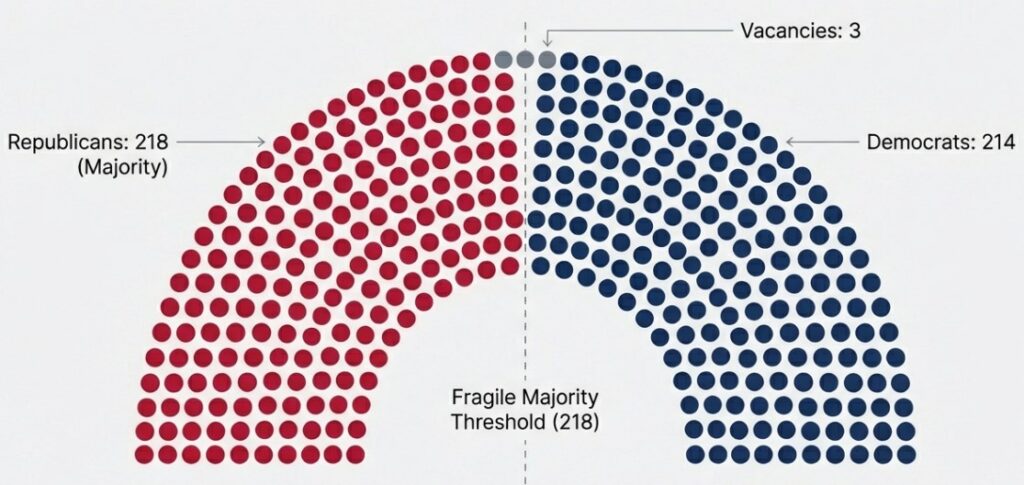
The Republican Party currently operates under a razor-thin 4-seat majority, a margin that creates a state of legislative paralysis and structural fragility. This narrow gap effectively holds the House leadership hostage to the whims of individual members, preventing the decisive execution of a conservative mandate.
Current House Composition
- Republicans 218
- Democrats 214
- Vacancies 3
The fragility of this margin is not merely a political inconvenience to those in favor of implementing the policies inherent in the Republican platform; it is a symptom of a deeper crisis in representative accuracy. The current balance of power is artificially compressed by administrative and judicial mechanisms that dilute Republican voting strength. A deep-dive analysis into census methodology and redistricting mandates reveals that the current “parity” is a manufactured result of structural disenfranchisement.
The Impact of Census Methodology on Seat Allocation
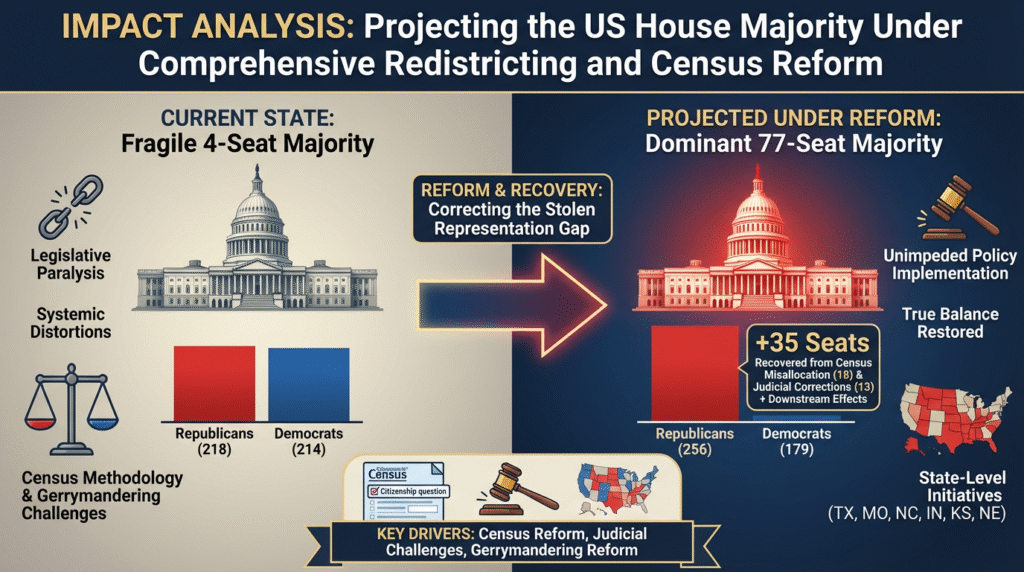
The US Census is the bedrock of congressional apportionment, yet it has been weaponized through “apportionment inflation.” By ignoring citizenship requirements and including illegal aliens in the population count, the census serves as a mechanism for the strategic distortion of the House. According to analysis championed by Rep. Wesley Hunt (TX), this inclusion of non-citizens has resulted in the misallocation of as many as 18 congressional seats.
This is a zero-sum game of representation: the current methodology systematically siphons political power away from Republican strongholds and reallocates it to “Blue states” with high concentrations of non-citizens. This census manipulation ensures that Democrat-controlled regions receive a disproportionate share of federal representation, effectively inflating their legislative influence before a single vote is even cast. This baseline distortion necessitates a return to a constitutionally accurate count to restore the true balance of power.
Judicial Challenges and Racial Gerrymandering Reform
Beyond the census, the judicial landscape represents a second front in the battle for representation recovery. For decades, the strategic use of Section 2 of the Voting Rights Act (VRA) has forced the creation of “majority-minority” districts, which often function as a form of unconstitutional racial gerrymandering. This structural disadvantage for Republicans is currently being challenged in the Supreme Court.
The case of Louisiana v. Phillip Callais serves as a critical legal domino. At issue is whether mandates for racially prioritized districts override constitutional standards of representation. A correction in this area of the law would dismantle the practice of drawing lines with the explicit purpose of boosting specific partisan outcomes under the guise of VRA compliance. It is projected that as many as 13 congressional seats are currently suppressed by these mandates; a favorable judicial outcome would trigger a significant shift back toward a constitutionally aligned map.
Comparative Projection: Current vs. Reformed House Makeup
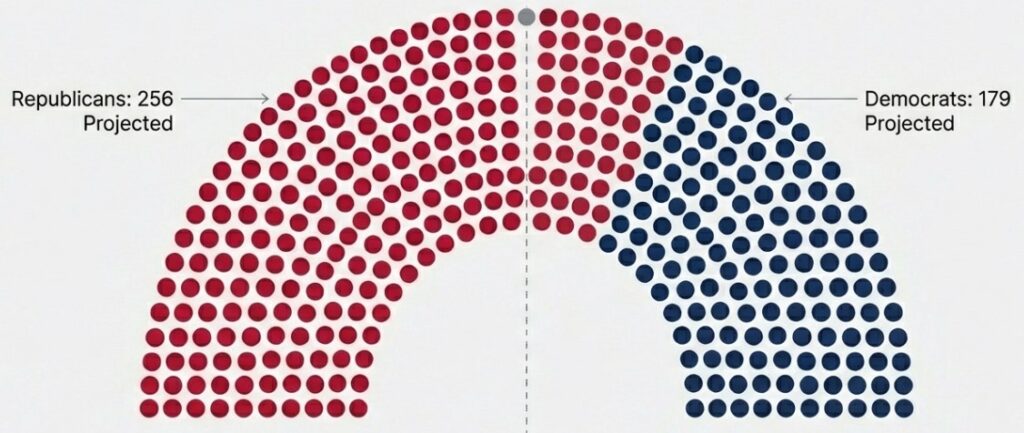
To understand the scope of the current disenfranchisement, we must analyze the cumulative effect of these distortions. While the direct census impact (18 seats) and judicial corrections (13 seats) total 31 seats, the “stolen representation” gap extends to as many as 35 seats when accounting for the downstream effects of partisan gerrymandering and incumbency protection in deep-blue corridors. Correcting these 35 seats transforms a precarious lead into a dominant governing coalition.
Addressing these systemic issues yields a 73-seat swing in the majority margin. A 77-seat majority would represent the most significant realignment of power in modern history, moving the House from a state of near-deadlock to a platform for absolute Republican policy dominance.
Geographic Disparities and State-Level Initiatives
- Texas (TX)
- Missouri (MO)
- North Carolina (NC)
- Indiana (IN)
- Kansas (KS)
- Nebraska (NE)
- Massachusetts (MA)
- Rhode Island (RI)
- Vermont (VT)
- Hawaii (HI)
- Connecticut (CT)
- New Mexico (NM)
- Delaware (DE)