
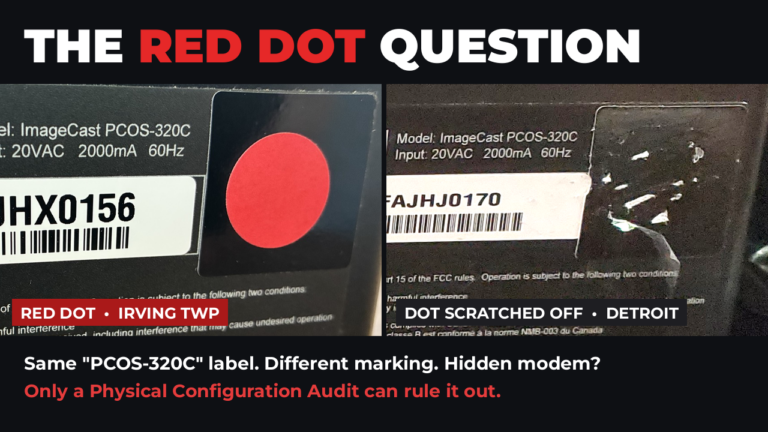
Why do some Dominion ImageCast Precinct (ICP) tabulators carry a red dot over their product label while others do not, and why does it matter for certification? It seems to be a means of differentiating between different configurations of the same tabulator model in the field. Does that mean that non-certified configurations of electronic voting systems have been deployed in support of our elections?
Let’s explore this possibility together.
Points to Ponder
- Four Michigan ICP tabulators photographed in the field all display the same product label: "Model: ImageCast PCOS-320C," "Made in USA." Two carry a red dot sticker in a dedicated window on the label; one has no dot; one, in Detroit, shows what appears to be a dot that was scratched or peeled off.
- The only documented functional difference between the PCOS-320C and the PCOS-321C is an internal dial-up modem. Michigan’s own contract says so. [1]
- Dominion’s own Alaska correspondence shows that only 34 of Alaska’s ICP 321C units were built with modems at the factory and 304 were retrofitted with dial-up modems after the fact, and that the retrofit units had to be identified from spreadsheets. [2]
- Hypotheses: the red dot marks (a) a modem-equipped or retrofit unit, or (b) a unit actually built as a PCOS-321C but carrying a 320C label. Benign explanations also exist.
- Only a Physical Configuration Audit (PCA) that opens the units and compares them with the EAC-certified configuration can rule these possibilities in or out.
What Has Been Observed
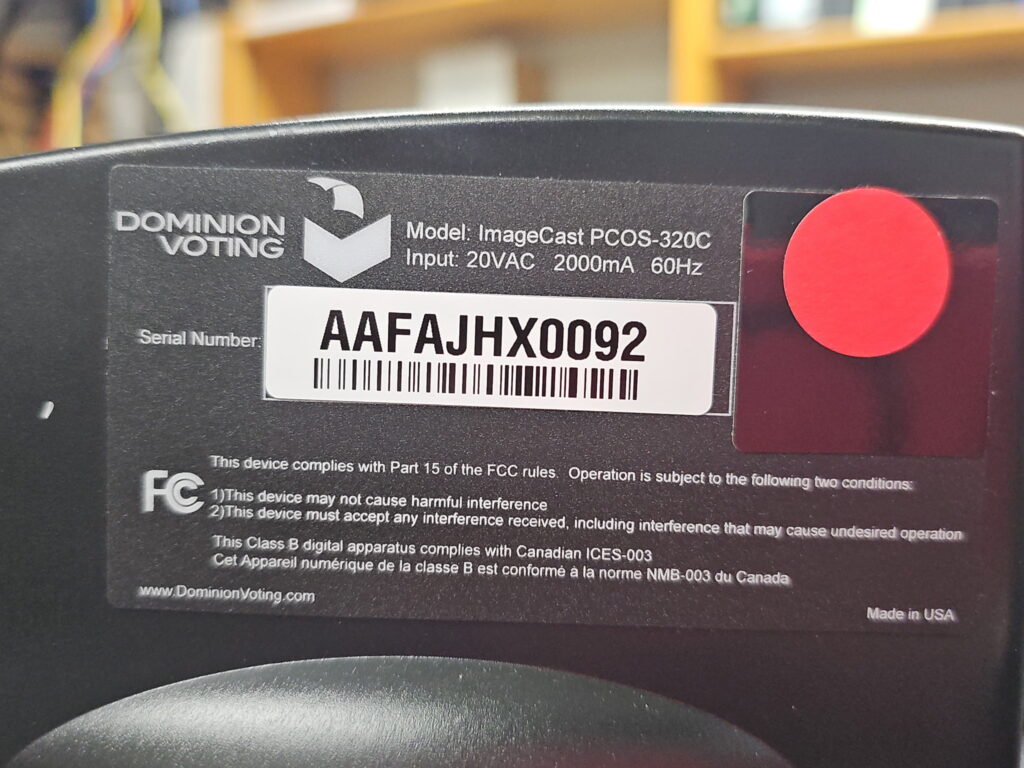
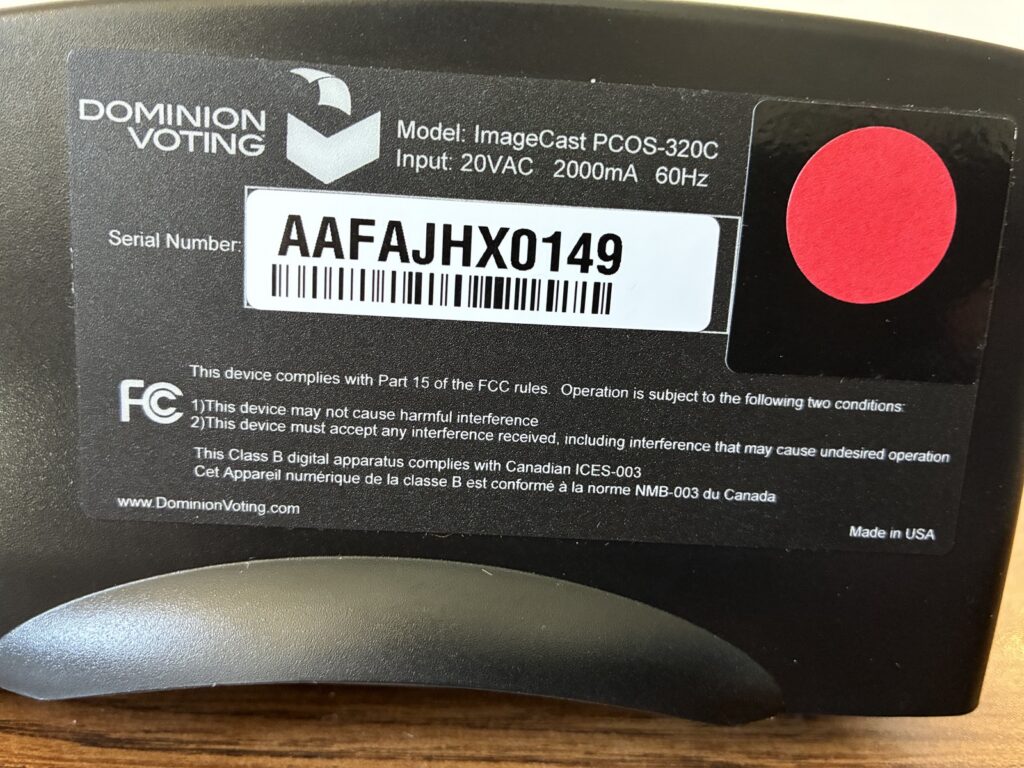
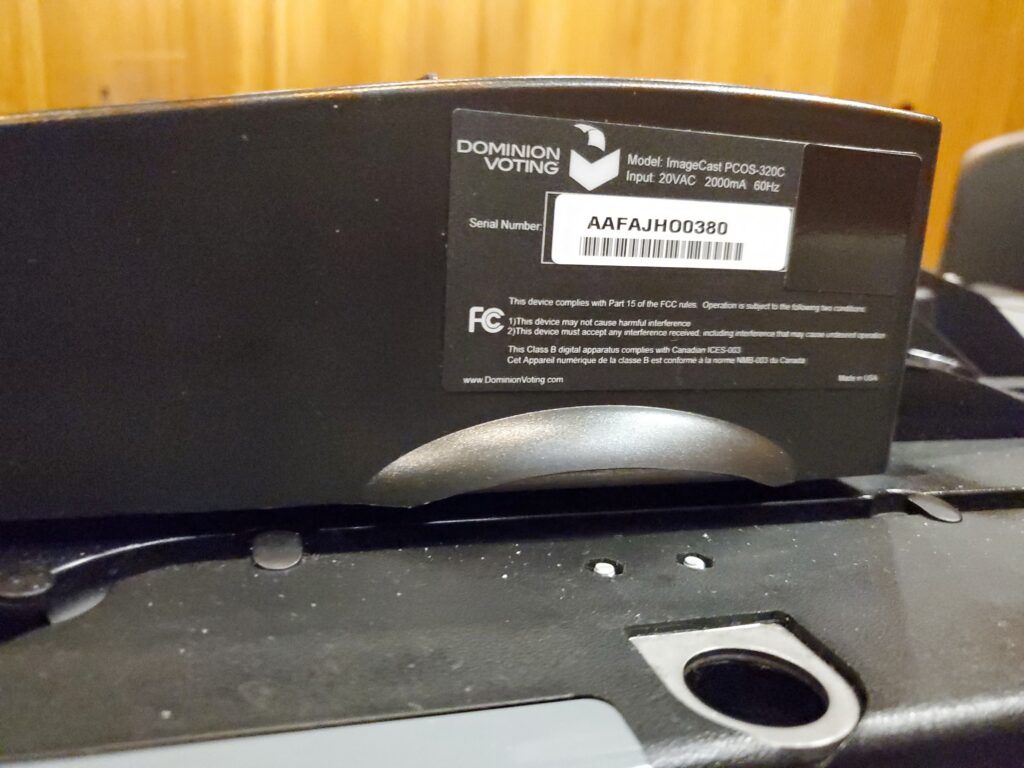
The four photographs below were taken of ImageCast Precinct tabulators in four Michigan jurisdictions. Each unit carries the standard Dominion product label: manufacturer, model, power rating, serial number, FCC Part 15 and Canadian ICES-003 statements, and country of origin. Each label also has a dark, glossy square window in its upper-right corner. That window is the location of the red dot.
Jurisdiction | Serial number | Label model | Origin label | Red dot window |
Martin Township (early voting unit) | AAFAJHX0092 | PCOS-320C | Made in USA | Red dot present |
Irving Township | AAFAJHX0156 | PCOS-320C | Made in USA | Red dot present |
City of Livonia | AAFAJHO0380 | PCOS-320C | Made in USA | No dot; window intact |
City of Detroit (Pct 66, ICP100018-66) | AAFAJHJ0170 | PCOS-320C | Made in USA | Dot apparently removed; window film torn, residue visible |
Serial numbers transcribed from the photographs. The seventh character of the Livonia serial appears to be the letter “O”; confirm against the asset record.
One pattern stands out. Both units with an intact red dot share the serial prefix AAFAJHX. The Livonia unit (AAFAJHO) has no dot, and the Detroit unit (AAFAJHJ) has a removed dot. If the seventh character is a production lot or build code, the red dot may track a specific build lot. A sample of four units cannot establish that; a fleet-wide inventory of serial numbers against dot status can.
The Detroit Unit: A Dot That Was Removed?
The Detroit tabulator, photographed October 19, 2026 (per the image file timestamp) with City of Detroit asset tag 118135 and the precinct label “ICP100018-66 / PCT 66,” shows something the other three do not. The label window is not clean like Livonia’s and has no dot like Martin’s and Irving’s. Instead it shows torn film, flecks of residue, and scratch marks in the exact place where the red dot sits on the other units.
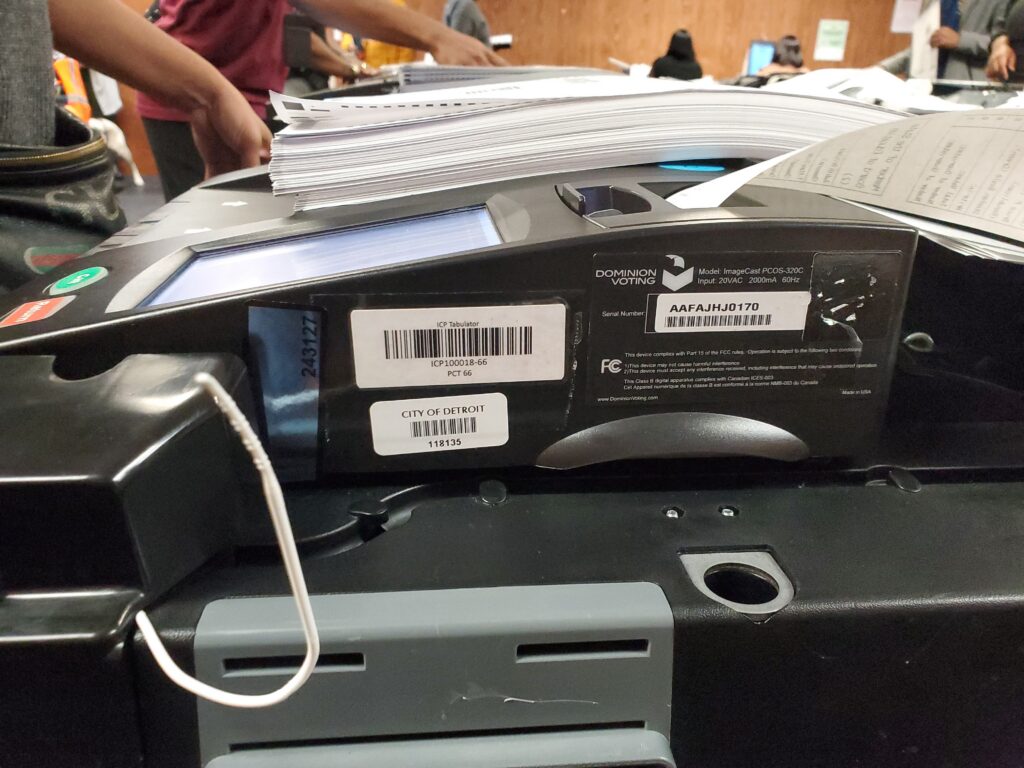
The removal raises questions that the photograph alone cannot answer:
- Who removed the dot, when, and under what work order or instruction?
- Was the dot removed because the unit’s configuration changed (for example, a modem removed), or to make the unit look like the rest of the fleet?
- Does Detroit’s asset or maintenance record show any service, retrofit, or configuration change for serial AAFAJHJ0170?
If the red dot is just an inventory marker, removing it is harmless but should be documented. If it marks a hardware configuration, removing it erases the only visible external clue to that configuration. Either way, the chain-of-custody record should explain it.
Why a Label Matters
Federal standards require every voting device to carry a permanently affixed nameplate showing the manufacturer, device name, model number, revision letter, serial number, and power requirements. Dominion has stated that its system conforms to that requirement. [3] The model on the nameplate is how election officials, canvassers, and observers determine whether a unit belongs to the certified configuration.
The EAC’s scope of certification is explicit that it covers only the hardware, firmware, and software listed, and that “any use, configuration changes, revision changes, additions or subtractions from the described system are not included in this evaluation.” [4, 5] A unit labeled PCOS-320C that has been modified or built differently is, by that definition, not the certified unit.
PCOS-320C vs. PCOS-321C
Dominion has built the ImageCast Precinct in several hardware versions. The difference that matters here is communications hardware:
Record | What it says about the 321C |
Michigan contract #071B7700117 [1] | “The ImageCast Precinct model 321-C contains an internal dial-up modem; wireless 3G modems are available as external devices.” It requires a different Device Configuration File to enable transmission, and “No other functional differences exist between the two versions.” |
Michigan BOE certification report, D-Suite 5.5 [6] | Lists both the PCOS-320C (“No Internal Modem”) and the PCOS-321C (“Internal Analog Modem”) as tested hardware, and describes modem transmission tests using the internal modem. |
EAC scope, D-Suite 5.5 [7] | Certified ICP hardware is PCOS-320C and PCOS-320A. “Wide Area Network – Use of Modems: NO.” |
EAC scope, D-Suite 5.17 [8] | Lists PCOS-320C and PCOS-320A; no 321C. |
EAC scope, D-Suite 5.20, v1.0 [4] | Listed the PCOS-321C as ICP hardware (Feb. 4, 2025), while modems and wireless remained “NO.” |
EAC scope, D-Suite 5.20, v1.1 [9] | “Updated component list to remove PCOS-321C,” dated October 26, 2026, eight days before the general election. |
Pro V&V 5.17S report (New Mexico) [10] | Lists “PCOS-321C (with internal dialup modem)” and tested “Use ICP PCOS-321C internal modem” for results transmission. |
Florida cert. 4.14.17 [11] | “Hardware version: PCOS 321C, includes internal analog modem.” |
Two points follow. First, the 320C and 321C are the same machine on the outside except for communications capability, so a 321C could be hard to tell from a 320C by eye. Second, the modem function itself has never been certified by the EAC for any Democracy Suite version in this record, and the 321C has now been removed from the 5.20 certified list.
Michigan officials have said the state no longer certifies tabulator modems for transmitting unofficial results, [12] and that the upgraded Dominion tabulators would not have internet modems. [13] Those statements describe policy and intent. They do not by themselves verify what is physically inside each unit in the field.
The Alaska Precedent
An internal Dominion email from Regional Sales Manager Dana LaTour, copied to David Moreno and Eric Coomer, shows how Dominion handled modem configurations in Alaska. [2]
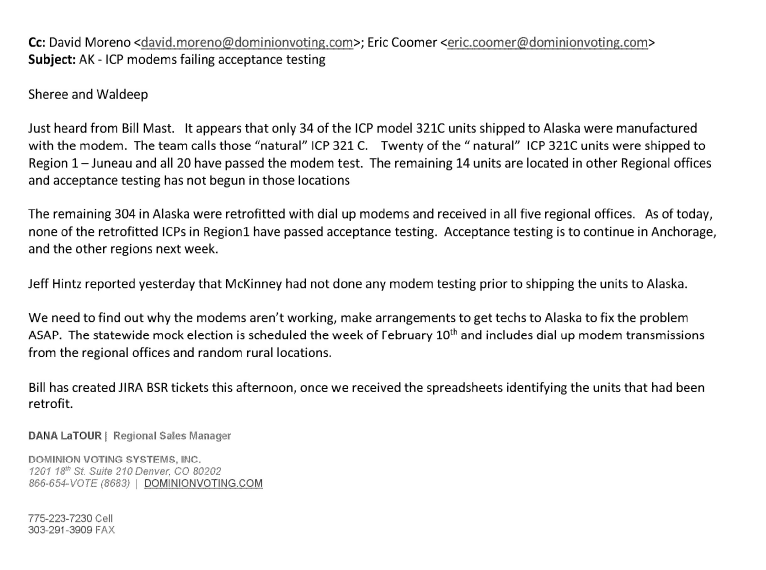
The email establishes several facts directly relevant to Michigan:
- Most “321C” units were not built as 321Cs. Only 34 of the ICP 321C units shipped to Alaska were manufactured with the modem; Dominion staff called these “natural” 321Cs.
- Retrofits were the norm. “The remaining 304 in Alaska were retrofitted with dial up modems,” roughly 90 percent of the fleet.
- Retrofits were not obvious from the outside. Service tickets were created only “once we received the spreadsheets identifying the units that had been retrofit,” which means the retrofits were tracked by list, not by the unit’s appearance.
- Testing gaps. Jeff Hintz reported that the McKinney facility “had not done any modem testing prior to shipping the units to Alaska,” and none of the retrofitted ICPs in Region 1 had passed acceptance testing at the time.
Alaska continues to buy the 321C by name: a 2024 Kodiak Island Borough purchase lists “ImageCast Precinct Tabulator (321C)” and a 321C firmware license and warranty. [14] The EAC has also approved at least one engineering change order covering the ICP PCOS-320A, -320C and -321C together (DVS-100503), confirming these versions share a common hardware platform. [15]
If Dominion retrofitted hundreds of units in one state and needed a spreadsheet to know which ones, a simple visual marker such as a colored dot is the kind of field tool a technician or warehouse might use to tell them apart.
Possible Explanations for the Red Dot
The red dot is not described in any public Dominion document reviewed for this report. Each explanation below makes a different prediction that a PCA or records request can test.
Hypothesis | What it would mean | How to test it |
H1. Modem or retrofit marker | The dot marks a unit with an internal modem installed, or one retrofitted from factory specification, as in Alaska. Units without a dot are unmodified 320Cs. | Open dotted and undotted units. Look for an installed modem module, RJ-11 jack, populated modem footprint, or added wiring. Compare against service and retrofit records. |
H2. Actually a PCOS-321C | The dotted units were built as 321C configurations but carry a 320C nameplate. They would differ from the certified 320C only by the modem, as the Michigan contract says. | Compare mainboard part and revision numbers to the 321C bill of materials. Read the Device Configuration File and firmware for enabled transmission settings. Check invoices and shipping records for “321C.” |
H3. Administrative marker | The dot marks something unrelated to hardware: acceptance-test status, early-voting assignment, an inventory cycle, a completed ECO, a battery or warranty item. | Ask the clerk and county for the written meaning of the dot. Check whether dot status tracks early-voting use, acceptance dates, or serial lot (e.g., AAFAJHX). |
The Martin Township unit was used for early voting, which is consistent with H3. The Irving Township unit, however, carries the same dot with no early-voting designation in the record available here, and the two dotted units share a serial lot. Neither fact settles the question.
Why Only a PCA Can Rule It Out
A Physical Configuration Audit is a hands-on inspection that checks whether the hardware, software, and network configuration of the machines actually in use match the machines that were tested and approved. [16] Visual label checks, logic-and-accuracy tests, and tabulator tapes do not answer this question. A modem that is present but disabled by configuration will not show up on a results tape and will not affect a test deck.
A PCA scoped to the red-dot question should, at a minimum:
- Select a sample that includes dotted, undotted, and dot-removed units, including Detroit serial AAFAJHJ0170, Martin AAFAJHX0092, Irving AAFAJHX0156, and Livonia AAFAJHO0380.
- Open each unit under observation and photograph the mainboard, communications ports, and any daughterboards, with board part numbers and revision letters recorded.
- Identify any modem chipset, populated or unpopulated modem footprint, RJ-11 port, internal antenna, or USB/serial wiring not present in the EAC-tested unit.
- Compare each unit to the bill of materials and test-lab photographs for the certified PCOS-320C configuration. [8, 17]
- Extract and hash the firmware and Device Configuration File, and record any enabled transmission or modem settings.
- Reconcile every inspected serial number with purchase invoices, shipping manifests, acceptance-test records, and Dominion/Liberty Vote service tickets.
Physical Configuration Audits
Records to Request
Alongside a PCA, these public-record requests would let the red-dot question be answered from documents:
- Any written definition, instruction, or training material describing the red dot sticker on ICP product labels, from the clerk, county, Bureau of Elections, or Dominion/Liberty Vote.
- Purchase orders, invoices, and packing lists showing the model number (320C vs. 321C) for each ICP serial number delivered under Contract #071B7700117.
- Acceptance-test records for each ICP, including any modem tests.
- Any list or spreadsheet identifying ICP units that were retrofitted, refurbished, or had modems installed or removed, similar to the Alaska retrofit spreadsheets.
- Maintenance, repair, and service-ticket records for Detroit serial AAFAJHJ0170, including any record of label or sticker removal.
Conclusion
The red dot is a small thing, but it sits on the one label that tells the public what machine is counting their votes. Every unit photographed says “PCOS-320C,” yet the marking differs from unit to unit, and in Detroit someone appears to have removed it. Dominion’s own Alaska records show that modem-equipped ICPs were routinely created by retrofitting rather than at the factory, and that the company needed lists to tell them apart. The PCOS-321C differs from the certified 320C only by its internal modem, and the EAC removed it from the 5.20 certified list days before the election.
None of this proves that any Michigan unit contains a modem. It does mean the possibility cannot be dismissed by looking at a label.
A Physical Configuration Audit is the only way to rule it out.
Necessary Actions
The responsible authorities (the Martin Township Clerk, the Allegan County Clerk, the Michigan Department of State, the House Oversight Committee, and CISA, which the Clerk has asked to conduct the audit) should support the Allegan County Sheriff’s ongoing investigation and
- preserve the equipment and records now,
- identify the device broadcasting “Renkchip-A9C4” from 40:9c:a7:bb:1a:03,
- complete a Physical Configuration Audit of the Martin Township early voting ICP (PCOS-320C, serial AAFAJHX0092) and its accessories, confirming that it contains no internal modem and runs the certified PCOS-320C configuration, with findings classified as Conforms, Does Not Conform, or Indeterminate, and
- inventory the ImageCast Precinct and ImageCast Precinct 2 units assigned to early voting and absentee counting boards statewide. If the unit conforms and the radio is an unrelated accessory, that is a useful public assurance and a lesson about storage practice. If it does not conform, Michigan voters are owed that finding before the next election.
Because a violation of MCL 168.720j(10) is probable, these findings should also go to the Sheriff’s Office for its investigation.
References
[1] State of Michigan Contract #071B7700117, Dominion Voting Systems, Inc. https://www.michigan.gov/dtmb/-/media/Project/Websites/dtmb/Procurement/Contracts/MiDEAL-Media/008/7700117.pdf
[2] Dominion internal email, Dana LaTour (Regional Sales Manager), “AK – ICP modems failing acceptance testing” (undated; record provided by author). Image reproduced as Figure 6.
[3] Dominion D-Suite 5.5-A Implementation Statement, VVSG 4.3.6 Product Marking. https://www.eac.gov/sites/default/files/voting_system/files/Attachment_A_-_Dominion_D-Suite_5.5-A_Implementation_Statement.pdf
[4] EAC, Democracy Suite 5.20 Certificate and Scope of Conformance, v1.0 (Feb. 4, 2025). https://www.eac.gov/sites/default/files/2025-02/DVS%205.20%20Certificate%20and%20Scope%20of%20Conformance.pdf
[5] Election Crime Bureau, “The Modem That Threatens National Security” (Nov. 2026). https://electioncrimebureau.com/pcos321c/
[6] Michigan Bureau of Elections, Voting System Certification Evaluation Report, Democracy Suite 5.5 (as filed in Attorney General amicus brief, Mich. 3rd Cir. Ct.). https://www.democracydocket.com/wp-content/uploads/2022/10/Nessel-Amicus-Brief-00052901xE249C32.pdf
[7] EAC, Democracy Suite 5.5 Certificate and Scope of Conformance. https://www.eac.gov/sites/default/files/voting_system/files/DSuite55_CertConf_Scope(FINAL).pdf
[8] EAC, Democracy Suite 5.17 Certificate and Scope of Conformance (Mar. 16, 2023). https://www.eac.gov/sites/default/files/voting_system/files/D-Suite%205.17%20Certificate%20and%20Scope%20SIGNED.pdf
[9] EAC, Democracy Suite 5.20 Certificate and Scope of Conformance, v1.1 (Oct. 26, 2026). https://www.eac.gov/sites/default/files/2026-10/DVS_5.20_Certificate_and_Scope_of_Conformance.pdf
[10] Pro V&V, D-Suite 5.17S State Certification Test Report (New Mexico SOS). https://www.sos.nm.gov/wp-content/uploads/2025/07/DVS-D-Suite-5.17S-VSTL-Report.pdf
[11] Florida Division of Elections, Certification #150526-DVS, Democracy Suite 4.14.17. https://files.floridados.gov/media/695108/dominion-democracy-suite-release-41417-version-3-certificaiton.pdf
[12] FOX 2 Detroit, “Secretary of State addresses voting result delay from primary night”. https://www.fox2detroit.com/news/secretary-of-state-addresses-voting-result-delay-from-primary-night
[13] Michigan Advance, “State canvassers approve upgrade to Dominion voting systems” (May 19, 2023). https://michiganadvance.com/2023/05/19/state-canvassers-approve-upgrade-to-dominion-voting-systems/
[14] Kodiak Island Borough, AK, Dominion Voting System Purchase Acquisition (May 1, 2024). https://records.kodiakak.us/WebLink/DocView.aspx?id=158630&dbid=0&repo=KIB
[15] EAC, Engineering Change Orders list (DVS-100503: ImageCast Precinct PCOS-320A, -320C, -321C). https://www.eac.gov/voting-equipment/engineering-change-orders
[16] Patrick Colbeck, Request to Wayne County Board of Canvassers for a Physical Configuration Audit (X post, Nov. 2026). https://x.com/pjcolbeck/status/2121004965791510962
[17] Pro V&V, D-Suite 5.20 Test Report, Rev. 05. https://www.eac.gov/sites/default/files/2025-02/Dominion%20Voting%20Systems%20D-Suite%205.20%20Test%20Report-Rev.%2005.pdf