
For years, Michigan election officials have pointed to a single phrase whenever citizens ask about Dominion tabulators: the system is EAC-certified. But “the system” is not a slogan. A U.S. Election Assistance Commission (EAC) certificate covers one precise list of hardware, firmware and software, and nothing else. The EAC’s own Scope of Certification says so plainly: “Any use, configuration changes, revision changes, additions or subtractions from the described system are not included in this evaluation” (EAC, Democracy Suite 5.20 Scope).
The public record shows that Michigan’s Bureau of Elections, and the Attorney General defending its work in court, have presented the Dominion ImageCast Precinct PCOS-321C, the model with an internal modem, alongside EAC certification documents as if it were part of the federally certified configuration. It is not. As of October 26, 2026, eight days before the November 3 general election, the EAC formally removed the PCOS-321C from the Democracy Suite 5.20 certified component list. And in every Democracy Suite certificate in the record, the modem function itself was never certified: “Wide Area Network – Use of Modems: NO.”
With county canvass deadlines arriving November 17 and the Board of State Canvassers required to certify by November 23 (Michigan Department of State), there is still time to do the one thing that would settle the question: a Physical Configuration Audit (PCA) of the equipment actually fielded.
This is not only a paperwork problem. Undisclosed communications hardware in a voting system is a foreign-interference problem and a threat to our national security. The modem architecture in this product line traces back to software developed in Venezuela, the modems tested with these tabulators are built overseas, the country of origin on fielded units does not match the units that were tested, and the whole system is required by contract to exchange data with Michigan’s Qualified Voter File. Each of those facts is addressed below.
What the 321C is, in Michigan’s own words
Michigan’s voting-system contract with Dominion (Contract #071B7700117) describes the “5.0-S” modification as adding “dial-up and wireless results transmission capabilities to the ImageCast Precinct,” and states: “The ImageCast Precinct model 321-C contains an internal dial-up modem; wireless 3G modems are available as external devices.” It adds that the 321C requires “a different Device Configuration File to enable the results transmission capabilities” and that “No other functional differences exist between the two versions.”
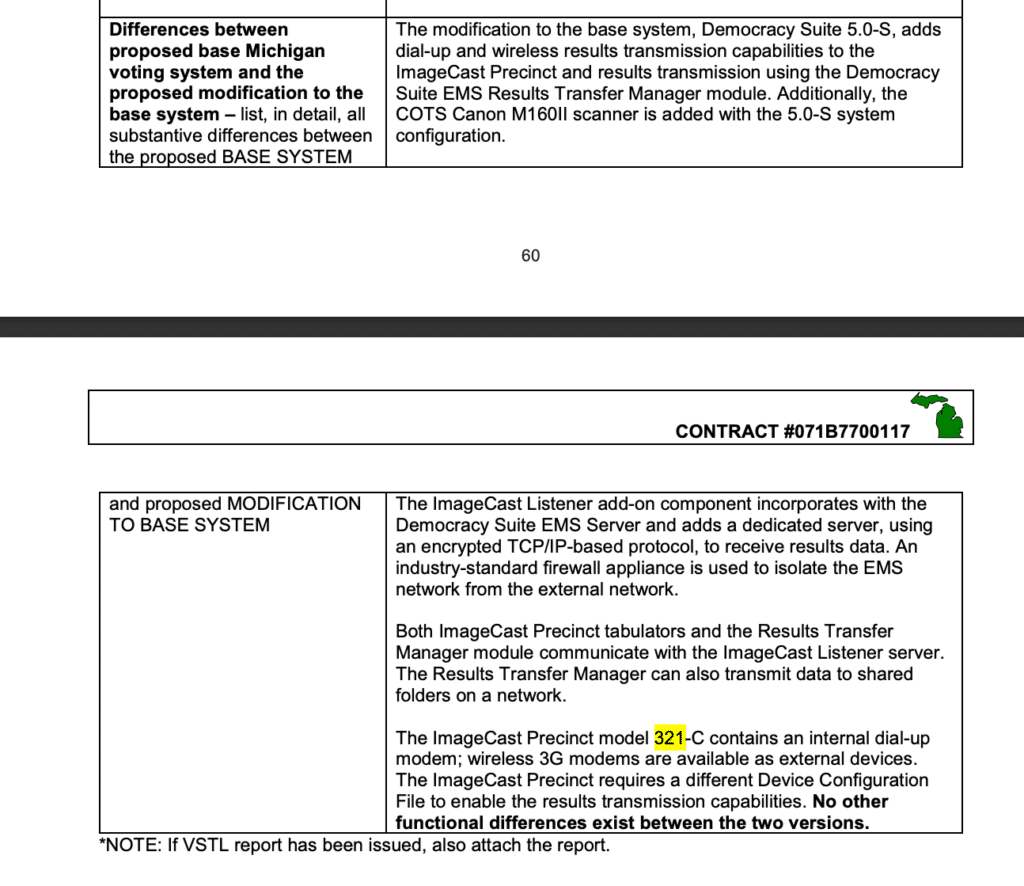
In other words, the only thing that distinguishes a 321C from a 320C is the communications capability.
How the Bureau presented the 321C as if it were EAC-certified
In November 2022, Attorney General Dana Nessel filed an amicus brief in Karamo v. Winfrey (Wayne County Circuit Court No. 22-012759) defending the Dominion system used in Detroit. Exhibit B of that brief, captioned “Report & Certification,” pairs two documents:
- The Bureau of Elections’ Voting System Certification Evaluation Report for Democracy Suite 5.5/5.5S, headed “EAC Certification Number: DVS-DemSuite5.5,” which lists under “Hardware Components” both the PCOS-320C (“No Internal Modem”) and the PCOS-321C (“Internal Analog Modem”). The report states that 5.5S “shares the same base system of the EAC Certified Democracy Suite 5.5 … with the modeming components enabled,” and that analog and cellular modem transmission was tested at the state
- The EAC Certificate of Conformance and Scope of Certification for Democracy Suite 5.5.
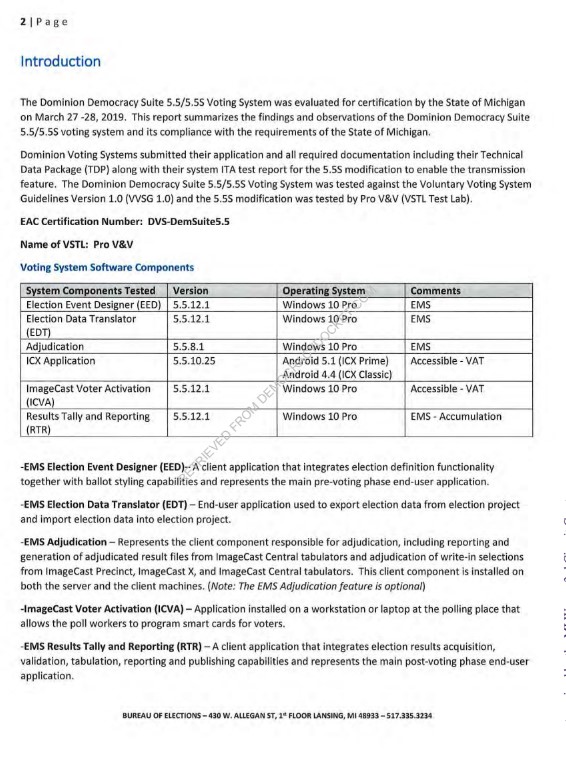
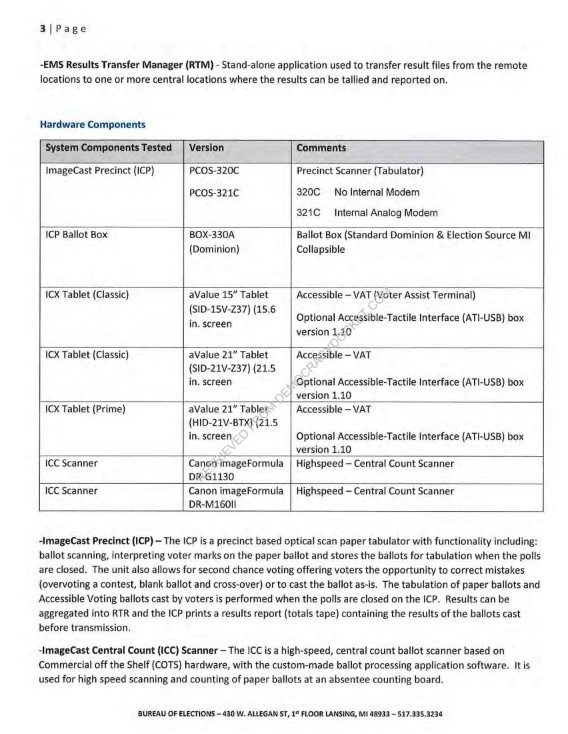
Put them side by side and the problem is obvious. The EAC’s 5.5 Scope of Certification lists the ImageCast Precinct hardware as PCOS-320C and PCOS-320A only. There is no 321C in the certified hardware list. And under “Networking,” the EAC records: Wide Area Network – Use of Modems: NO. Wide Area Network – Use of Wireless: NO. (EAC, Democracy Suite 5.5 Scope)
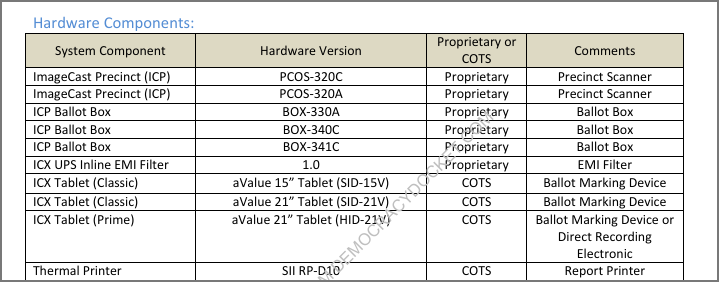
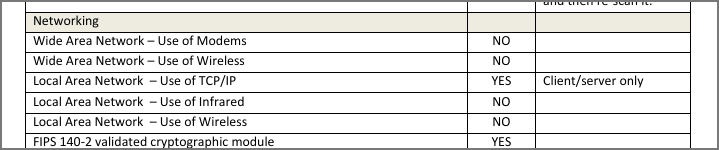
The “S” in 5.5S matters. The EAC’s own test-lab paperwork lists “5.5S” among state-certified Democracy Suite versions, separately from the EAC-certified ones (Pro V&V ECO 101047 Analysis, Rev. 00). The modem-enabled configuration was a Michigan approval stacked on top of a federal certificate that expressly excluded modems. Presenting the two together as “Report & Certification” invites a court, and the public, to believe the federal certificate covers the modem unit. It does not.
Engineering Change Order “mentions” Do Not Support Certification Claims
Defenders of the 321C will point to Engineering Change Orders (ECOs) that name it. The EAC’s 5.5 scope lists three baseline ECOs affecting “ICP PCOS-320C & ICP PCOS-321C”: an inductor footprint, a cable clip and a door hinge. A Pro V&V analysis of ECO 100503 lists the 321C among products that may use a collapsible ballot box.
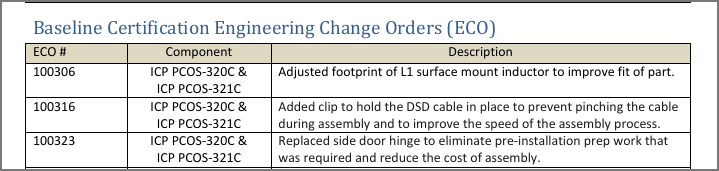
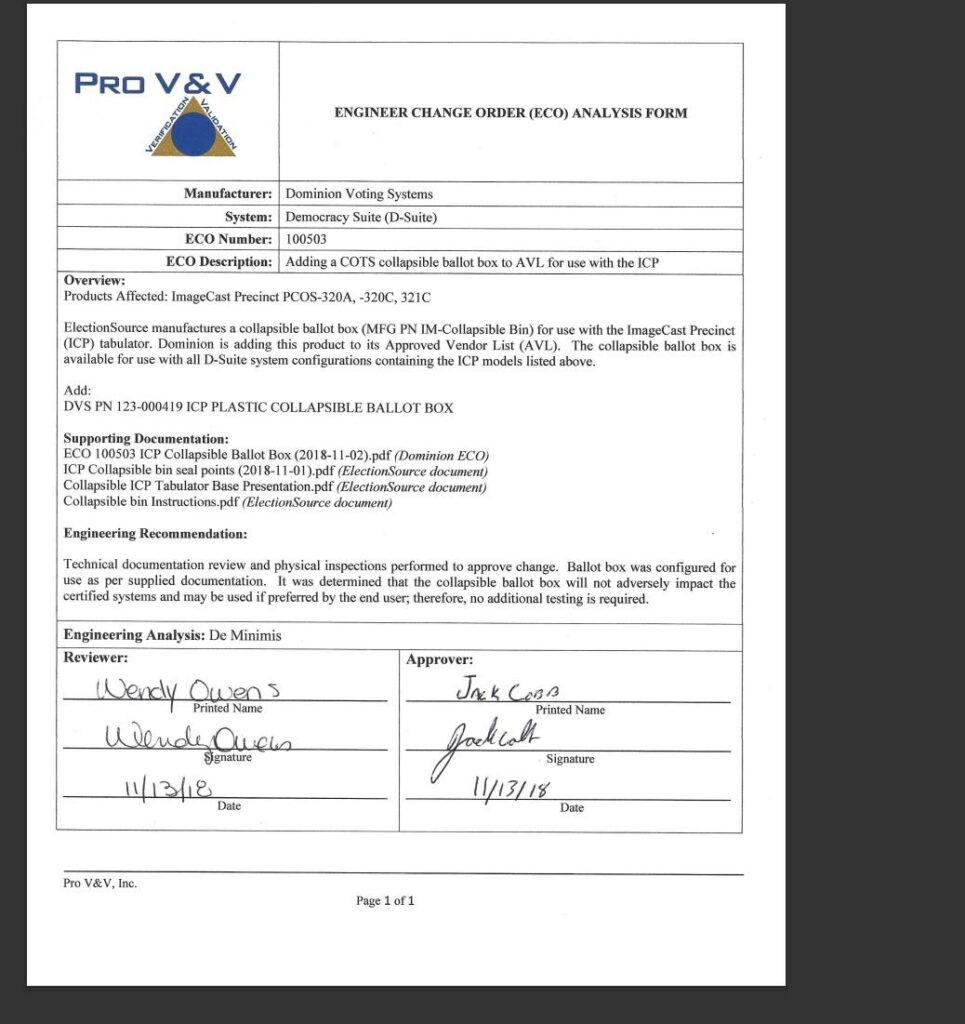
None of these ECOs evaluates, tests or approves a modem. Each was rated “De Minimis,” meaning a change that by definition does not alter system functionality. A hinge approval for a cabinet does not certify what is inside it. And again, every one of these scopes says modems: NO.
The Bureau’s answer to a PCA request: monitors and Ethernet switches
When Wayne County Canvasser Lisa Capatina asked for a Physical Configuration Audit, the response from the office of Director of Elections Jonathan Brater pointed to the Board of State Canvassers’ May 16, 2025 minutes approving three “de minimis” ECOs for Democracy Suite 5.20: ECO 101025, ECO 101046 and ECO 101047.
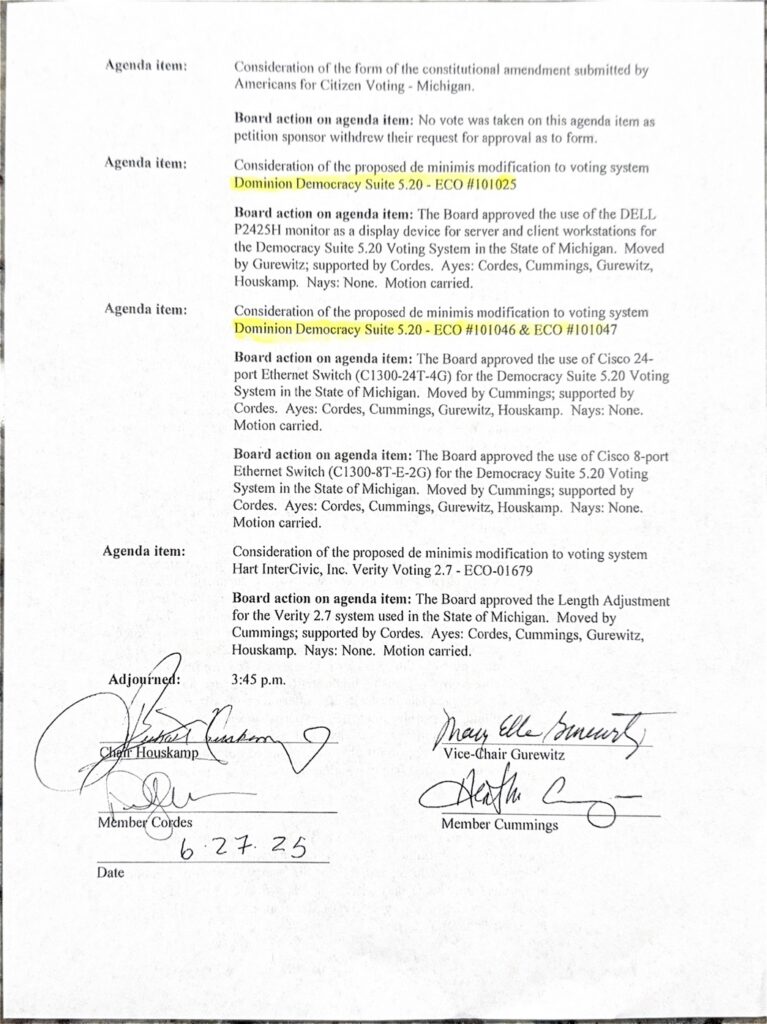
I obtained the EAC’s records for all three. Here is what they approve:
ECO | What it actually approves | EAC record |
101025 | A Dell P2425H monitor replacing the discontinued P2422H | |
101046 | A Cisco C1300-24T-4G 24-port wired Ethernet switch for the EMS Standard Server | |
101047 | A Cisco C1300-8T-E-2G 8-port wired Ethernet switch for the EMS Express Server |
Every one was reviewed by Pro V&V under the policy’s commercial-part replacement section, rated “De Minimis,” and required “No change to firmware/software” (Pro V&V ECO 101046 Analysis). Not one of the nine EAC documents for these ECOs contains the words modem, wireless, cellular or PCOS-321C. None of them approves a modem configuration, and none of them touches the precinct tabulator at all. They are a monitor and two network switches in the county’s back office.
If these are the records the Bureau relies on to answer a question about modem-equipped tabulators, the question has not been answered.
The EAC itself removed the 321C eight days before the election
The most important evidence comes from the EAC’s own website.
When the EAC certified Democracy Suite 5.20 on February 4, 2025, its Scope of Certification listed the PCOS-321C as an ImageCast Precinct hardware version (EAC 5.20 Scope, v1.0), while still stating that modems and wireless were not part of the system. Pro V&V’s test report Rev. 05 listed the ICP hardware as “PCOS-320A and PCOS-320C, PCOS-321C (with internal dialup modem)” (Pro V&V 5.20 Test Report Rev. 05). Michigan’s Board of State Canvassers certified 5.20 for use in Michigan on February 21, 2025 (BSC minutes).
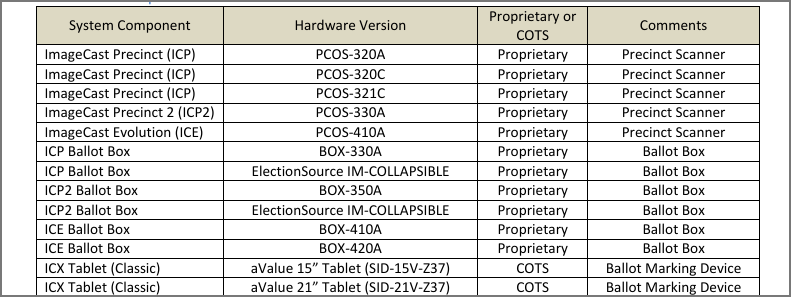

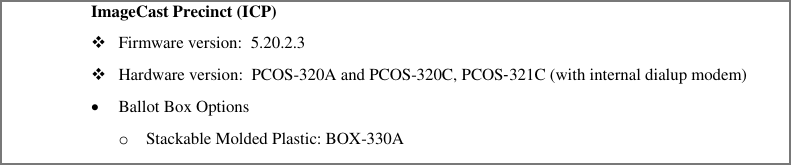
Then, in the weeks before the 2026 general election, the record was rewritten:
- September 17, 2026: Pro V&V issued Test Report Rev. 06, described as “Removed incorrect ICP hardware version.” The ICP hardware now reads only “PCOS-320A and PCOS-320C” (Pro V&V 5.20 Test Report Rev. 06).
- October 23, 2026: The EAC approved Rev. 06 (EAC approval letter).
- October 26, 2026: The EAC issued Scope v1.1: “Updated component list to remove PCOS-321C” (EAC 5.20 Scope, v1.1).
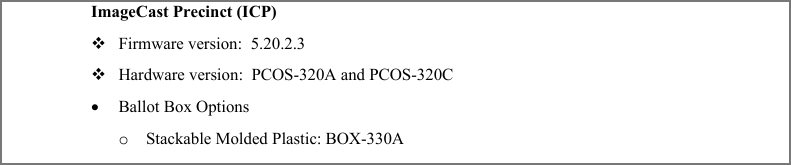
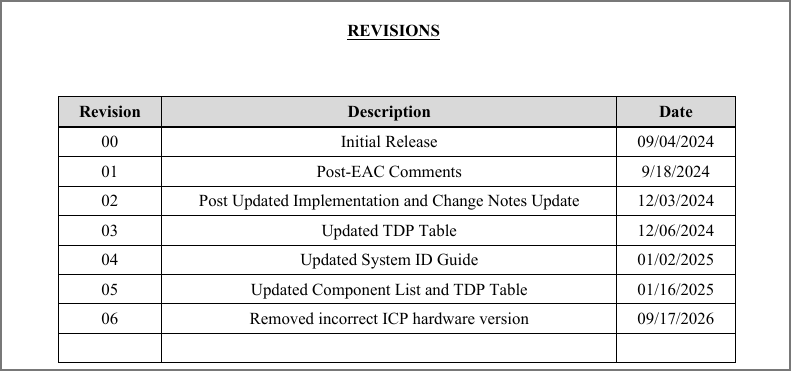

The prior federal certificate, Democracy Suite 5.17, never listed the 321C at all; its ICP hardware is the PCOS-320C and PCOS-320A, with modems: NO (EAC 5.17 Scope).
The EAC’s own Inspector General is now looking at the same kind of problem. On October 22, 2026, the EAC Office of Inspector General issued an interim report in its “Review of Physical Configuration Audits Supporting EAC Voting System Certifications,” addressing “a scanner erroneously listed in the certified configuration” and recommending that the EAC “Correct the Democracy Suite 5.20 voting system’s Certificate of Conformance and other public-facing supporting documents to accurately reflect the components tested” (EAC OIG Interim Report P26HQ0007-27-01). The OIG does not name the component, and it described the “practical impact” as appearing “limited.” But the timing lines up with the 321C removal four days later, and the subject of the review is the very thing I am asking Michigan to do: a physical configuration audit.
So the federal record now says the 321C listing was “incorrect.” Michigan’s state certification of 5.20 was granted on the earlier documents that included it. The public deserves to know whether the Board of State Canvassers has been told, and whether any modem-equipped 321C units were used to tabulate ballots on November 3.
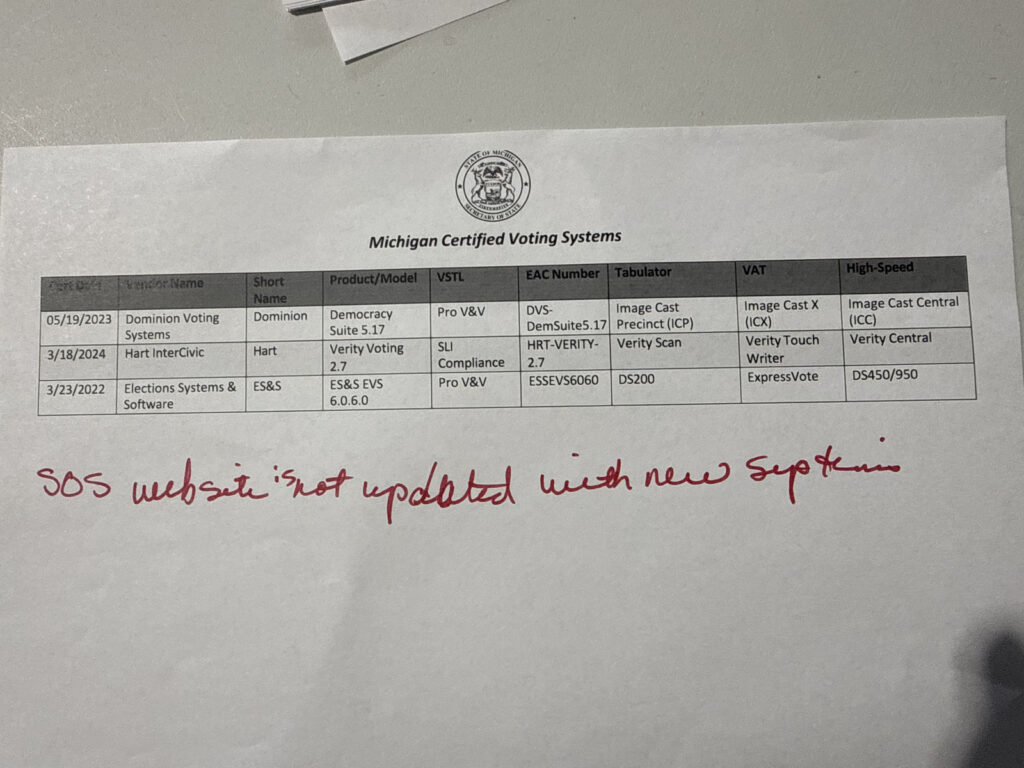
Meanwhile, the “Michigan Certified Voting Systems” list offered to the public identifies the Dominion tabulator only as “Image Cast Precinct (ICP),” with no model number, and carries the handwritten note that the SOS website “is not updated with new systems.”
Where are the PCOS-321C labels?
Here is a simple question for the Bureau. If the PCOS-321C is truly part of Michigan’s approved configuration, why have no PCOS-321C product labels been cited, by the Bureau, by any county, or in any certification document, to show which units in the field are 321Cs?
Every Dominion tabulator carries a model label. The labels documented by observers in Michigan read ImageCast PCOS-330A, the ICP2. A 321C, if fielded, should be identifiable on sight. Either the 321C is not in Michigan, in which case the state’s contract, evaluation report and court filings described equipment that does not exist here, or its modem capability exists in hardware that does not carry a 321C label.
That leads to the next question.
Could 320A and 330A units carry 321C-style retrofits?
Compare two PCOS-330A labels:
- The unit photographed in Pro V&V’s certification test report (TÜV SÜD Canada, Report #7169006118E-000, June 17, 2019) bears serial FAL18480532 and is marked “Made in USA.”
- A unit fielded in Barry County bears serial VAL23250334-004 and is marked “Made in Taiwan.”
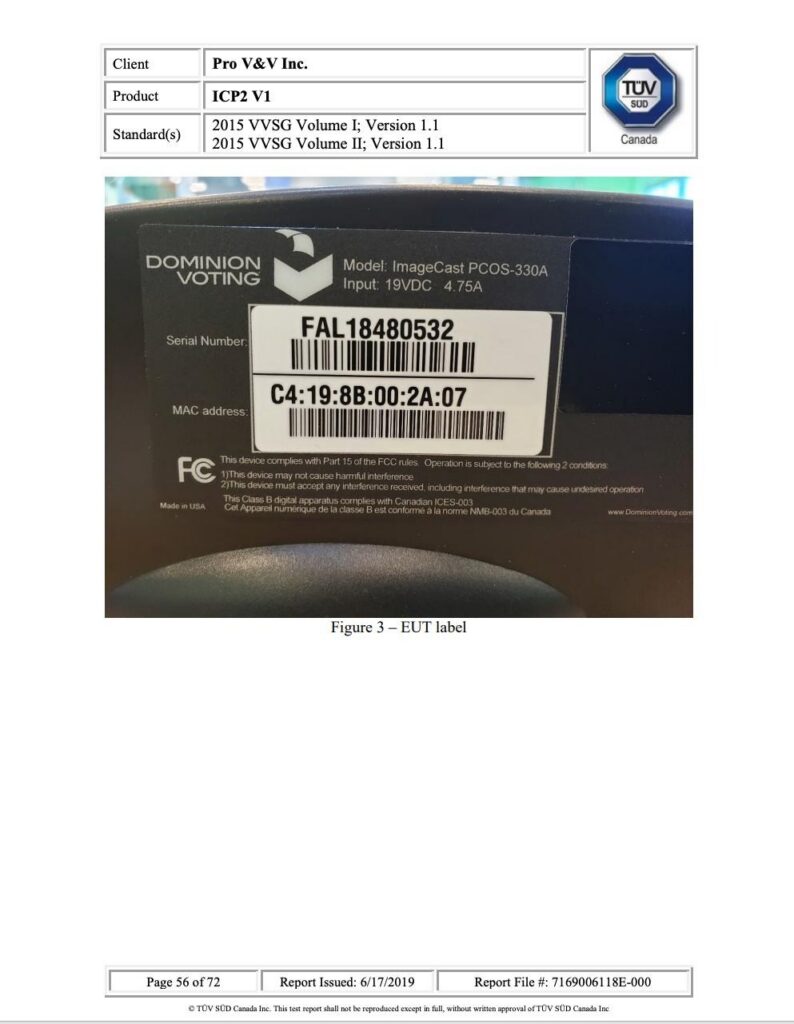
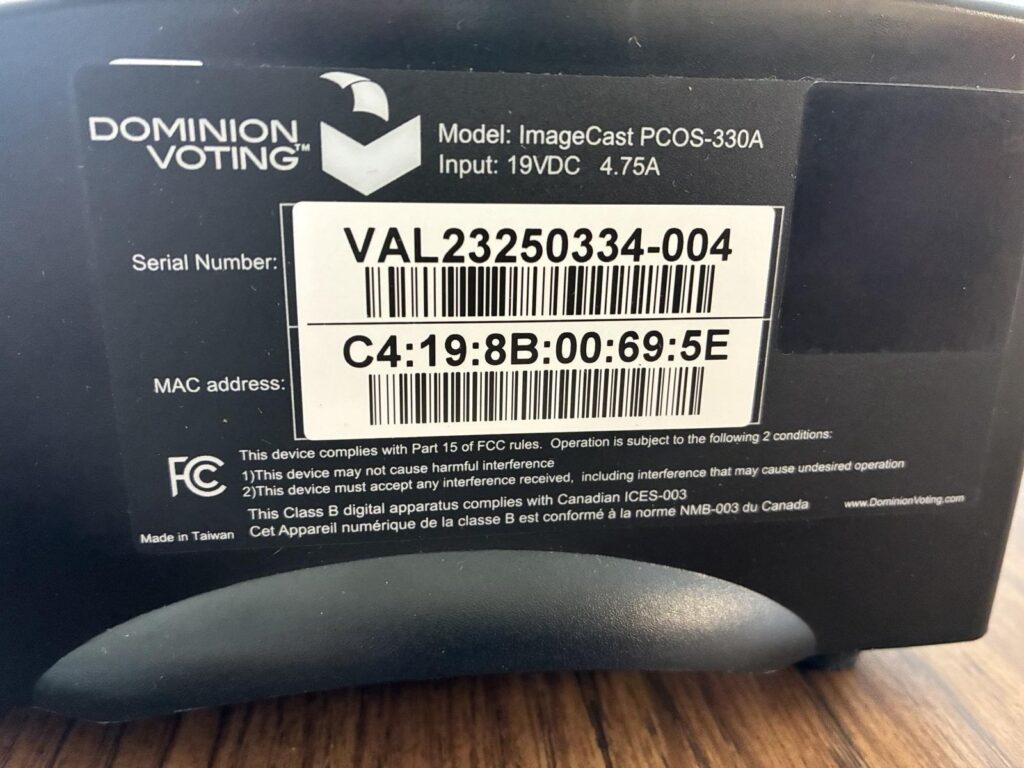
Same model number. Different serial-number series. Different country of origin. The certification lab tested one; the other is in the field in Michigan.
There may be an innocent explanation, such as a change in contract manufacturer. But no ECO in the record we have reviewed documents it, and no one has produced one. So the question must be asked: Could PCOS-320A or PCOS-330A units have been built or refurbished with 321C-style internal modem hardware, a retrofit that would explain why no “321C” label appears in the field and why labeling, including country of origin, differs from the units that were tested? Retrofitting is not hypothetical in this product line. An internal Dominion email concerning Alaska’s ImageCast Precinct fleet states that 34 ICP 321C units were built with modems and that “the remaining 304 in Alaska were retrofitted with dial up modems” (internal record, produced in prior ECB research; undated). If 320-series units could be retrofitted in Alaska, the question for Michigan is fair. I am not asserting that this happened. I am asserting that no document produced so far rules it out, and that only opening the units can.
The foreign-interference dimension
A hidden modem is a doorway. Who might want to walk through it is a national-security question, and the record on this product line gives several reasons to ask it.
The Venezuelan lineage of the modem architecture
Dominion’s precinct-modem results path did not originate with Dominion. In 2010 Dominion acquired “all intellectual property, including software, firmware and hardware” of Sequoia Voting Systems (Illinois State Board of Elections FOIA production). Sequoia had been owned by Smartmatic, and Sequoia’s own counsel wrote in January 2008 that the company “continues to use the Venezuelan developed ‘Edge2Plus and HAAT,’” with the report stating that “The Edge2Plus and HAAT are owned by Smartmatic and licensed by Smartmatic to Sequoia” (Voter Action report hosted by NIST).
The HAAT is the results-transmission system. Sequoia documents in an archive reviewed by the ECB (unauthenticated) define the RAS, the Remote Access Server, as the “Analog (POTS) telephone endpoint at Central Count for a HAAT90 transmission.” A 2007 RAS specification was prepared by Smartmatic Labs in Venezuela, specified a “Telephone cable modem” on a Windows Server 2003 routing and remote-access build, and noted the work “would have to wait until the people in Caracas gets back to me.” A later iBeta trusted-build record for WinEDS 4.0 lists “HAAT Listener, HAAT Installer, and Saes_Log.” That is the same architecture the 321C’s internal analog modem serves: a tabulator dialing a central receiving server.
I want to be precise. Dominion denies that Smartmatic or Sequoia code is in Democracy Suite, and I have not seen source code that proves continuity into 5.x. That is unresolved. But the U.S. government has taken the lineage seriously. A CIA note declassified in July 2026 records that a 2006 assessment rated Smartmatic’s acquisition of Sequoia a “moderate overall threat to US national security interests,” and describes a reported technique to “Mimic real voting machines that favored the ruling party” (CIA Note, declassified, hosted by Cato Institute, pp. 2-3). The same note also concluded that neither Smartmatic nor the Venezuelan government “had the capability … to manipulate the outcome of an election outside of Venezuela in a predictable fashion” (p. 4). Fairness requires reporting both. It should further be noted, however, that the mechanisms that would be needed to change this assessment such as remote access capabilities have since been revealed. It should also be noted that the U.S. Department of Commerce today lists the “Maduro Regime” among foreign adversaries for information-and-communications supply-chain purposes, alongside China and Russia (15 CFR 791.4).
What was detected in Martin Township
During early voting in Martin Township, Allegan County, poll worker Tom Thornton used a phone-based wireless analyzer and recorded a 5 GHz Wi-Fi network named “Renkchip-A9C4” (BSSID 40:9c:a7:bb:1a:03). The signal was strongest, about −48 dBm, roughly one meter from the ICP2 tabulator at 4:00 PM on October 31, 2026, and was still detectable after the tabulator was moved to locked storage. The hardware prefix 40:9C:A7 is registered to China Dragon Technology Limited of Shenzhen (MAC address registry lookup).
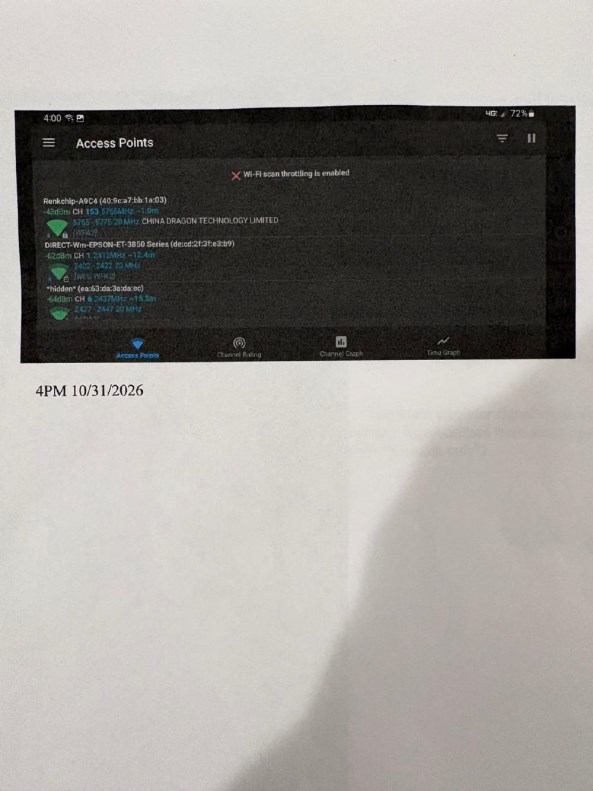
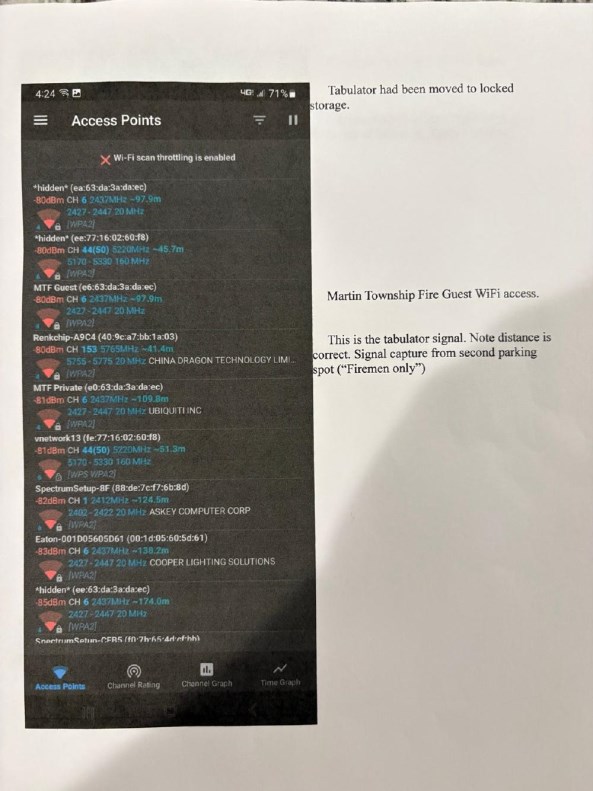
Two cautions. First, this was a Wi-Fi radio, not an analog modem, and it is a field observation that has not been authenticated by a forensic examiner. Second, the “Renkchip” default name matches a consumer wireless display adapter (product manual), so an ordinary device near the tabulator is a possible explanation. But the EAC scope says wireless: NO, Michigan says no wireless is permitted, and a Chinese-registered radio that tracks the tabulator’s location is exactly what a PCA is designed to resolve. The Martin Township Clerk has herself requested a PCA.
Country of origin and China-built modems
The PCOS-330A that was tested reads “Made in USA.” Fielded units throughout Michigan including the following examples found in Barry County and Saugatuck read “Made in Taiwan” (Exhibits 15 and 16; the Saugatuck unit, serial VAL24280001-005, is documented in ECB field records). A Dominion origin table cited in our October 6, 2026 referral to the Department of Justice indicates that roughly 48% of ICP2 parts by count are of Chinese origin, and ECO 100762 added a Taiwanese assembler (internal records; see the referral).
The modems are the other half. In the Pro V&V test report for Democracy Suite 5.17S, prepared for New Mexico, the lab lists the ICP hardware as “PCOS-320A, PCOS-320C, PCOS-321C (with internal dialup modem),” and its telecommunications test list includes “Use ICP PCOS-321C internal modem” and the “Zoom 3095 56K USB” analog modem on the ICP2 and ICE, concluding that “Modem transmission of election results was verified from ICP, ICP2, and ICE” (Pro V&V D-Suite 5.17S report, New Mexico SOS, pp. 6, 22, 38). Note also that this testing was “witnessed by Pro V&V via teleconferencing.”
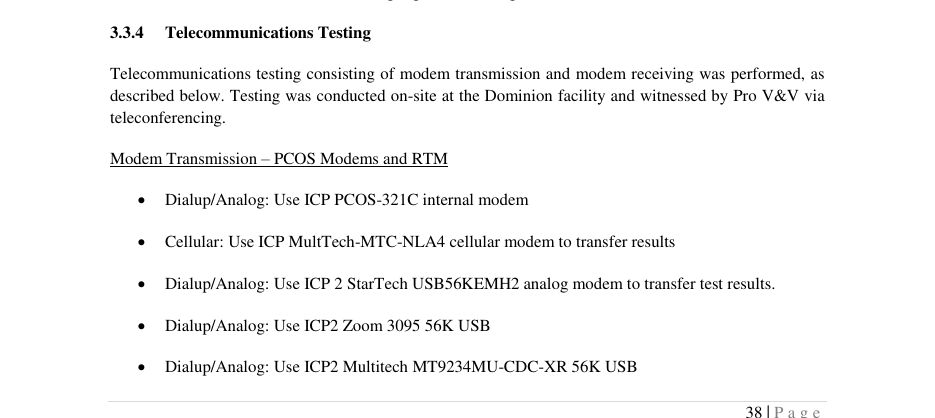
Zoom Telephonics is a Boston company, but its own SEC filing states that “Almost all of our products are built in mainland China or Taiwan” and identifies “T&W, a Chinese manufacturer” as its primary supplier (Zoom Telephonics Form 10-K). To be accurate: the Zoom 3095 is documented with the ICP2 and ICE, not as the 321C’s internal modem, whose maker, model and origin have never been disclosed. And China-built is not the same as a federally banned vendor. But Michigan’s own legislature has a pending bill, HB 4720, that would bar newly acquired voting systems from containing parts from entities with equipment on the FCC Covered List (Michigan Legislature, HB 4720). The concern is plain: nobody can tell you where the communications chip inside a 321C was made, and nobody has looked.
The federal government is already treating voting-system modems as an intelligence issue. The Office of the Director of National Intelligence has said equipment it obtained in Puerto Rico included “cellular modems … that actively connected to cellular networks outside of the United States,” though it has not published detailed evidence (CNN). Reuters has reported that the administration’s broader review found no evidence that foreign actors infiltrated voting systems (Reuters). Both statements can be true at once, and neither is a substitute for opening Michigan’s machines.
The Qualified Voter File connection
Michigan does not buy tabulators in isolation. The 2017 Request for Proposal under which Michigan’s current Dominion equipment was purchased required bidders to “demonstrate how data can flow from the State Qualified Voter File (QVF) into EMS,” required import of the QVF export file, and required that tabulators be “capable of transmitting unofficial election results by cellular or analog modem at the close of polls,” “directly from precinct tabulators to the EMS” (RFP requirements 1.2.B.11, 1.2.D.16, 1.1.A.17 and 1.2.D.2, as reproduced in ES&S’s 2017 bid). The resulting Dominion contract includes a “Michigan QVF Export File Format” exhibit (Contract 071B7700117).
Early voting tightened the coupling further. Michigan’s own Election Officials’ Manual describes the early-voting electronic pollbook as “a web-based application with a secure, live connection to the QVF” that “is connected to the internet,” with inspectors able to “update their voting history in real time” (Election Officials’ Manual, Ch. 11).
Put those together. During nine days of early voting, the state’s systems hold a live, internet-connected record of who has voted. If a tabulator in the same room carries undisclosed communications hardware, it could add how they voted, in aggregate, by precinct. Who has voted plus running tallies is the targeting data for ballot injection: it tells a bad actor which voters have not yet voted and how many ballots are needed where. Michigan law makes disclosing early-voting results before 8 p.m. on Election Day a felony precisely because that information is so valuable (MCL 168.720j). This is a risk scenario, not a finding. But it explains why a hidden modem in a QVF-coupled system matters to national security, not just to election administration. Any malfeasance related to this scenario would not be detectable by a recount.
2017 vs. 2026: what Michigan’s own RFPs reveal
The Michigan Bureau of Elections has repeatedly issued directives and rules that prevent transparency into the conduct of elections. The modus operandi in court testimonies has been to assert how elections are supposed to be conducted while systematically preventing access to the records that determine how elections under the guidance are actually conducted. Meanwhile, they have taken dangerous steps towards increasing the interoperability between election system components thereby expanding the risks that could compromise the integrity of these systems.
In keeping with this predisposition, Michigan issued a new voting-system RFP, No. 260000000114, on January 14, 2026 (HigherGov listing of the state solicitation; Michigan SIGMA VSS). Compare it with 2017:
Topic | 2017 RFP (current equipment) | 2026 RFP (next generation) | Direction of risk |
Modems in the tabulator | Required: “capable of transmitting … by cellular or analog modem” directly from precinct tabulators | “Prohibit any electronic transmission directly from the tabulator” (1.8.1.2) | The state now treats tabulator modems as a risk to eliminate |
Remote results transmission | From the tabulator to the EMS | By “cellular or secured, encrypted fixed line from a device other than the tabulator” (1.8.5.1); EMS accepts uploads over a “secure VPN” (1.3.22) and simultaneous connections (1.8.11) | Remote paths persist, moved one step away from the tabulator |
Air gap | Not required | No explicit air gap; “closed environment” (1.8.10.1) | Unresolved |
QVF interface | One-way import of a QVF export file | Two-way NIST Common Data Format interface (1.1.10.1, 1.8.9, 1.8.16), tested before contract signature and annually (1.1.10.2, 1.6.8); pollbook barcode carries QVF IDs (1.2.4.4) | Deeper coupling, higher consequence of any compromise |
The directional conclusion is uncomfortable for the Bureau. In 2026 Michigan wrote into its own procurement that electronic transmission from the tabulator must be prohibited. That is an implicit acknowledgment that the modem capability it required in 2017 is a risk. Yet the 2017 contracts run through February 28, 2027 (MiDEAL voting-system contracts), so the November 3, 2026 election was conducted on 2017-era equipment, including the configuration the state itself is now banning. At the same time, the QVF is becoming more tightly integrated, so the consequence of any communications path into or out of the system is rising. The tabulator-modem risk goes down for the future; the national-security risk from any undisclosed modem hardware still in the field goes up. Only a PCA tells us what is still in the field.
Why a recount cannot answer this question
Some will say: if you have concerns, ask for a recount. A recount does not address this risk.
A recount re-tabulates the paper ballots in the container. It confirms that the machine counted the paper it was given. It cannot tell you whether the paper it was given is legitimate. A ballot that was fraudulently injected but properly marked will be counted in a recount exactly as it was counted the first time.
Now consider what a communications-capable tabulator could offer to someone intent on manipulating an outcome. Michigan’s early-voting period means tabulators are live and processing ballots for days before Election Day. A tabulator with an undisclosed modem would not need to change a single vote to be dangerous. Used as a pre-Election Day intelligence platform, it could expose running tallies, turnout by precinct and margins in real time. That is precisely the information someone would need to know how many ballots to inject, where, and for whom in the final days, whether through absentee drop-offs, late-arriving ballots or other channels. Those ballots would then sit in the box as paper, and every recount would faithfully confirm them.
Combine that with the live, internet-connected early-voting pollbook described above, and the scenario becomes concrete: one data stream shows who has not yet voted, the other shows how the count is trending. A foreign or domestic actor with both would not need to touch a tabulator’s count at all.
To be clear, this is a risk scenario, not a finding. But it is exactly the scenario a recount is blind to, and exactly the scenario a PCA is designed to rule in or out. The paper can only be trusted if the machine that counted it, and the information it could leak, matches the certified configuration.
What a Physical Configuration Audit would establish
A PCA is a standard engineering practice: you inspect the item as built and compare it to its approved baseline. Applied to a representative sample of tabulators used in the November 3, 2026 election, it would establish:
- the model, serial number and label of each unit, including country of origin;
- whether any modem, cellular, Wi-Fi or other radio hardware is present inside the unit or its accessories, whether or not it is “enabled”;
- the board revisions and component markings compared with the EAC-certified hardware;
- the firmware and software hashes compared with the EAC trusted build;
- the maker, model, FCC ID and country of origin of any communications module, and the source of any “Made in Taiwan” units versus the “Made in USA” tested unit;
- a radio-frequency survey of fielded tabulators, powered and unpowered, to resolve observations like Martin Township’s;
- the Device Configuration File in use, since the 321C’s transmission capability is enabled by a different configuration file;
- and the acceptance-testing, chain-of-custody and Board approval records for every hardware change.
A PCA does not presume wrongdoing. It replaces assurances with evidence. If the units match the certified configuration, the audit will say so and public confidence will be strengthened. If they do not, Michigan will learn it before, not after, results are made final.
The Ask
Before any Michigan board of canvassers certifies the results of an election conducted with equipment that may include the non-certified PCOS-321C configuration, and before the Board of State Canvassers certifies on November 23, I am asking for the following:
- The Bureau of Elections should state in writing whether any PCOS-321C units, or any ICP or ICP2 units containing internal modem hardware, were used in the November 3, 2026 election, and in which jurisdictions.
- The Board of State Canvassers should be formally briefed on the EAC’s October 26, 2026 removal of the PCOS-321C from the Democracy Suite 5.20 certified configuration, and should state whether Michigan’s February 21, 2025 approval of 5.20 still extends to the 321C.
- County boards of canvassers should request, and the state should support, an independent Physical Configuration Audit of a statistically meaningful sample of tabulators before certification.
- Dominion (now Liberty Vote) and Pro V&V should produce the records explaining what “incorrect ICP hardware version” means, when the error was discovered, and whether any fielded units correspond to it.
- All parties should explain the “Made in USA” vs. “Made in Taiwan” PCOS-330A labeling and identify the ECO, if any, that approved the change in manufacturing source.
- The Cybersecurity and Infrastructure Security Agency (CISA) should offer technical support for the PCA, including a radio-frequency survey and identification of the 321C’s communications module and its supply chain.
- The U.S. Department of Justice should investigate whether non-certified or undisclosed communications hardware was represented as certified, and whether foreign-sourced components create a foreign-interference exposure, and should request preservation of all related records.
A note on the law: Michigan’s Constitution makes canvassing a “ministerial, clerical, nondiscretionary duty” and makes state certification final “subject only to” a recount or “a post-certification court order” (Mich. Const. art. II, sec. 7). That is why I am asking the Board to use its separate authority over voting-system approval, and the state and federal authorities to act now, rather than asking canvassers to simply refuse to sign. If a pause is required, the lawful paths are a court order or action under the Board’s voting-system powers, and the evidence for either should be gathered before November 23, not after.
The Bureau has told Michigan voters for years that the system is certified. The EAC has now told us that one of the configurations Michigan presented as certified was “incorrect.” The burden is on the state to show what is in the machines. A Physical Configuration Audit is how they can do it.
References
- EAC, Democracy Suite 5.20 Certificate and Scope of Conformance, v1.1 (Oct. 26, 2026): gov
- EAC, Democracy Suite 5.20 Certificate and Scope of Conformance, v1.0 (Feb. 4, 2025): gov
- Pro V&V, D-Suite 5.20 Test Report Rev. 05: gov
- Pro V&V, D-Suite 5.20 Test Report Rev. 06: gov
- EAC approval of 5.20 Test Report Rev. 06 (Oct. 23, 2026): gov
- EAC, Democracy Suite 5.17 Certificate and Scope: gov
- EAC, Democracy Suite 5.5 Certificate and Scope: gov
- EAC ECO records: DVS-101025, DVS-101046, DVS-101047
- Michigan Board of State Canvassers minutes, Feb. 21, 2025: gov
- Michigan Department of State, 2026 Election Dates: gov
- Board of State Canvassers minutes, May 16, 2025 (provided in Bureau of Elections response to PCA request)
- Attorney General Dana Nessel, Amicus Brief, Ex. B, Karamo v. Winfrey, Wayne County Circuit Court No. 22-012759 (Nov. 2022)
- State of Michigan Contract #071B7700117, p. 60
- Pro V&V ECO 100503 Analysis (Nov. 13, 2018)
- TÜV SÜD Canada / Pro V&V, ICP2 V1 test report #7169006118E-000, p. 56 (June 17, 2019)
- Field photograph, PCOS-330A label, Barry County, Michigan
- EAC Office of Inspector General, Interim Report P26HQ0007-27-01 (Oct. 22, 2026): eac.gov
- Pro V&V, D-Suite 5.17S VSTL Report (New Mexico): nm.gov
- Voter Action, Sequoia/Smartmatic report (hosted by NIST): gov
- CIA Note on Venezuela voting machines (declassified July 2026, hosted by Cato Institute): org
- Illinois State Board of Elections FOIA production, Dominion acquisition of Sequoia: il.gov
- 15 CFR 791.4, Determination of foreign adversaries: gov
- MAC address registry, prefix 40:9C:A7: app
- Zoom Telephonics Form 10-K: gov
- Michigan HB 4720 (2025-2026): mi.gov
- CNN on ODNI and Puerto Rico voting machines (Feb. 4, 2026): com
- Reuters investigation (Oct. 2, 2026): com
- ES&S 2017 bid reproducing Michigan RFP requirements: gov
- Michigan Contract 071B7700117 (Dominion): org
- Michigan RFP No. 260000000114 (2026): com
- MiDEAL voting-system contracts: gov
- Michigan Election Officials’ Manual, Ch. 11, Early Voting: gov
- MCL 168.720j: mi.gov
- Michigan Constitution, art. II, sec. 7: mi.gov
- Martin Township wireless field captures (T. Thornton, Oct. 31, 2026) and internal Dominion Alaska email (ECB records)