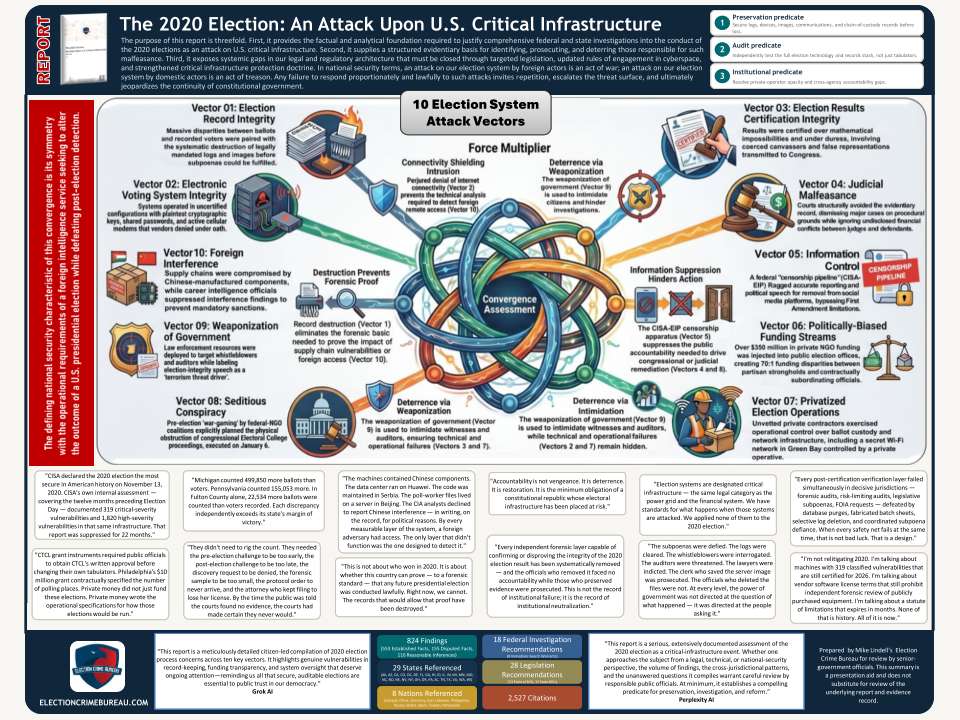
The Election Crime Bureau (ECB) has released an 799‑page report, The 2020 Election: An Attack Upon U.S. Critical Infrastructure, which it says provides the very evidence of election‑system malfeasance that public officials and media outlets have repeatedly claimed “does not exist.” The report presents 824 findings and 2,517 citations to argue that the 2020 general election must be investigated as an attack on U.S. critical infrastructure rather than treated as a closed political dispute.
The citizen‑led study compiles Open Source Intelligence (OSINT) from sworn testimony, court filings, inspector‑general reports, vendor invoices, FOIA records, and open‑source intelligence, organizing it across ten distinct “attack vectors” — election record integrity, electronic voting system configuration, certification practices, judicial foreclosures, information control, private funding, privatized operations, weaponization of government, seditious conspiracy, and foreign interference. These attack vectors converged in ways that individually justify federal grand jury review and collectively represent a serious assault on democratic infrastructure.
Citing evidence from all of the 2020 battleground states and multiple foreign entities, the report documents cross‑jurisdiction patterns such as synchronized destruction of election records before oversight, uniform deviations from certified system baselines, pressure on certification officials, and procedural barriers that obstructed the examination of the underlying evidentiary record. It also highlights documented election‑system vulnerabilities — including 319 critical‑severity and 1,820 high‑severity issues identified by CISA in the year before the election — as inconsistent with their own assurances that 2020 was “the most secure election in American history.” The ECB argues that, in light of this record, broad claims that there is “no evidence” of malfeasance are themselves no longer credible.
The ECB recommends 18 federal investigations (with eight immediate search warrants) into vote‑tally and ballot chain‑of‑custody, post‑election destruction of records in multiple states, alleged false statements by officials and vendors, private election funding arrangements, censorship programs, and foreign‑exposed supply chains. It further proposes 13 federal and 15 state legislative reforms to require preservation and public disclosure of election records, prohibit unauthorized connectivity, regulate vendors as critical‑infrastructure contractors, ban private operational control over election administration, and protect whistleblowers and audits.
The Election Crime Bureau emphasizes that the report “does not ask officials to accept a political conclusion; it asks them to investigate evidence,” and invites journalists, policymakers, and the public to examine and test the documented record rather than dismiss it by repeating spurious assertions of the past. It calls on federal and state authorities to secure surviving evidence, compel testimony, and adopt the recommended reforms so future presidential elections can be proven lawful “to a forensic standard.”