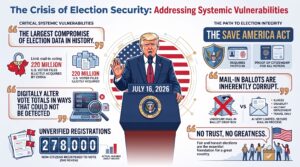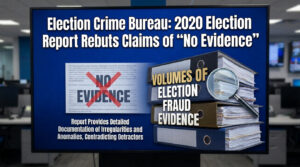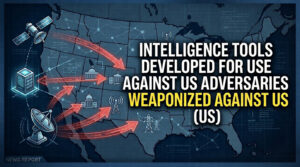
Across all three Information Control subtopics—misinformation policy, censorship, and influence operations—the report finds that government‑anchored networks systematically managed domestic election‑related speech in 2020, suppressing or marginalizing evidence‑based criticism of election administration while amplifying official narratives and doing so through structures originally justified as defenses against foreign disinformation.

Collectively, these findings depict an information‑control architecture that constrained what officials, courts, and the public could see about how the 2020 election was actually run, and that did so in a way aligned with the interests of one side of the political contest. From a national security perspective, this has three core effects: it degrades internal situational awareness about vulnerabilities in a critical‑infrastructure sector; it repurposes foreign‑influence defenses into tools of domestic narrative management, raising potential exposure under 18 U.S.C. 241–242 and 595; and it signals to foreign and domestic adversaries that, if they can achieve technical effects inside U.S. election systems, ensuing anomalies and whistleblower accounts are likely to be suppressed rather than openly investigated, making perception management—not resilience and transparency—the effective front line of election defense.
MOST SIGNIFICANT FINDINGS
1 | CISA Declared the Election “Most Secure in History” While Holding Classified Proof of 319 Critical Vulnerabilities On November 13, 2020, CISA Director Christopher Krebs issued a joint agency statement calling the 2020 election “the most secure in American history.” CISA’s own internal Election Infrastructure Cyber Risk Assessment — covering the twelve months preceding Election Day — documented 319 critical-severity vulnerabilities, 1,820 high-severity vulnerabilities, and active command-and-control indicators on approximately 47 election infrastructure systems. That internal assessment was withheld from Congress and the press when the public declaration was made. The public declaration was factually false on its face. CISA’s website records referencing its domestic Cyber and Foreign Influence Task Force coordination were subsequently scrubbed after congressional oversight letters arrived and Missouri v. Biden was filed. |
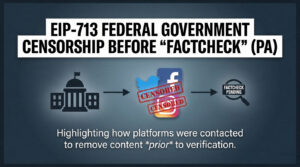
2 | CISA-EIP Censorship Pipeline Removed Factually Accurate Election Speech — Including the Sitting President’s CISA created the Election Integrity Partnership (EIP) in July 2020 by commissioning Stanford Internet Observatory, the University of Washington Center for an Informed Public, Graphika, and the Atlantic Council’s DFRLab to build a shared Jira ticketing system routing content-removal recommendations to Twitter, Facebook, Reddit, and YouTube. Internal communications obtained by congressional subpoena acknowledge the architecture was built to fill a “critical gap for non-governmental entities” — an explicit admission it was designed to circumvent the First Amendment. The Democratic National Committee participated in the ticketing system; the Republican National Committee declined the same invitation. Documented Jira tickets flagged factually accurate posts: the confirmed Antrim County algorithmic error (EIP-482), sworn federal whistleblower testimony under active USPS OIG investigation (CISA official Brian Scully directly contacted Facebook), credentialed legal observer reporting from Philadelphia (EIP-614), and tweets from the sitting President’s @realDonaldTrump account — targeted for removal without White House consultation or legal process. |
3 | 51 Former Intelligence Officials Coordinated False “Russian Disinformation” Label on Authenticated Evidence On October 19, 2020 — sixteen days before the election — 51 former senior U.S. intelligence officials published a letter asserting the Hunter Biden laptop story bore “the classic earmarks of a Russian information operation.” Twitter locked the New York Post’s account; Facebook reduced distribution. Former CIA Deputy Director Michael Morell subsequently testified to the Senate Judiciary Committee that the letter was coordinated with the Biden presidential campaign specifically to provide political cover. The Intelligence Community Inspector General later confirmed the laptop was authentic. The letter was not an independent intelligence assessment; it was a coordinated pre-election narrative operation executed by credentialed former officials acting on behalf of an active presidential campaign. |
4 | State Officials Issued False Official Statements While Simultaneously Holding Contradicting Evidence Georgia Secretary of State Brad Raffensperger transmitted a ten-page letter to Congress on January 6, 2021, stating “there is nowhere close to sufficient evidence to put in doubt the results” — while his own office had 250 open election investigations and had received a December 17, 2020 Georgia Senate Judiciary Subcommittee report finding the election “should not have been certified.” His November 17, 2020 press release announced a successful “forensic audit” by Pro V&V; subsequent records requests established the described forensic review had not yet taken place. Wisconsin Elections Commission Administrator Meagan Wolfe made three statements to the state legislature later documented by the Special Counsel to be contradicted by primary evidence. Michigan Secretary of State Jocelyn Benson publicly stated TCF window obstruction was caused by challengers “breaking windows”; the pizza boxes and cardboard were on the inside of the glass, placed by workers. |
5 | DHS Classified Election-Integrity Speech as a Terrorism Threat Driver — FBI “Operation Arctic Frost” Followed EIP Target Lists On February 7, 2022 — while post-election litigation and legislative investigations were still active — the Department of Homeland Security issued a National Terrorism Advisory System bulletin explicitly classifying “false or misleading narratives regarding unsubstantiated widespread election fraud” as a primary driver of domestic terrorism. The bulletin’s practical effect was to position attorneys, citizens, auditors, and journalists raising documented election-integrity concerns in proximity to a federal terrorism designation — a First Amendment chilling effect executed by the executive branch. Senate oversight documentation subsequently established that the FBI’s “Operation Arctic Frost” multi-agency investigation opened against pro-Trump organizations and individuals substantially overlapped with the organizations the EIP had earlier classified as “delegitimization” nodes — creating a structural pipeline from an academic content-flagging list into federal criminal process. |
WHY SUBSTANTIVE RESOLUTION IS ESSENTIAL
Election systems were designated critical infrastructure by DHS in January 2017 on the premise that their integrity depends on transparent, publicly verifiable governance. The Information Control findings destroy that premise at the informational layer. A federally certified critical-infrastructure system is resilient only if its public, its courts, and its Congress can see and debate its actual performance. Each mechanism documented here — a false “most secure” declaration concealing hundreds of classified vulnerabilities, a government-built censorship pipeline removing accurate reporting, a coordinated intelligence-credential operation falsely labeling authenticated evidence as foreign disinformation, state officials transmitting false statements to Congress while holding contradicting evidence, and a federal terrorism framework weaponized against election-integrity speech — foreclosed a different piece of that oversight. Failure to address this attack vector means the information architecture that would alert citizens, legislators, and courts to future election compromise has been structurally demonstrated to be controllable by the same actors whose conduct it is supposed to reveal.
NATIONAL SECURITY IMPLICATION: A federal intelligence and security apparatus that publicly contradicts its own classified risk assessments, constructs a censorship pipeline targeting accurate domestic speech, deploys credentialed former officials to falsely label authentic evidence as foreign disinformation, and frames citizens’ election-integrity speech as a terrorism threat has been fundamentally compromised as an instrument of honest national security assessment. An adversary planning information operations against a future U.S. election does not need to invent any new architecture — it needs the existing pipeline, the existing credential pool, and the existing terrorism framework to remain in place and be redeployed. |
Supporting Evidence