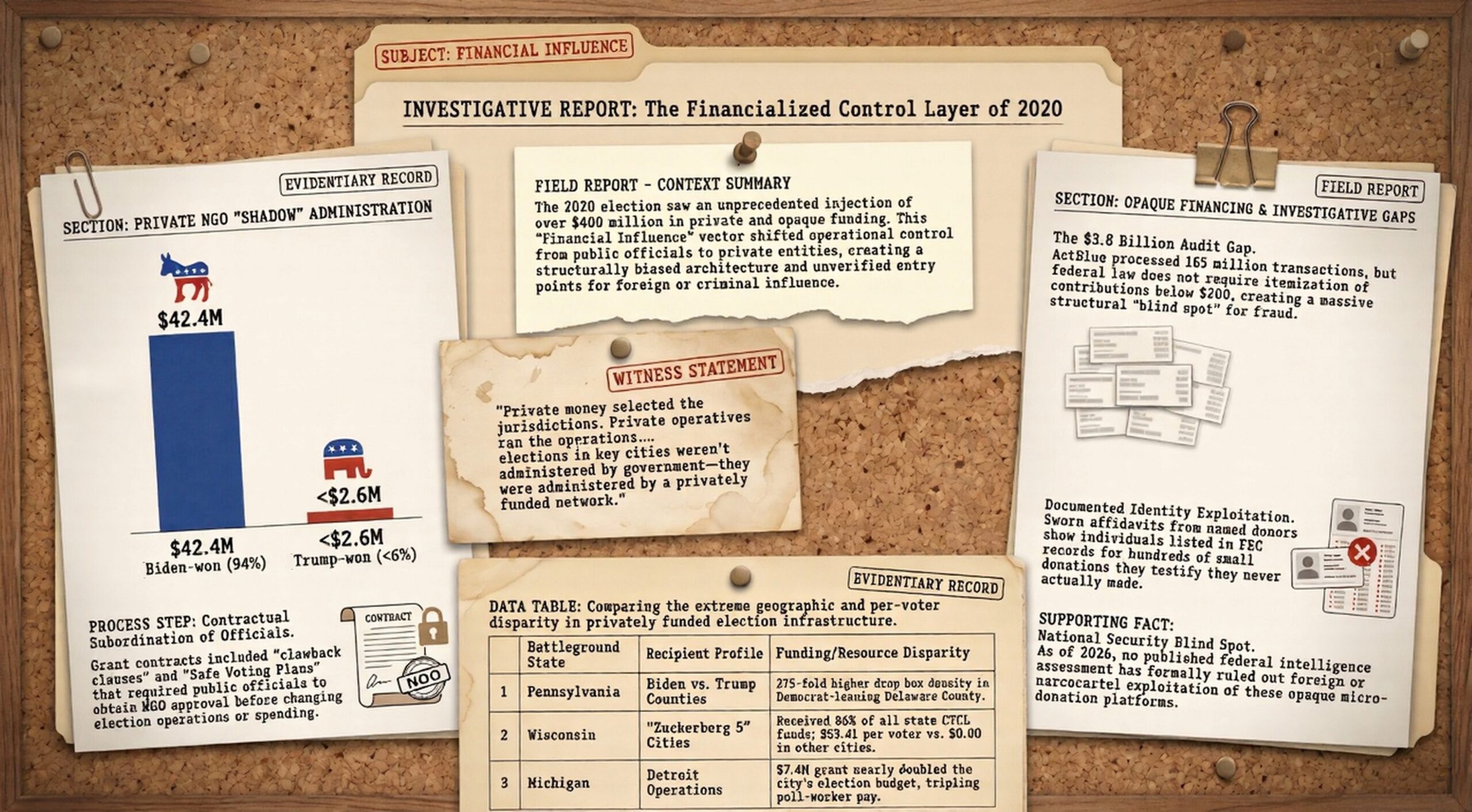
1 | $3.8 Billion Through a Single Unaudited Conduit — Structural Disclosure Blind Spot ActBlue processed approximately $3.8 billion across 165 million transactions from 15.3 million reported donors during the 2020 federal cycle. Federal law does not require campaigns to itemize any contribution below $200 per donor, creating a structural zone where fraudulent or foreign contributions are individually invisible by design. CVV card verification was not consistently required — removing a standard fraud control. A House Committee analysis of over 200 million FEC records found patterns characterized as potential straw-donor exploitation. No completed FEC audit of the 2020 cycle has been published. |
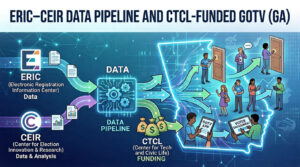
2 | Private Grant Dollars Concentrated Overwhelmingly in One Party’s Counties Over $350 million in private grants — routed primarily through CTCL and CEIR — entered public election offices in five battleground states. In Georgia, 94% of CTCL funding flowed to Biden-won counties. In Wisconsin, the “Zuckerberg 5” cities received ~86% of the state total. In Arizona, 76% went to Biden-won counties (confirmed by state Auditor General Report No. 22-301). In Michigan, 86% of funds went to Biden-won jurisdictions. Wisconsin’s Special Counsel concluded the arrangement “facially violates” the state’s election-bribery statute. |
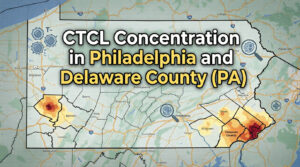
3 | Grant Contracts Subordinated Public Election Officials to Private Directives CTCL’s standard grant instruments included clawback clauses reserving sole discretionary judgment to the grantor and required officials to obtain CTCL’s written approval before changing tabulators or reallocating spending. Philadelphia’s $10 million grant contractually specified “800+ in-person polling places” inside the grant instrument. Delaware County, PA received $2.2 million tied to 50 drop boxes. A private entity with conditional funding authority over a public official’s operational decisions is not philanthropic support — it is a parallel command structure inside a public election office. |
4 | State Government Infrastructure Used to Channel Private Partisan Funding Michigan’s Bureau of Elections used its official govdelivery.com state email system to relay CTCL grant information to every clerk in the state — giving a private grantor the government’s own distribution list. MCELA, a nonprofit founded by Michigan Secretary of State Jocelyn Benson, received $11.9 million from CEIR and directed approximately 99% to two Democratic-aligned firms. Wisconsin’s WisVote/BadgerBooks real-time voter-file API was shared with CTCL partners, providing live read access to the state voter roll during the election. |
5 | Cartel Designation Creates Statutory Perimeter — Federal Audit Gap Remains Open Treasury OFAC designated Cartel de los Soles as a Specially Designated Global Terrorist (July 25, 2025); the State Department designated Sinaloa Cartel, Cartel de los Soles, and Tren de Aragua as Foreign Terrorist Organizations. These designations activate 52 U.S.C. § 30121 (foreign contribution ban), 18 U.S.C. §§ 2339A–2339B (material support, up to life imprisonment), IEEPA asset-freeze authority, FARA registration obligations, and RICO. No published DOJ, FBI, or intelligence community assessment has tested whether money traceable to any designated cartel network has reached U.S. federal elections since the designations took effect. |