
Established Fact
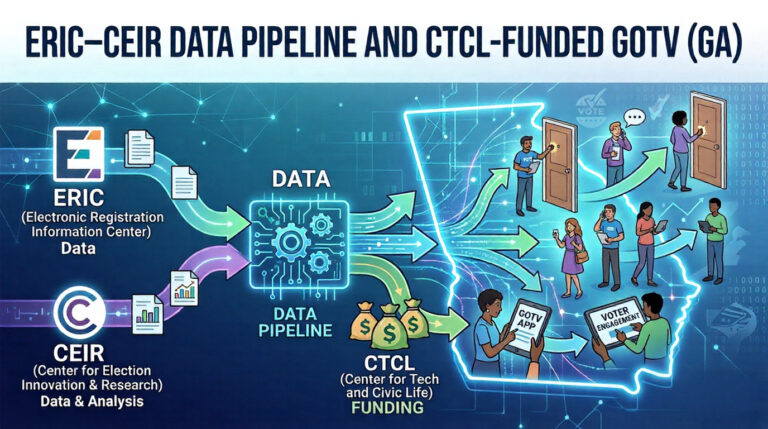
In Georgia, over 94% of CTCL funds — $42.4 million of a total $45 million — flowed to 17 counties won by Biden, while the remaining $2.6 million reached 26 Trump-won counties. Separately, Georgia’s membership in ERIC generated “Eligible but Unregistered” lists that were transmitted to CEIR — a $69.5 million Zuckerberg-funded nonprofit — which created targeted mailing lists from that data and returned them to state officials through ERIC’s distribution channel. CEIR simultaneously received $5.59 million in direct grants to Georgia election officials. The convergence of concentrated private election funding and CEIR-directed registration targeting prompted the Center for Renewing America to allege that the full pattern “clearly operated as a de facto get-out-the-vote effort for the Democrat party.”
Citations
H.R. Rep. 118-509, p. 9 (House Comm. on House Admin., 118th Cong.): “CTCL granted Georgia counties $45 million with $42.4 million, or over 94 percent of all CTCL funds going to 17 counties won by Biden. In contrast, the remaining $2.6 million, or less than 6 percent of CTCL funds, were received by 26 counties won by Trump.” Available at https://www.govinfo.gov/content/pkg/CRPT-118hrpt509/pdf/CRPT-118hrpt509-pt1.pdf.
Scott Walter, Capital Research Center (June 7, 2022): “Over 94 percent of the $42 million in Zuck bucks that flowed to Georgia went to counties Biden won.” See also CRC CTCL Georgia grants spreadsheet (Dec. 2020), available at https://capitalresearch.org/app/uploads/CTCL-Grants-to-Georgia-2020-v4-website-12-2-2020.xlsx.
Verity Vote, Threats to Election Integrity: ERIC-CEIR-REVERE (Aug. 2022), citing Georgia Secretary of State FOIA records: “An email received from a FOIA request submitted to the GA Secretary of State’s office reveals that ERIC is transferring EBU data to CEIR. This is NOT voter registration data but data from people who have chosen not to register to vote. CEIR is creating targeted mailing lists from the EBU data. [Jenny Lovell, former research manager of CEIR] explains that the data from GA should be sent to ERIC for transfer to CEIR. That transfer process is reversed so GA can download the mailing lists from ERIC.” Available at https://verityvote.us/wordpress/wp-content/uploads/2022/08/national-ERIC-data-sharing_VerityVote.pdf.
Election Fairness Institute (Mar. 22, 2023), summarizing same Georgia FOIA records: “A September 2020 email obtained via public records request by Verity Vote reveals a complex process wherein Georgia elections officials transmit data through ERIC to CEIR, generates a list of eligible-but-unregistered individuals to target with registration mailers (paid for by states). That list is then transmitted from CEIR back to ERIC, and finally on to the states.” Available at https://electionfairnessinstitute.org/eric-caught-sharing-voter-data-with-ceir/.
InfluenceWatch, Center for Election Innovation & Research (CEIR), citing CEIR grant records: “In October 2020, CEIR granted $830,779 to Pennsylvania for postcard ‘outreach to additional citizens included on the ERIC EBU refresh list’ totaling 2.1 million individuals.” (Confirming the operational CEIR/ERIC EBU mailing pipeline; Georgia EBU activity documented separately through FOIA records cited in fn–.) Available at https://www.influencewatch.org/non-profit/center-for-election-innovation-research/.
InfluenceWatch, Center for Election Innovation & Research (CEIR), CEIR 2020 grantmaking table: Georgia — $5,591,800. CEIR “ultimately received $69.5 million from the Chan Zuckerberg Initiative.” Available at https://www.influencewatch.org/non-profit/center-for-election-innovation-research/.
Center for Renewing America, IRS Complaint against CTCL, CEIR, and National Vote at Home Institute (Sept. 22, 2022), quoted in InfluenceWatch: “the pattern of Zuckerbucks spending and how these organizations targeted, penetrated into, and harvested data out of local election offices clearly operated as a de facto get-out-the-vote effort for the Democrat party.” Available at https://www.influencewatch.org/non-profit/center-for-election-innovation-research/.