“‘Just look at the ballots’ is a great answer — right up until somebody tries.”
The standard reassurance after any contested election is some version of “the paper is the ground truth — just look at the ballots.” The record on Ballot Integrity across Arizona, Georgia, Michigan, Pennsylvania, and Wisconsin describes what happens when someone actually tries. In Maricopa, 263,139 ballot images were corrupt and 21,273 were missing, paper stock did not match the certified specification, and box manifests delivered to auditors did not match the ballots inside. In Fulton County, Georgia, the county itself admitted in federal court that the majority of in-person ballot images from the 2020 machine count were not preserved; statewide, roughly 1.7 million ballot images were destroyed along with the cryptographic hashes that would have let anyone prove the survivors were unaltered. In Detroit, tens of thousands of ballots arrived at the counting center at 3:30 AM with no chain of custody, and a fifth of sampled absentee ballots lacked the legally required application. In Delaware County, Pennsylvania, an eyewitness testified that a named official tore machine tapes and return sheets into pieces and threw them in the trash; statewide, 440,781 Pennsylvania mail ballots are carried on federal EAVS data as “status unknown” — more than five times the certified margin. In Wisconsin, a USB drive holding more than 120,000 absentee votes briefly went missing during active counting, ballots are alleged to be retained by a private vendor across state lines, and in Green Bay a non-government actor controlled the tabulators through a hidden Wi-Fi access point at the central count facility. Taken together, the record describes a ballot corpus that, in the places that decided the election, cannot be independently verified — because the paper was commingled, the images were destroyed, the hashes were deleted, the custody was broken, and in several jurisdictions the people with physical control of the ballots were not government officials.
The record on Ballot Integrity runs to 33 detailed findings drawn from court admissions, forensic reports, sworn affidavits, federal EAVS data, and a state-commissioned Office of Special Counsel. The following highlights are chosen for what they say about whether a ballot corpus can be independently verified at all:
Fulton County, GA — the county admitted in federal court that the majority of in-person ballot images from the 2020 machine count were not preserved. Statewide, roughly 1.7 million ballot images were destroyed and 132,286 of 148,318 absentee-ballot cryptographic authentication files were deleted — erasing the ability to prove that any surviving image is unaltered.
Fulton County, GA — 17,852 recount votes have no corresponding ballot image; 20,713 ballots came from tabulators with no provenance; 3,930 ballots were scanned and counted more than once. Georgia’s certified presidential margin was 12,670 votes. Dr. Philip Stark of UC Berkeley — the inventor of risk-limiting audits — concluded on the record that Georgia’s results cannot be validated.
Maricopa County, AZ — 263,139 ballot images were corrupt and 21,273 were missing; up to ten non-compliant paper stocks drove an 11.2% adjudication rate, roughly ten times the 2016 baseline. Box manifests delivered to auditors did not match the ballots inside, with duplicates commingled with originals and a documented case of UOCAVA ballots counted more than once.
Detroit, MI — tens of thousands of ballots arrived at the TCF Center at roughly 3:30 AM with no chain-of-custody documentation. A Speckin Forensics sample found up to 20% of absentee ballots lacked the legally required application — the document that authorizes issuance and ties a ballot to a specific registered voter.
Delaware County, PA — sworn testimony that named officials physically tore machine tapes and return sheets into pieces and placed them in the trash, with one reportedly saying the data had “no audit value” because it “wouldn’t match the election results.”
Pennsylvania statewide — 440,781 mail ballots are classified in federal EAVS data as “status unknown.” The state has no record of whether they were delivered, returned, counted, rejected, or disposed of. The certified margin was 81,660 votes; the unaccounted-for volume exceeds the margin by more than 5:1.
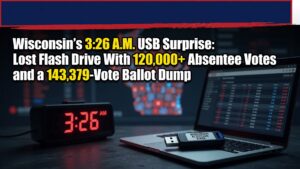
Milwaukee, WI — a USB drive holding absentee voter data for more than 120,000 votes briefly lost chain of custody on election night, during the same window as an unexplained 143,379-vote batch upload reported at 3:26 AM. The drive’s write metadata has not been forensically examined.
Wisconsin — a Dominion reseller is alleged to have retained physical Wisconsin ballots at a facility in Minnesota without governmental authorization and refused to comply with Office of Special Counsel subpoenas. In Green Bay, a private non-government actor controlled the tabulators, the ballots, and a hidden Wi-Fi access point at the central count facility.
Fulton County, GA — 35 tabulator memory cards were swapped mid-election with no chain-of-custody documentation, and closing tapes were printed on surrogate machines rather than the actual scanners. Dominion Voting Systems personnel, not government officials, were in operational control of voting systems in nearly every Georgia county during the election period.
Industry-wide design feature — scanners use a documented “color dropout” function that deletes red-ink markings such as “TEST” or “VOID” from the digital ballot image. In the 2021 New York City mayoral primary, 135,000 test ballots were accidentally included in preliminary results — demonstrating that a test ballot and a cast ballot become indistinguishable in the digital record of record.
What the record shows is not a dispute about specific votes; it is a dispute about whether the votes can be looked at. A ballot without an application has no legal origin. A ballot image without its hash cannot be authenticated. A recount vote with no corresponding image has no paper behind it. A batch of ballots from a tabulator with no provenance cannot be traced to any polling place. A USB drive that briefly went missing on election night cannot be excluded as a write event without metadata forensics that have not been performed. A mail ballot classified “status unknown” in federal survey data is neither counted nor rejected — it is simply gone. Ballots in the custody of a private vendor across a state line or controlled by a non-government actor through a hidden Wi-Fi access point, have passed out of the chain of lawful custody entirely. Across the five states that decided one election, these facts describe a ballot corpus that has been rendered unverifiable — and a verification mantra that stops working the moment the paper, the images, the hashes, and the custody records are simultaneously gone.