
On March 31, 2026, Speaker Emerita Nancy Pelosi told MS NOW’s Ali Vitali that Democrats “have to be on guard as to what they may try to do to the technology. They may try to creep into the technology and create a false count.”[1] Seven months earlier, President Donald Trump had announced that he would “lead a movement to get rid of” mail-in ballots “and also, while we’re at it, Highly ‘Inaccurate,’ Very Expensive, and Seriously Controversial VOTING MACHINES.”[2]
The two statements came from opposite ends of American politics, and each was aimed at the other side. But they rest on the same premise: the computers that count American votes could be made to report a result the voters did not choose, and citizens cannot simply take that count on faith.
When the most powerful House Democrat of her generation and the sitting Republican President both say, in effect, that the machines could produce a false count, the machines have lost the one thing a vote-counting system cannot do without: the confidence of both sides. That loss is also an opening. For the first time in two decades, leaders of both parties are on record doubting the same technology. They can keep using that doubt against each other, or they can agree to remove the thing both of them distrust.
This article makes the case for the second course: a bipartisan commitment to retire electronic voting systems from every step that determines the official result, and to replace them with voter-marked paper ballots counted by people, in public, at the precinct.
Democrats Sounded the Alarm First
Distrust of voting machines did not begin with Donald Trump or the 2020 election. For most of the period from 2003 to 2020, the loudest warnings about electronic voting came from Democrats.
The Paper-Trail Fight After 2004
Three months after the Help America Vote Act (HAVA) became law in 2002, Rep. Rush Holt (D-N.J.) introduced the Voter Confidence and Increased Accessibility Act, which would have required every voting system used in federal elections to produce a voter-verified paper record that could be used for a manual audit. After the 2004 presidential election, Democratic sponsorship of Holt’s bill rose from 149 to 197 members, or 98 percent of House Democrats. [3] The bill never reached the House floor, but it established a durable Democratic position: a vote that exists only inside a computer cannot be trusted.
Kamala Harris and the Benedict Arnold Demonstration
On April 12, 2018, then-Sen. Kamala Harris and Republican Sen. James Lankford hosted a Capitol briefing at which University of Michigan computer scientist J. Alex Halderman ran a mock presidential election between George Washington and Benedict Arnold on a real voting machine. Harris later wrote that all four senators voted for Washington, “But when the result came back, Benedict Arnold had prevailed. The professor had used malicious code to hack the software of the voting machine in a way that assured Arnold’s victory, no matter how the four of us had voted.”[4]
Seven years to the day before Pelosi’s interview, on March 31, 2019, Harris wrote: “Paper ballots are the smartest, safest way to ensure your vote is secure against attacks by foreign actors. Russia can’t hack a piece of paper like they can a computer.” [5] She repeated the line on the campaign trail, telling a New Hampshire audience that “the most secure way to conduct elections” was “paper ballots.” [6]
Ron Wyden: "a child safety lock"
In July 2018 testimony before the Senate Rules Committee, Sen. Ron Wyden (D-Ore.) warned that “at least 44 million Americans, and perhaps millions more, have no choice but to use insecure voting machines that make hackers and hostile foreign governments salivate,” and concluded: “Americans need to have paper ballots marked by hand.” [7][8] In 2019 he went further: “Depending on hackable machines is the election security equivalent of protecting our nuclear codes with a child safety lock.”[9]
Wyden also challenged the industry’s central reassurance. After reports that Election Systems & Software (ES&S) had sold election equipment with pre-installed remote-access software, he wrote to the company: “The American public has been repeatedly assured that voting machines are not connected to the internet, and thus, cannot be remotely compromised by hackers.”[10]
Klobuchar, Warren, and the Vendors
In March 2019, Sens. Amy Klobuchar, Mark Warner, Jack Reed, and Gary Peters (all Democrats) wrote to the three vendors that supply equipment used by 92 percent of eligible U.S. voters: ES&S, Dominion Voting Systems, and Hart InterCivic. “Although each of your companies has a combination of older legacy machines and newer systems,” they wrote, “vulnerabilities in each present a problem for the security of our democracy and they must be addressed.”[11]
In December 2019, Sens. Elizabeth Warren, Amy Klobuchar, and Ron Wyden and Rep. Mark Pocan wrote to the private-equity firms that owned or invested in those same vendors. They warned that the companies “have long skimped on security in favor of convenience,” leaving voting systems “prone to security problems,” and concluded: “These problems threaten the integrity of our elections and demonstrate the importance of election systems that are strong, durable, and not vulnerable to attack.”[12][13]
Speaker Pelosi's House Votes for Paper
Democrats did more than write letters. On June 27, 2019, the Democratic House passed the SAFE Act, 225 to 184, with only one Republican vote.[14][15]The bill would have required “individual, durable, voter-verified paper ballots,” mandated post-election risk-limiting audits, and banned internet connections for voting systems.[16] Speaker Pelosi celebrated its passage, promising Democrats would “make sure that our vote is protected and… that the votes will be counted as cast.”[17]
Wyden’s companion proposal, the Protecting American Votes and Elections (PAVE) Act, used even blunter language. “The PAVE Act scraps insecure voting machines that are juicy targets for hackers,” Wyden said, “and replaces them with reliable, secure hand-marked paper ballots.”[18]
Tulsi Gabbard, Democrat
One of the most consistent Democratic voices was Rep. Tulsi Gabbard of Hawaii. Her Securing America’s Elections Act of 2019 would have required a voter-verified paper ballot for every vote and made that paper the official ballot for any recount or audit.[19] She called the bill a way to make elections “hack-proof.”[20] On the 2020 campaign trail she said it was “essential that we implement immediately to make sure that our 2020 elections can be carried out without voters questioning who may be manipulating the outcome.”[21]
"The Hardware of Our Democracy"
The warnings continued into 2020. In 2019, the DEF CON Voting Village report on that year’s hacking conference, which featured a keynote by Sen. Wyden, concluded that “it is beyond the current and foreseeable state of the art to construct computerized (software and hardware based) voting devices that effectively resist known, practical forms of malicious tampering.”[22] In March 2020, eight months before the presidential election, HBO aired Kill Chain: The Cyber War on America’s Elections, featuring Sens. Klobuchar, Warner, Wyden, and Lankford. “It’s not just about hardware,” Klobuchar said in the film. “It’s the hardware of our democracy.”[23]
Pelosi Brings the Warning Home
After 2020, many Democrats came to treat questions about voting machines as a sign of election denial. Pelosi’s March 2026 interview shows that the underlying worry never went away. It changed targets, from Moscow to the Republican Party.
“We always have concerns,” she said, “but with this president and the Republicans who have no commitment to the rule of law and doing things the appropriate way, we’re ready.” She then warned that Republicans “may try to creep into the technology and create a false count.”[24][25] Her suggested defenses were early voting and voting by mail, not any measure that would actually protect the machine count.[26]
Pelosi offered no evidence that anyone had breached, or planned to breach, a voting system, and conservative outlets called her remark a conspiracy theory.[27] That criticism has merit as far as evidence goes. But it misses what matters for policy. A former Speaker of the House told a national audience that the party in power might quietly corrupt the electronic count. If she believes that is possible, then Democrats share the premise behind the Republican push for paper. They disagree only about who the likely culprit is.
Trump Administration Call for Paper
President Trump
Trump’s August 18, 2025, Truth Social post called voting machines “Highly ‘Inaccurate,’ Very Expensive, and Seriously Controversial” and argued that “Watermark Paper” is “faster, and leaves NO DOUBT, at the end of the evening, as to who WON, and who LOST, the Election.”[28] In the Oval Office the same day, he called paper ballots “the most secure form” of voting.[29]
In a primetime address on July 17, 2026, Trump released declassified intelligence documents and said Americans “were blatantly lied to about the security of our election infrastructure, including electronic voting machines and ballot counting systems.”[30] The White House published an assessment stating, “We judge that U.S. adversaries, including at a minimum Russia, China, Iran, and North Korea, as well as non-state groups, have the capability to compromise U.S. election infrastructure.”[31] The documents also cut the other way: one stated, “We assess that vote tabulation systems would be difficult to manipulate on a wide enough scale to compromise election results.”[32]
Tulsi Gabbard, Director of National Intelligence
No one connects the two parties’ warnings better than Tulsi Gabbard. In 2019 she was a Democratic presidential candidate pushing paper ballots. At an April 2025 Cabinet meeting, as Trump’s Director of National Intelligence, she said: “We have evidence of how these electronic voting systems have been vulnerable to hackers for a very long time, and vulnerable to exploitation to manipulate the results of the votes being cast,” adding that this “further drives forward your mandate to bring about paper ballots across the country so that voters can have faith in the integrity of our elections.”[33]
Her office later obtained and examined voting machines used in Puerto Rico. It reported “extremely concerning” cybersecurity and deployment practices, including “extensive use of cellular modems throughout the voting system architecture that actively connected to cellular networks outside of the United States.”[34] Reuters reported that the inquiry found no clear evidence of Venezuelan interference, and that the cybersecurity contractor found software flaws but no evidence they had been exploited.[35][36] Gabbard resigned as DNI in May 2026, effective June 30, citing her husband’s cancer diagnosis.[37]
The Department of Homeland Security
In July 2026, DHS Secretary Markwayne Mullin announced that states seeking full Homeland Security Grant Program awards must submit a plan to transition “away from unsecure electronic voting systems that use bar codes and QR codes to count votes and instead use equipment that accepts hand-marked paper ballots,” conduct manual audits of at least 5 percent of ballots, and reconcile voters against ballots cast.[38] On September 28, 2026, a federal judge blocked the policy, ruling that FEMA had exceeded its statutory authority.[39] Two days later, Mullin told reporters, “We’ve had some trouble with some machines; can’t say that it was fraud or not fraud.”[40]
The administration has faced significant headwinds in their attempt to address the security vulnerabilities inherent with electronic voting systems. Courts have repeatedly held that the president cannot rewrite state election procedures by executive action, and investigations have found vulnerabilities rather than proof that votes were changed.[41][42] Still, the administration’s stated goal of paper ballots that voters mark by hand, with hand verification, is where the Democrats’ own pre-2020 warnings were heading.[43]
Common Ground?
An election has a job beyond choosing winners: it has to persuade the losers that they lost. A counting method that each side believes the other could secretly manipulate fails at that job, whether or not anyone has actually manipulated it.
That is where America is in 2026. Republicans fear that vendor software, foreign actors, or insiders could alter totals. Democrats fear that a Republican administration could “creep into the technology.” Both fears point to the same structural fact: in most American jurisdictions, the official count is produced by proprietary software that ordinary citizens cannot observe, inspect, or understand.
This argument does not depend on proving that any past election was stolen. The public record so far documents vulnerabilities, not undeniable evidence of altered outcomes. The case for elimination is that no amount of certification can prove a negative about software the public cannot see. The question is not whether the machines were hacked. It is whether any citizen, of either party, can confirm with their own eyes that they were not.
Why Paper Backups Are Not Enough
The common response is that the problem has already been solved, because nearly every American vote now leaves a paper record.[44] That is a real improvement, and Democrats deserve credit for pushing it. But a paper record is not a paper count.
About 69.5 percent of registered voters mark paper ballots by hand, and most of those ballots are read and tallied by optical scanners. About 26.5 percent live in jurisdictions that use ballot-marking devices for all voters.[45] In both cases, software produces the official result. The paper is consulted only when an audit, a recount, or a court calls for it. Even the administration’s own proposed 5 percent manual audit would mean 95 percent of ballots are never seen by a human counter.
That arrangement creates two records and then requires procedures, statistics, experts, and often litigation to decide which one controls when they disagree. It asks the public to trust a machine count first and verify it afterward, if at all. The DEF CON researchers’ conclusion that no computerized voting device can be built to resist known tampering applies to scanners as well as touchscreens.[46] When Wyden said the PAVE Act would “scrap insecure voting machines,” he named the right goal.[47]
It Has Been Done Elsewhere

Germany
In 2009, Germany’s Federal Constitutional Court held that the computerized voting machines used in the 2005 Bundestag election were unconstitutional. The court ruled that the principle of public elections requires that “the essential steps of the voting and of the determination of the result can be examined by the citizen reliably and without any specialist knowledge of the subject.”[48] The ruling did not permanently ban every possible voting device, but it set a standard no current machine met, and Germany returned to paper.[49]
Canada
Canada, a large and technologically advanced neighbor and the former home of Dominion Voting Systems, counts its federal elections by hand. The Canada Elections Act requires that federal ballots be hand-counted, and electronic tabulators are not used to decide federal results.[50] At each polling place, paid and trained election workers count in pairs in front of candidates’ representatives or other witnesses. They reconcile ballots used, spoiled, and unused against the number of electors who voted, then unfold each ballot, read the choice aloud, and show it to everyone present.[51] Computers are used only to report the results after the hand count is finished.
Canada also shows that accessibility does not require a voting computer. Federal polling stations offer tactile and braille voting templates that fit over the paper ballot, braille and large-print candidate lists, magnifiers, large-grip pencils, and assistance in marking the ballot.[52]
A Framework for a Bipartisan Bill
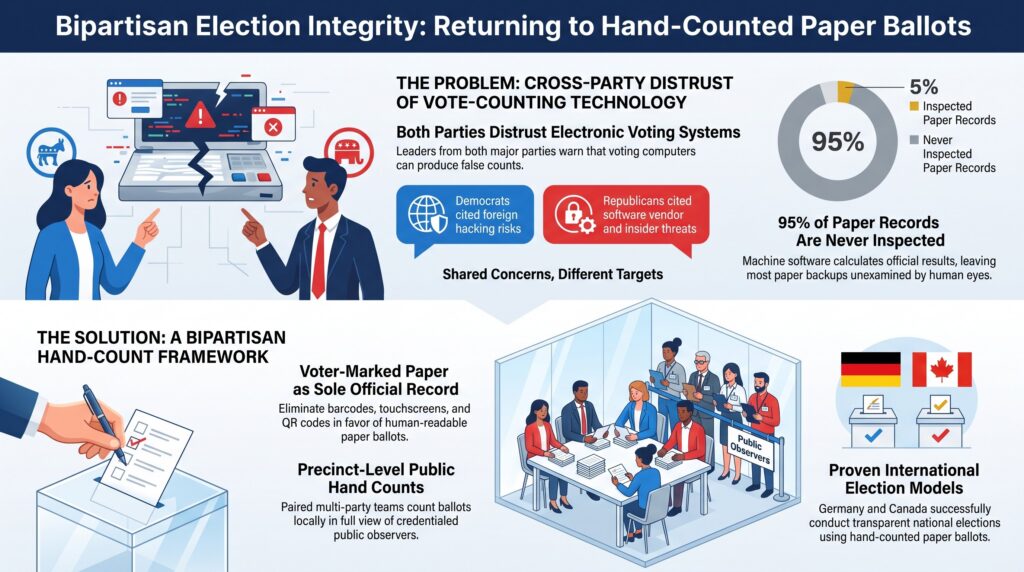
Members of both parties could build legislation around the following commitments:
- Paper is the vote. The sole official record of each vote in a federal election is a durable, human-readable paper ballot marked by the voter, or by a lawful assistant under public rules. No barcode, QR code, or electronic record counts as a vote.
- People count in public. Official vote totals are found by direct human examination of every ballot, at or near the precinct, by paired teams representing both major parties, in front of credentialed observers.
- Reconcile before counting. Each counting unit accounts publicly for ballots issued, spoiled, unused, and cast, and reconciles them against the pollbook before counting any votes.
- Sign it and post it. Counters and observers sign a paper statement of votes, record any objections on it, and post a copy at the counting location before the ballots are moved.
- Paper governs the canvass. County and state canvasses add up the signed precinct statements. Computers may publish unofficial results and images of the signed statements, but no electronic total has legal effect.
- Accessible without software. Congress amends HAVA to require non-electronic accessibility aids and trained assistance that let voters with disabilities mark a paper ballot privately and independently, developed with disability-rights organizations.
- Fund the people. Federal funding moves from buying and certifying equipment to recruiting, training, and paying counters, securing ballot custody, and running full rehearsals, on a phased schedule that starts after the 2026 midterms.
- States run it, both parties watch it. States keep administering elections. The federal role is to set the paper-ballot standard, pay for the transition, and guarantee observer access for both parties.
The Opportunity
For twenty years, each party has discovered voting-machine vulnerabilities when it lost and forgotten them when it won. Democrats warned about hackable machines, opaque vendors, and invisible code while Republicans held power. Republicans took up the same warnings after 2020. Now Pelosi’s warning about a “false count” shows the fear has come full circle.
That cycle can end only when the count no longer depends on which party controls the software, the vendor, or the federal government. A paper ballot does not know whether its voter is a Republican or a Democrat. A public hand count does not ask anyone to trust the other side’s programmers. It asks only that both sides watch.
Harris was right that “Russia can’t hack a piece of paper.” Pelosi is right that Americans should be on guard against a false count. Trump is right that a paper result should leave “NO DOUBT” about who won and who lost. Gabbard has said the same thing from both parties. The way to put all of them on the same side is a count that every citizen can watch.
Citations
- “Pelosi: GOP May Try to ‘Creep into the Technology’ and Create a ‘False Count’ in Midterm Elections,” Breitbart, March 31, 2026 (transcript of MS NOW interview), https://www.breitbart.com/clips/2026/03/31/pelosi-gop-may-try-to-creep-into-the-technology-and-create-a-false-count-in-midterm-elections/; see also Mediaite, https://www.mediaite.com/media/tv/nancy-pelosi-claims-republicans-may-hack-voting-machines-and-create-fake-count-in-midterms-be-on-guard/.
- Donald J. Trump, Truth Social posts, August 18, 2025, The American Presidency Project, UC Santa Barbara, https://www.presidency.ucsb.edu/documents/truth-social-posts-august-18-2025.
- “The Voter-Verified Paper Trail Debate,” Publius: The Journal of Federalism 38, no. 3 (2008), https://academic.oup.com/publius/article/38/3/515/1866915.
- “Hacked Voting Machine Donated to Henry Ford Museum” (quoting Kamala Harris, The Truths We Hold), University of Michigan Computer Science and Engineering, https://cse.engin.umich.edu/stories/hacked-voting-machine-donated-to-henry-ford-museum.
- Kamala Harris (@KamalaHarris), post on X, March 31, 2019, https://x.com/KamalaHarris/status/1112410982607974400.
- “Harris Calls for Paper Ballots in Elections: ‘Russia Can’t Hack a Piece of Paper,’” The Hill, February 2019, https://thehill.com/policy/cybersecurity/430565-harris-calls-for-paper-ballots-in-elections-russia-cant-hack-a-piece-of/.
- Statement of Sen. Ron Wyden, “Election Security Preparations: Federal and Vendor Perspectives,” Hearing before the Senate Committee on Rules and Administration, July 11, 2018, https://www.congress.gov/115/chrg/CHRG-115shrg35266/CHRG-115shrg35266.pdf.
- Ibid.
- “Wyden Remarks at ‘In Defense of American Democracy’ on Election Security and Vote by Mail,” Office of Sen. Ron Wyden, 2019, https://www.wyden.senate.gov/news/press-releases/wyden-remarks-at-in-defense-of-american-democracy-on-election-security-and-vote-by-mail.
- “Wyden Questions Voting Machine Manufacturer on Security Weakness Posed by Remote Access,” Office of Sen. Ron Wyden, 2018, https://www.wyden.senate.gov/news/press-releases/wyden-questions-voting-machine-manufacturer-on-security-weakness-posed-by-remote-access.
- “Ranking Members Klobuchar, Warner, Reed, and Peters Press Election Equipment Manufacturers on Security,” Office of Sen. Amy Klobuchar, March 2019, https://www.klobuchar.senate.gov/public/index.cfm/2019/3/ranking-members-klobuchar-warner-reed-and-peters-press-election-equipment-manufacturers-on-security.
- “Democratic Senators Investigate Vulnerabilities and Shortcomings of Election Technology Industry with Ties to Private Equity,” YubaNet (press release text), December 10, 2019, https://yubanet.com/usa/democratic-senators-investigate-vulnerabilities-and-shortcomings-of-election-technology-industry-with-ties-to-private-equity/.
- Letter text reprinted in Senate Hearing 116-405, Congress.gov, https://www.congress.gov/event/116th-congress/senate-event/LC67877/text.
- Committee on House Administration Democrats, 116th Congress record of SAFE Act passage, https://democrats-cha.house.gov/116th-congress?page=16.
- “House Dems Pass Bill with Election Security Safeguards, Paper Ballots,” MS NOW (The Rachel Maddow Show blog), June 2019, https://www.ms.now/rachel-maddow-show/house-dems-pass-bill-election-security-safeguards-paper-ballots-msna1247791.
- H.R. 2722, Securing America’s Federal Elections (SAFE) Act, 116th Congress, Congress.gov, https://www.congress.gov/bill/116th-congress/house-bill/2722.
- “Pelosi Remarks at Election Security Week of Action Press Conference,” Office of Speaker Nancy Pelosi, July 2019, https://pelosi.house.gov/news/press-releases/pelosi-remarks-at-election-security-week-of-action-press-conference.
- “Wyden and Bicameral Coalition Introduce Bill to Require States to Secure Elections,” Office of Sen. Ron Wyden, https://www.wyden.senate.gov/news/press-releases/wyden-and-bicameral-coalition-introduce-bill-to-require-states-to-secure-elections-.
- H.R. 1946, Securing America’s Elections Act of 2019, 116th Congress (introduced text), GovInfo, https://www.govinfo.gov/content/pkg/BILLS-116hr1946ih/html/BILLS-116hr1946ih.htm.
- “Rep. Gabbard Introduces Securing America’s Elections Act,” Big Island Now, March 28, 2019, https://bigislandnow.com/2019/03/28/rep-gabbard-introduces-securing-americas-elections-act/.
- “2020 Candidate Conversation: U.S. Rep. Tulsi Gabbard,” New Hampshire Public Radio, March 21, 2019, https://www.nhpr.org/the-exchange/2019-03-21/2020-candidate-conversation-u-s-rep-tulsi-gabbard.
- DEF CON 27 Voting Machine Hacking Village Report, September 2019, https://harris.uchicago.edu/files/def_con_27_voting_village_report.pdf.
- “Kill Chain: The Cyber War on America’s Elections Debuts March 26,” HBO / Warner Bros. Discovery press release, 2020, https://press.wbd.com/na/media-release/hbo-0/kill-chain-cyber-war-americas-elections-debuts-march-26.
- Matt Margolis, “Why Are Democrats Claiming the 2026 Election Will Be Rigged?” (quoting the MS NOW interview), April 2026, https://www.mattmargolis.com/p/why-are-democrats-claiming-the-2026.
- “Pelosi: GOP May Try to ‘Creep into the Technology’ and Create a ‘False Count’ in Midterm Elections,” Breitbart, March 31, 2026 (transcript of MS NOW interview), https://www.breitbart.com/clips/2026/03/31/pelosi-gop-may-try-to-creep-into-the-technology-and-create-a-false-count-in-midterm-elections/; see also Mediaite, https://www.mediaite.com/media/tv/nancy-pelosi-claims-republicans-may-hack-voting-machines-and-create-fake-count-in-midterms-be-on-guard/.
- “Pelosi: GOP May Try to ‘Creep into the Technology’ and Create a ‘False Count’ in Midterm Elections,” Breitbart, March 31, 2026 (transcript of MS NOW interview), https://www.breitbart.com/clips/2026/03/31/pelosi-gop-may-try-to-creep-into-the-technology-and-create-a-false-count-in-midterm-elections/; see also Mediaite, https://www.mediaite.com/media/tv/nancy-pelosi-claims-republicans-may-hack-voting-machines-and-create-fake-count-in-midterms-be-on-guard/.
- “Watch: Nancy Pelosi Plants Absurd Conspiracy Theory About 2026 Election,” The Western Journal, April 2026, https://www.westernjournal.com/watch-nancy-pelosi-plants-absurd-conspiracy-theory-2026-election/.
- Donald J. Trump, Truth Social posts, August 18, 2025, The American Presidency Project, UC Santa Barbara, https://www.presidency.ucsb.edu/documents/truth-social-posts-august-18-2025.
- Fox 13 Seattle, “Trump Executive Order on Mail-In Ballots and Voting,” August 2025, https://www.fox13seattle.com/news/trump-executive-order-mail-in-ballots-voting; see also NPR, “Trump Announces on Truth Social That He’ll Ban Mail-In Voting and Voting Machines,” August 18, 2025, https://www.npr.org/2025/08/18/nx-s1-5506137/trump-announces-on-truth-social-that-hell-ban-mail-in-voting-and-voting-machines.
- “Key Moments from Trump’s Primetime Speech,” CNN, July 17, 2026, https://www.cnn.com/2026/07/17/politics/key-moments-trump-primetime-speech.
- “Election Integrity,” The White House, https://www.whitehouse.gov/election-integrity/.
- “Trump Speech on Elections: Live Updates,” The New York Times, July 16–17, 2026, https://www.nytimes.com/live/2026/07/16/us/trump-speech-election.
- “Tulsi Gabbard Tells Trump She Has Evidence Voting Machines Are Vulnerable to Hackers,” Todayville, April 2025, https://www.todayville.com/tulsi-gabbard-tells-trump-she-has-evidence-voting-machines-are-vulnerable-to-hackers/.
- “Gabbard’s Office Obtained Voting Machines from Puerto Rico,” CNN, February 4, 2026, https://www.cnn.com/2026/02/04/politics/gabbard-office-obtained-voting-machines-puerto-rico.
- “US Spy Chief’s Office Investigated Voting Machines in Puerto Rico,” Reuters, February 4, 2026, https://www.reuters.com/world/americas/us-spy-chiefs-office-investigated-voting-machines-puerto-rico-2026-02-04/.
- “Trump Aides Chase Vote-Rigging Claims Even After Latest Probe Finds Nothing,” Reuters, April 23, 2026, https://www.reuters.com/world/us/trump-aides-chase-vote-rigging-claims-even-after-latest-probe-finds-nothing-2026-04-23/.
- “Gabbard Resigns as Trump’s National Intelligence Director,” Reuters, May 22, 2026, https://www.reuters.com/world/us/gabbard-resigns-trumps-national-intelligence-director-fox-news-digital-reports-2026-05-22/.
- “DHS Requires States to Adopt Common-Sense Election Security Measures Before Receiving Federal Grants,” U.S. Department of Homeland Security, July 10, 2026, https://www.dhs.gov/news/2026/07/10/dhs-requires-states-adopt-common-sense-election-security-measures-receiving-federal.
- “Judge Blocks Trump from Tying Anti-Terrorism Grants to Election Changes,” Reuters, September 28, 2026, https://www.reuters.com/world/judge-blocks-trump-tying-anti-terrorism-grants-election-changes-2026-09-28/.
- “DHS State Funding, Election Security and the Court Ruling,” Politico, September 30, 2026, https://www.politico.com/news/2026/09/30/dhs-state-funding-election-security-court-ruling-01102677.
- “Frequently Asked Questions About the 2026 Midterm Elections,” Protect Democracy, https://protectdemocracy.org/work/frequently-asked-questions-about-the-2026-midterm-elections/.
- “Trump Aides Chase Vote-Rigging Claims Even After Latest Probe Finds Nothing,” Reuters, April 23, 2026, https://www.reuters.com/world/us/trump-aides-chase-vote-rigging-claims-even-after-latest-probe-finds-nothing-2026-04-23/.
- “Trump’s Election Plans and the Midterms,” Global News (Reuters), 2026, https://globalnews.ca/news/11860433/trump-election-voting-machines-kurt-olsen-us-midterms/.
- “Voting Machines and Ballot Technology,” Sciline, https://www.sciline.org/elections/voting-machines-ballot-technology/.
- “DHS Requires States to Adopt Common-Sense Election Security Measures Before Receiving Federal Grants,” U.S. Department of Homeland Security, July 10, 2026, https://www.dhs.gov/news/2026/07/10/dhs-requires-states-adopt-common-sense-election-security-measures-receiving-federal.
- DEF CON 27 Voting Machine Hacking Village Report, September 2019, https://harris.uchicago.edu/files/def_con_27_voting_village_report.pdf.
- “Wyden and Bicameral Coalition Introduce Bill to Require States to Secure Elections,” Office of Sen. Ron Wyden, https://www.wyden.senate.gov/news/press-releases/wyden-and-bicameral-coalition-introduce-bill-to-require-states-to-secure-elections-.
- “Use of Voting Computers in 2005 Bundestag Election Unconstitutional,” Federal Constitutional Court of Germany, Press Release No. 19/2009, March 3, 2009, https://www.bundesverfassungsgericht.de/SharedDocs/Pressemitteilungen/EN/2009/bvg09-019.html.
- “Voting Machines” (glossary), Federal Returning Officer of Germany, https://bundeswahlleiterin.de/en/service/glossar/w/wahlgeraete.html.
- “Security Considerations for Electronic Vote Tabulators (ITSM.10.102),” Canadian Centre for Cyber Security, https://www.cyber.gc.ca/en/guidance/security-considerations-electronic-vote-tabulators-itsm10102.
- “Safeguards for Counting the Votes,” Elections Canada, https://www.elections.ca/content.aspx?section=vot&dir=int/cou&document=index&lang=e.
- “Voting Tools and Services,” Elections Canada, https://www.elections.ca/content2.aspx?section=acc&dir=tol&document=index&lang=e.