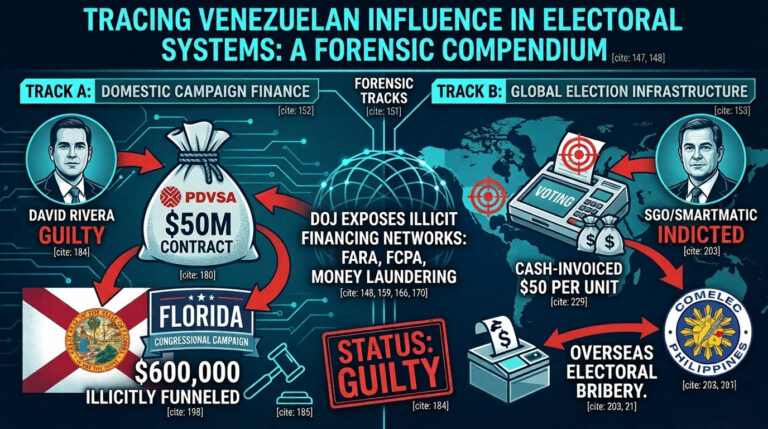
This report deconstructs these risks through two primary vectors: Track A, the illicit financial flows that create an enabling environment for capture, and Track B, the compromise of the physical and digital infrastructure used to record and count votes.

Recent legal proceedings in Florida (Case No. 24-20343-CR-WILLIAMS) have exposed the operational mechanics of this interference. Central to these proceedings are Juan Andres Donato Bautista, the former Chairman of the Philippines Commission on Elections (COMELEC), who allegedly received bribes to facilitate contracts, and Roger Alejandro Pinate Martinez, a co-founder and executive of SGO Corporation (Smartmatic), who is implicated in orchestrating the bribery scheme. These actions demonstrate how state interests utilize private corporate vehicles to bypass transparency safeguards.
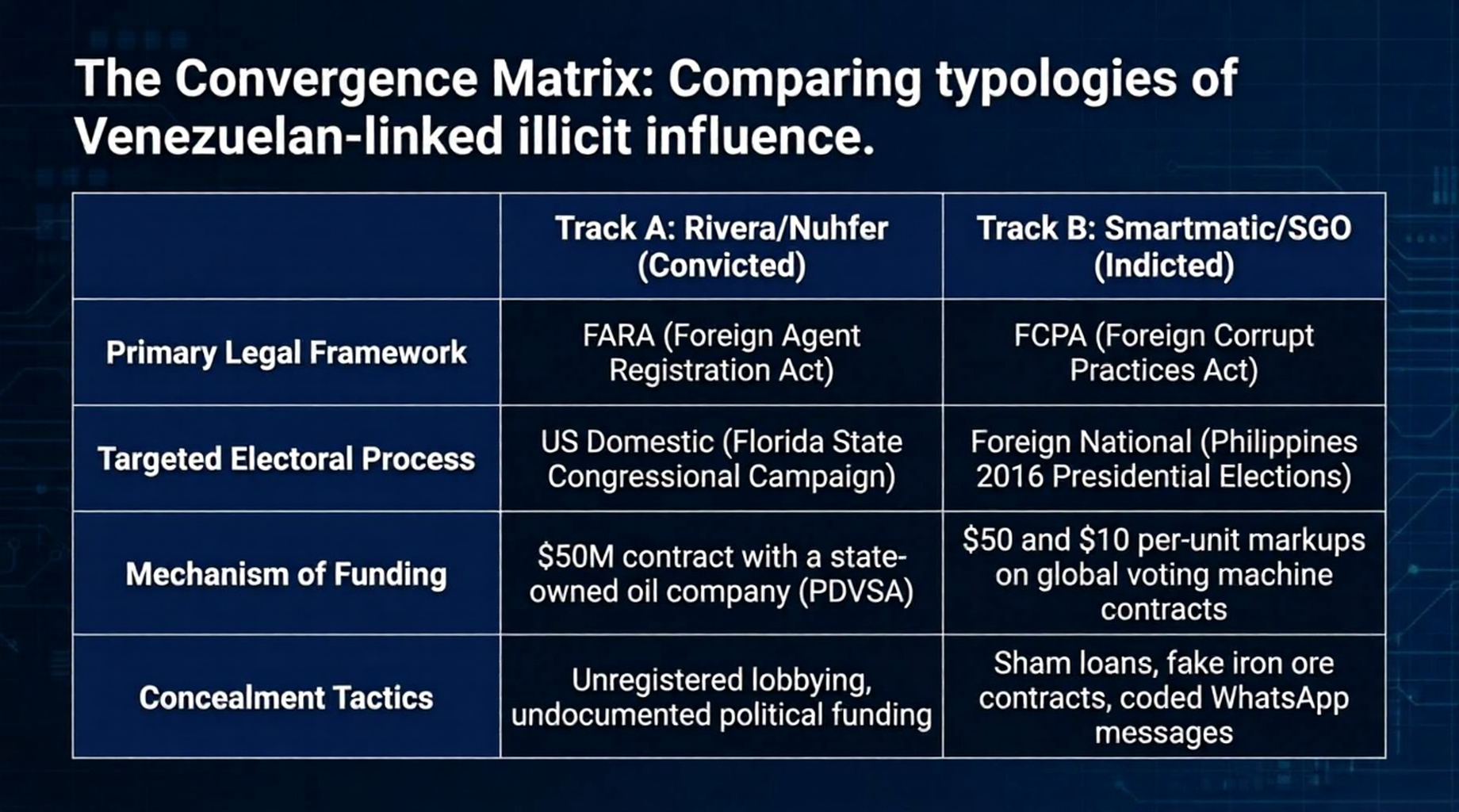
Examination of the investigative materials pertinent to the Track A convictions and the Track B indictments reveal a concerning landscape for the conduct of elections in the United States.
Track A: Domestic Campaign Finance
Track A represents the strategic “softening” of a target nation’s defenses. By utilizing illicit financial flows and unregistered lobbying, foreign actors bypass the Foreign Agents Registration Act (FARA) and other democratic safeguards to manipulate policy and public perception. These maneuvers allow foreign state-controlled entities to exercise “soft power” through hard currency, effectively purchasing political path-clearing for their technical systems.
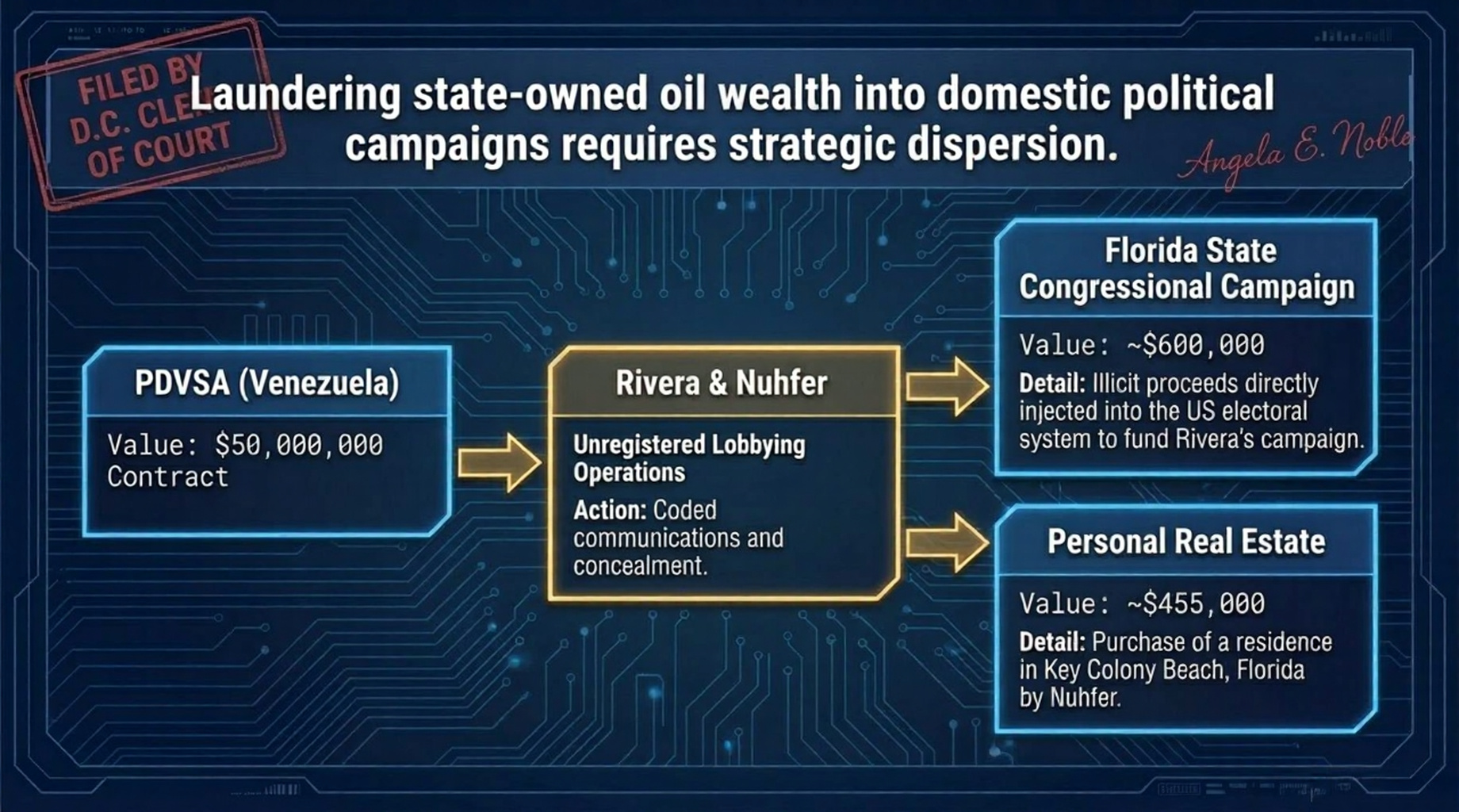
- Violations of the Foreign Corrupt Practices Act (FCPA): Systematic use of U.S.-based and international financial channels to pay bribes to foreign officials, specifically targeting election administrators to secure non-competitive contracts.
- Conspiracy to Commit Money Laundering (18 U.S.C. § 1956 and § 1957): The deployment of complex, multi-jurisdictional transfers to hide the illicit origins and destinations of funds used in these influence operations.
- Subversion via the SGO Corporate Structure: The indictment details how the SGO (Smartmatic) corporate architecture was leveraged to move capital across borders, obfuscating the trail of influence and preventing regulators from identifying the ultimate beneficial owners.
Multi-jurisdictional money laundering in the critical infrastructure sector utilizes “shell hopping” to transform public contract disbursements into private wealth. This traversal relies on “chokepoints” within the US financial system to move illicit capital through the following four-stage protocol:
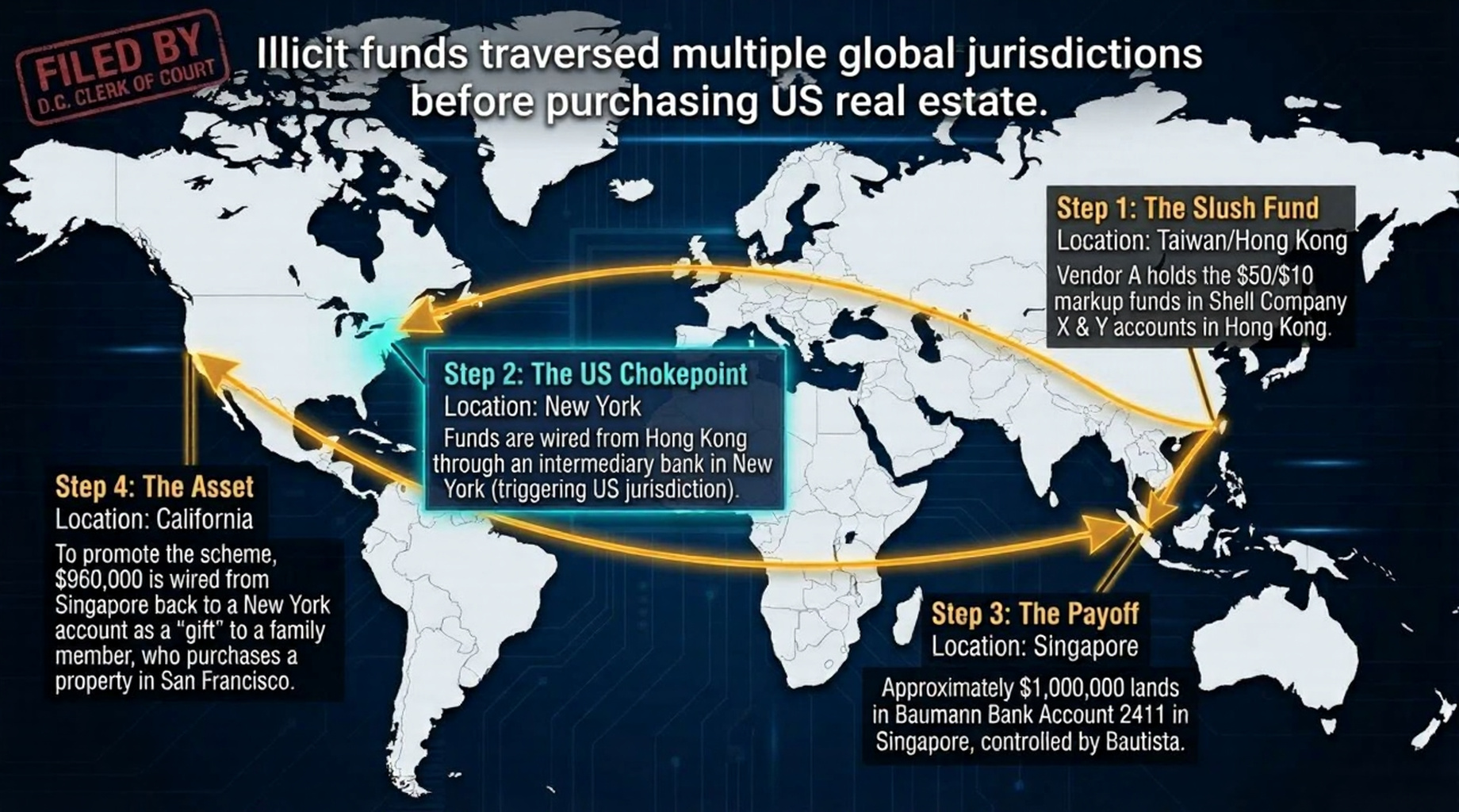
This financial architecture represents a persistent threat vector where fraudulent public contracts fund the acquisition of private property, undermining both financial and democratic integrity.
The “So What?” of Track A is that financial corruption is the precursor to technical compromise. These financial maneuvers allowed Venezuelan-linked interests to penetrate the U.S. and international political landscapes without the transparency required by law. By operating behind a corporate veil, these actors established a presence that was unvetted and highly susceptible to state-directed manipulation, eventually transitioning from financial corruption to the control of election infrastructure.
Track B: Global Election Infrastructure
Election infrastructure is a cornerstone of national sovereignty; therefore, any foreign ownership, funding, or technical control of voting technology constitutes a primary national security threat. A chronological analysis of Smartmatic reveals a history defined by opaque state ties and recurrent technical failures.
- The Bizta Connection (2003): In June 2003, the Venezuelan government acquired a 28% ownership stake in Bizta R&D Software C.A. through an intermediary, Omar Montilla Castillo. This “seed money,” totaling 300 million Bolivares (approximately $200,000), provided the Venezuelan state a direct entry point into the SBC consortium (Smartmatic, Bizta, and CANTV) tasked with automating the nation’s elections. Bizta and Smartmatic operated as “sister companies” that operated concurrently with shared ownership by Antonio Mugica and Alfreda Anzola. Both companies shared the same office in Caracas, Venezuela and worked together to carry out elections. Bizta created the election software system while Smartmatic was responsible for running the elections and manufacturing the machines.
- The Sequoia Acquisition and CFIUS Intervention (2005): Smartmatic utilized wealth generated from Venezuelan contracts to purchase the U.S.-based Sequoia Voting Systems for $16 million. This triggered a 2006 investigation by the Committee on Foreign Investment in the United States (CFIUS). To avoid an audit of its convoluted ownership structure, Smartmatic divested Sequoia, yet the divestment was largely a shell game.
- Technical Failures and Audits (Nov 2005): In November 2005, a mock audit conducted by technician Leopoldo Gonzalez—observed by the European Union (EU) and the Organization of American States (OAS)—exposed a fatal flaw: the technology could not guarantee the “secrecy of the vote.” Gonzalez demonstrated he could identify how individual participants voted, leading to a mass withdrawal of opposition parties and a total collapse of electoral trust.
- Dominion Voting Systems announced the purchase of Sequoia Voting Systems on June 4, 2010. Sequoia had previously been acquired by Smartmatic in 2005. The 2010 acquisition was facilitated by a prior working relationship between Dominion and Sequoia, as the two companies had collaborated on elections in the Philippines from 2007 to 2013
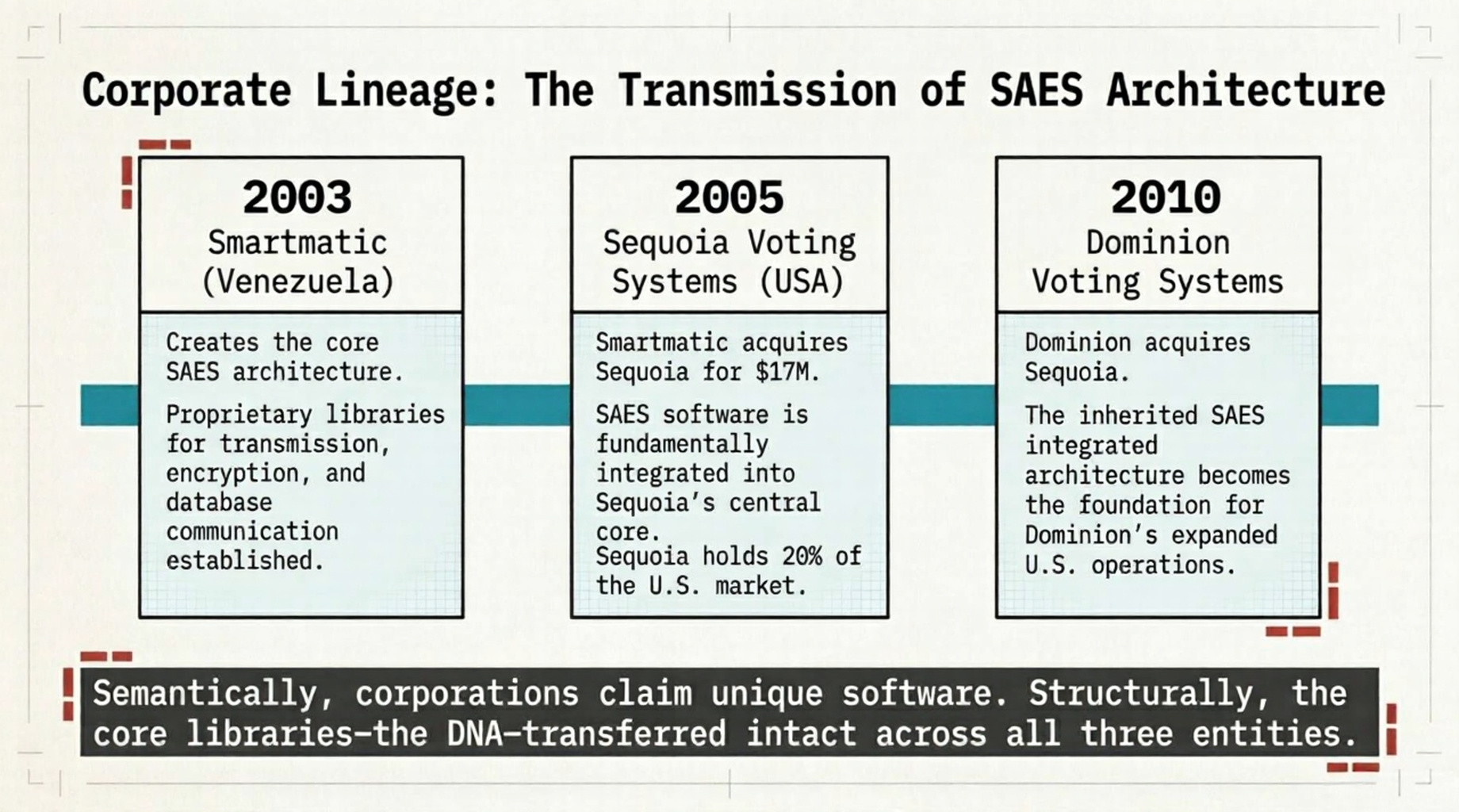
The core architects of this network—Antonio Mugica, Alfredo Anzola, and Roger Piñate—transitioned Smartmatic from a struggling software venture into a global infrastructure provider using Venezuelan state support. Investigation reveals that high-ranking Venezuelan officials, including Ambassador Bernardo Alvarez Herrera and Vice President Jose Vicente Rangel, maintained intimate relationships with these directors. Furthermore, the Venezuelan government secured a 28% stake in Bizta R&D Software C.A. via a 300-million-bolivar investment (approx. $200,000) through a venture capital fund designed to mask the state’s hand.
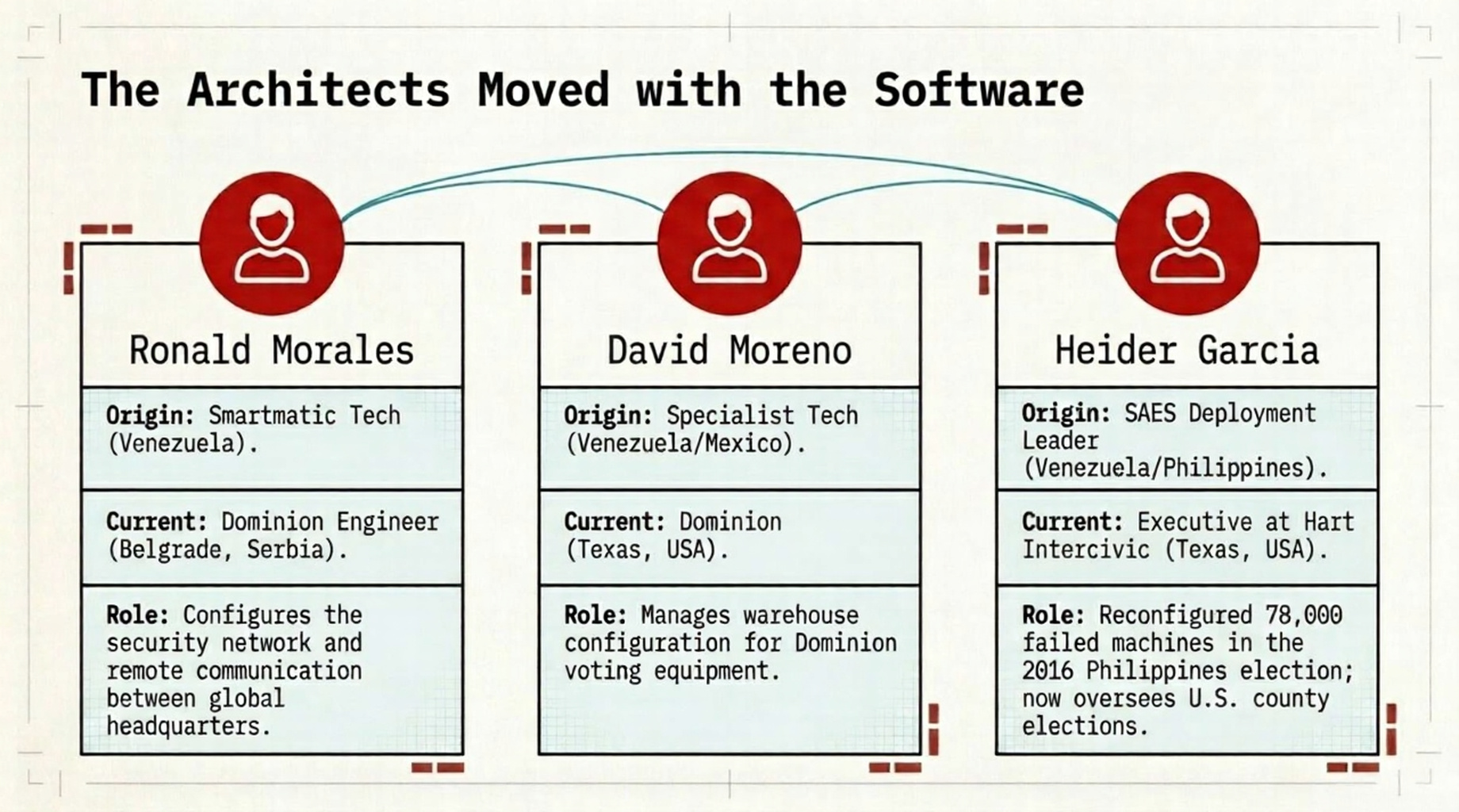
The forensic investigation into the Smartmatic-Sequoia-Dominion nexus reveals a deeply compromised ecosystem designed for regulatory evasion and the promulgation of “features” of electronic voting systems which preserve significant election security vulnerabilities.
Conclusion
- Mandatory disclosure of ultimate beneficial ownership and creditor lists for all infrastructure vendors.
- The elimination of foreign-licensed IP in critical election software.
- A move to voter-verified paper trails that are immune to technical “erasure” mechanisms.
Citations
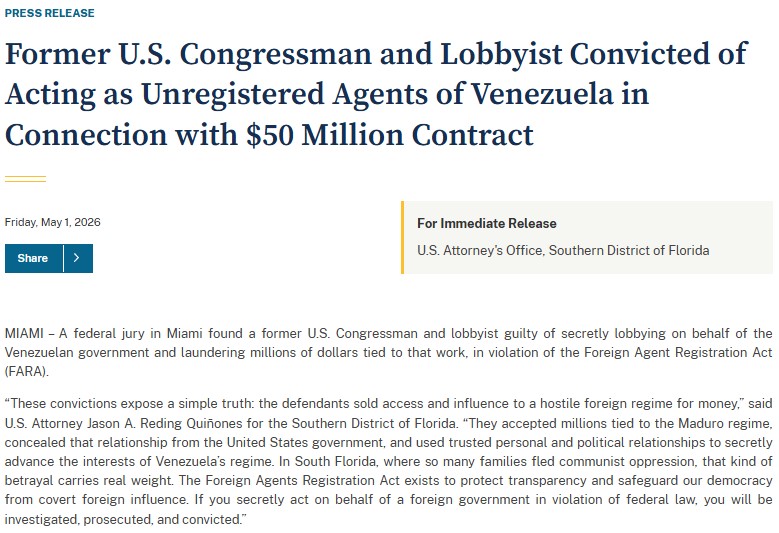
U.S. Department of Justice. (2026, May 1). Former U.S. Congressman and Lobbyist Convicted of Acting as Unregistered Agents of Venezuela in Connection with $50 Million Contract [Press Release]. U.S. Attorney’s Office, Southern District of Florida.
- Link: justice.gov/usao-sdfl/pr/former-us-congressman-and-lobbyist-convicted-acting-unregistered-agents-venezuela
- Note for Readers: Related court documents for this conviction can be found at pacer.flsd.uscourts.gov under case number 22-cr-20552.
Infodio. Smartmatic revisited.
United States District Court, Southern District of Florida. Superseding Indictment: United States of America vs. Juan Andres Donato Bautista, Roger Alejandro Pinate Martinez, Jorge Miguel Vasquez, Elie Moreno, and SGO Corporation Limited (a/k/a “Smartmatic”). Case No. 24-20343-CR-WILLIAMS(s). Filed October 16, 2025.
United States District Court, Southern District of New York. Sealed Superseding Indictment: United States of America v. Nicolas Maduro Moros, Diosdado Cabello Rondon, Ramon Rodriguez Chacin, Cilia Adela Flores De Maduro, Nicolas Ernesto Maduro Guerra, and Hector Rusthenford Guerrero Flores. Case No. S4 11 Cr. 205 (AKH).
Cruise, T. R. (Court Reporter). (2025, September 18). Examination Under Oath of Confidential Witness (Morning and Afternoon Sessions). Examination conducted by John Case, Esq. on behalf of Tina Peters. Pasco County, Florida.
Carvajal Barrios, H. (2025, December 2). Letter to President Trump and The People of the United States.
Alcalá Cordones, C. A. (2025, December 8). Letter to President Donald J. Trump.
Florida Department of State / Division of Corporations. Smartmatic Corporation: Transmittal Letters and Application by Foreign Corporation for Authorization to Transact Business in Florida. Includes international corporate registry filings and related addenda.