
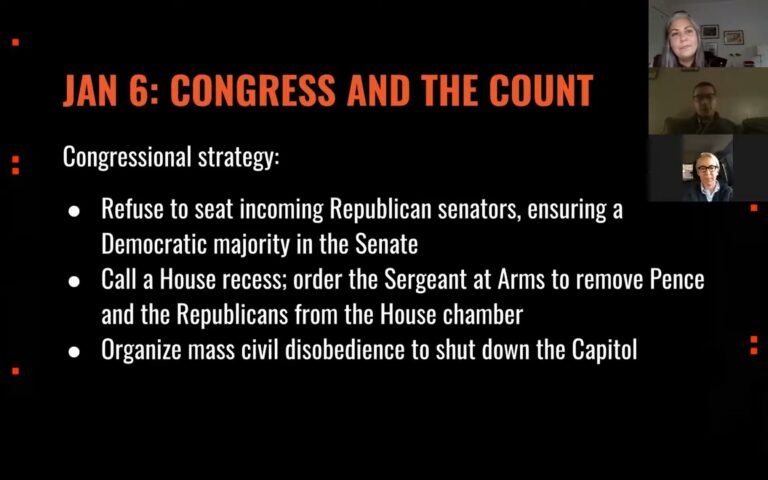
In the tense weeks before the November 2020 presidential election, three progressive organizers sat down and wrote out, step by step, how they believed a sitting president might try to hold onto power after losing — and what ordinary citizens and elected officials could do to stop it. The result was a roughly 40-page strategy guide called “The Count,” subtitled “A practical guide to defending the Constitution in a contested 2020 election.” Last updated on October 14, 2020, it reads today as a striking pre-election artifact: a document that openly war-gamed an Electoral College and “fake electors” dispute months before the events of January 6, 2021.
Who is behind it
The guide is credited to three authors with deep roots in progressive electoral and advocacy organizing:
Zack Malitz — a partner at The Social Practice and co-founder of the Real Justice PAC. He ran Beto O’Rourke’s record-breaking 2018 statewide organizing effort and previously served as Deputy Distributed Organizing Director for Bernie Sanders’ 2016 campaign.
Brandon Evans — national political director of the Real Justice PAC, advising reform-minded elected prosecutors. He previously managed campaigns for Philadelphia Mayor Jim Kenney and District Attorney Larry Krasner, and directed the Working Families Party in Pennsylvania.
Becky Bond — executive director of the Real Justice PAC and a partner at The Social Practice. She is co-author of “Rules for Revolutionaries: How Big Organizing Changes Everything,” drawn from her experience on the 2016 Sanders campaign.
The guide lists a single contact point: [email protected]. Beyond the authors, the key figures discussed in the text are Donald Trump (cast as a “would-be autocrat”), Joe Biden, congressional Republicans and Democrats, state legislators and governors, and the Electoral College electors themselves. The authors also lean on outside reporting, notably Barton Gellman’s Atlantic piece “The Election That Could Break America,” which described Republican contingency plans to appoint loyal electors in battleground states.
The core argument
The central thesis of “The Count” is blunt: in a close election, the outcome would be decided not in the courtroom but through “a contest of political will and power.”
The authors warn against putting too much faith in judges and Republican officials, writing that “pleading with courts and Republican officials to do the right thing is akin to continuing to play a board game that the opposition has set on fire.” They point to the 2000 Florida recount as a cautionary tale — arguing that Democrats put their faith in the courts while Republicans “fought a dirty war,” resulting in “eight years of George W. Bush in the White House.”
How it’s organized
The guide is structured around three main parts, plus front matter that includes author bios and a “Key Dates” timeline running from Election Day to Inauguration:
I. Understanding the System. A plain-language explanation of how presidents are actually elected — the Electoral College, the reality that voters are choosing electors rather than candidates directly, the December 8 “safe harbor” deadline, the December 14 Electoral College meeting, faithless electors, the January 6 congressional count, and Inauguration Day. It anchors the discussion in two historical disputes: the 1876 Hayes–Tilden crisis (in which multiple states sent competing slates of electors) and Florida 2000.
II. Understanding the Threat. A scenario-by-scenario walkthrough of how the authors believed the election could be disrupted: voter suppression on Election Day, interference with the ballot count, the “blue shift” in late-counted mail ballots, competing slates of electors appointed by state legislatures, the Electoral Count Act of 1887, and the roles of Congress and the Supreme Court. Each phase is paired with concrete “Action Steps.”
III. Conclusion: Defending Democracy. A closing call for mass organizing, protest “at an unprecedented scale,” and decisive action by Democratic officials in swing states and Congress.
Why it still matters
Read in hindsight, “The Count” is notable for a couple of reasons. First, it is a genuine pre-election document that explicitly anticipated an Electoral College and competing-electors dispute well before such scenarios played out in late 2020 and early 2021. Second, its authorship — Real Justice PAC organizers and veterans of the Sanders and O’Rourke campaigns — situates it firmly within progressive movement strategy rather than legal or academic commentary.