
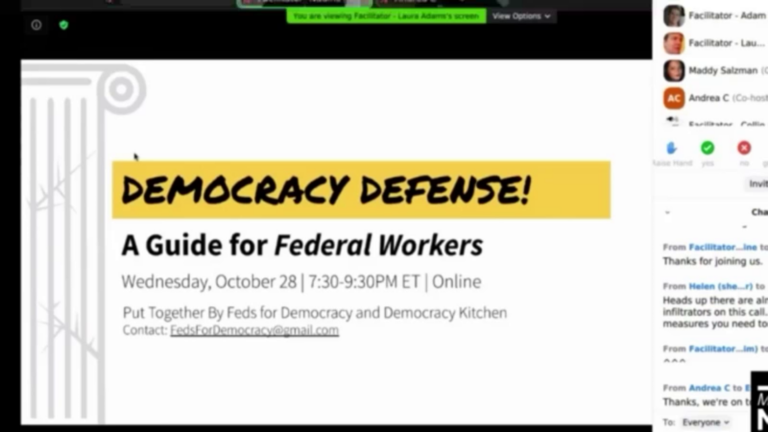
On October 28, 2020, Nadine Bloch with Feds for Democracy moderated a training session for federal workers called “Democracy Defense”. The session is a live Zoom meeting with an unspecified number of attendees — all identified as current federal government employees — less than one week before the 2020 election.
The session features two primary speakers:
Laura Adams — Identified as a member of “Democracy Kitchen,” the group hosting the workshop. She states she previously worked for USAID for four years and co-organized prior “federal worker rights workshops” with Nadine Bloch (of Shutdown DC). She serves as the session facilitator.
Maddie — Identified as a “management and programs analyst in a federal agency” and a union member. She explicitly states she is “not here in any official professional capacity.” She delivers the primary substantive presentation.
Session Structure & Stated Purpose
The workshop is framed as a training for federal employees on how to “defend democracy” in the event of a disputed 2020 election result. The agenda includes:
Framing the “threat” (Trump’s statements on ballots)
Defining activist roles for federal employees
Discussing legal protections (Hatch Act framing)
Breakout room sessions for tactical planning
Exchange of contact information and formation of encrypted Signal groups
Obstruction Themes — Key Elements
Pre-conditioning Participants to Reject a Trump Victory
Maddie frames the election as already “at risk” and directly cites Trump’s statement that “there won’t be a transfer, frankly, there will be a continuation” as evidence of an impending “coup.” The framing is explicitly one-directional: a Trump win or a disputed outcome is equated with authoritarianism, and any resistance to that outcome is framed as constitutionally required defense. No scenario is entertained where Biden might challenge results.
“If election officials stop counting votes or if a winner’s declared regardless of votes or if someone stays in power that didn’t win, it’s a coup.”
This language pre-emptively labels a Trump victory claim — under any contested vote-count scenario — as illegitimate, laying ideological groundwork for federal employees to refuse to recognize or implement such an outcome.
Direct Coaching of Federal Employees to Obstruct Executive Orders
One of the most operationally significant moments in the transcript is Maddie’s explicit instruction to federal employees regarding executive orders:
“If you’re being asked to do things sooner than stated in the executive order, ask for it in writing and slow walk what you can.”
“Slow walking” directives is a recognized term of art for bureaucratic obstruction — the deliberate delay or non-compliance with lawful orders from within the executive branch. Directed at federal employees in the context of a potential Trump second term or contested victory, this is a direct coaching of insubordination against the incoming or continuing executive.
Redefining Obstruction as “Protecting Democracy”
The session builds an explicit legal and moral framework designed to immunize participants from guilt or legal accountability for obstructive acts:
“It is not a coup to act against a government or officials who are trying to prevent a legitimate transfer of power. Thwarting a coup is not the same thing as a coup. It’s protecting democracy.”
This rhetorical construction is significant: it pre-authorizes any act of resistance, obstruction, or insubordination against a Trump administration as morally and legally legitimate, regardless of whether that administration lawfully won. Participants are told they are not obstructing — they are defending.
Mobilizing Federal Employees as a Political Force
Maddie explicitly argues that federal employees have unique leverage to shape political outcomes:
“There’s over four million civilian workers, contractors, and other types of staff and personnel… We set and enforce rules. We hold people accountable to social norms. Rules have meaning because we decide they do. We decide to enforce them.”
“The rest of the country looks to people like us in roles of… the norm to look at what is normal and allowable, and we can help shape public opinion on what is right.”
This is a direct call for the federal bureaucracy — 4+ million employees — to act as a unified political bloc capable of determining what is “normal and allowable” in government, and shaping public opinion accordingly. In the context of a disputed election, this is a roadmap for a bureaucratic refusal of a duly elected administration’s authority.
Operational Security Instructions — Signal Encryption, Anonymity Protocols
Laura Adams instructs all participants at the outset to:
Keep cameras off and use pseudonyms or no identifying information
Speak only hypothetically about planned actions (“if someone were considering doing X, Y…”)
Take any discussion of specific or “higher risk” actions off the Zoom call entirely and form encrypted Signal groups
“Get each other’s contact information and form a Signal group to talk about that. Signal’s an app that’s very secure, end-to-end encryption. It’s a good way to communicate about anything that you wouldn’t want to get out, um, that might get you in trouble with your boss.”
These are not passive privacy suggestions — they are active counter-surveillance instructions designed to ensure that any concrete operational planning by federal employees cannot be monitored, recorded, or traced. The explicit reference to avoiding consequences with “your boss” (i.e., their agency or ultimately the executive branch) confirms this is designed to shield illegal or insubordinate conduct from accountability.
Hatch Act Preemption — Legal Cover for Political Activism
Maddie addresses the primary legal barrier to federal employees engaging in partisan political activity — the Hatch Act — and dismisses it:
“The Hatch Act applies to partisan activities and protecting democracy is non-partisan. We have freedom of expression and assembly, and these rights are not banned by the Hatch Act.”
By rebranding coordinated anti-Trump obstruction as “non-partisan democracy protection,” the session attempts to create a legal shield for what would otherwise be clear Hatch Act violations involving federal employees organizing politically while in federal employment.
Summary Assessment
This video documents a pre-election, coordinated training session targeting active federal government employees, conducted approximately one week before the November 3, 2020 election. Its content — in the context of a potential Trump victory — constitutes a structured program for:
Ideological pre-conditioning — framing any Trump victory claim as a “coup” requiring resistance
Tactical instruction — directly coaching federal workers to “slow walk” executive directives
Moral immunization — redefining obstruction as constitutionally sanctioned democracy defense
Bureaucratic mobilization — organizing 4+ million federal workers as a political bloc
Operational security — instructing participants to use encryption and anonymity to evade accountability
Legal preemption — dismissing the Hatch Act as inapplicable to their activities
This training video documents a coordinated pre-election infrastructure designed to obstruct, delay, and delegitimize a Trump victory from within the federal government itself.
Citations
Democracy Kitchen and Feds for Democracy. Democracy Defense: Options for Federal Workers. Recorded Zoom workshop, approx. October 28–November 2, 2020, Millennial Millie