
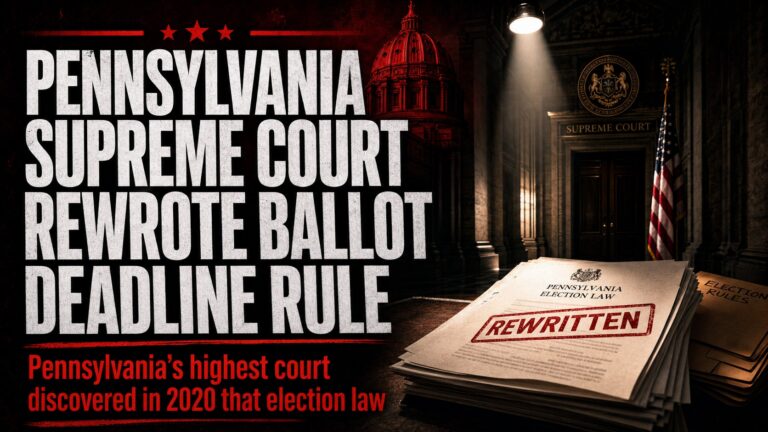
Established Fact
[Established Fact – Orders were issued; legislative authority was not invoked] The Pennsylvania Supreme Court, in a series of 2020 pre-election orders, extended mail ballot receipt deadlines (to November 6 for ballots postmarked by November 3), altered ballot-curing procedures, and modified signature-verification requirements – changes that were made by judicial order rather than by the legislature, which is the constitutionally designated authority for election law under Art. I, § 4 and the Electors Clause. Three of the seven Pennsylvania Supreme Court justices were elected with significant campaign contributions from groups with a documented partisan interest in the outcome of the election. This does not establish improper judicial conduct but creates an appearance-of-impartiality question that warrants examination under 28 U.S.C. § 455 principles.
Citations
PA Democratic Party v. Boockvar, https://www.scotusblog.com/wp-content/uploads/2020/09/1589ec07-66e0-485c-b9be-9f7a03e99643-1.pdf
Republican Party of Pennsylvania v. Boockvar US SCOTUS Cert Petition, https://www.supremecourt.gov/DocketPDF/20/20-542/162063/20201130140620945_RPP%20Opp%20Cert%20v.FINAL.pdf
John Roberts Sides with Liberal Justices Gateway Pundit, https://www.thegatewaypundit.com/2020/10/john-roberts-sides-liberal-judges-allows-pennsylvania-count-non-postmarked-ballots-three-days-election-day/