
Reasonable Inference
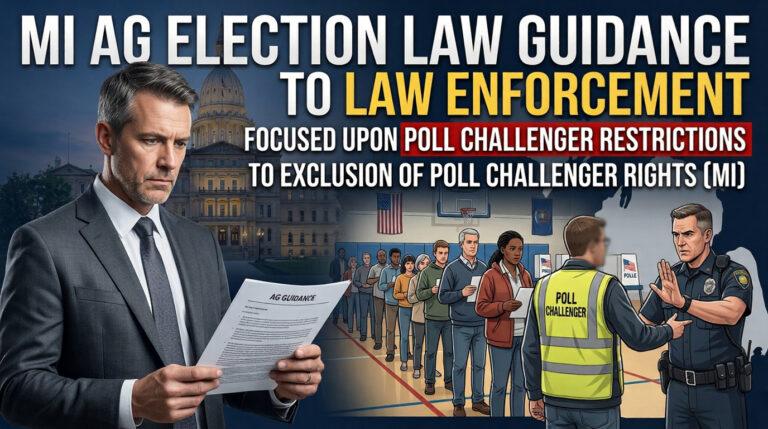
How the Attorney General’s own law-enforcement guidance treated poll challenger rights — the near-total 2020 silence on challenger rights, contrasted with the restriction-heavy challenger section of the 2024 guidance letter.
The threshold fact: there was no 2020 AG challenger guidance
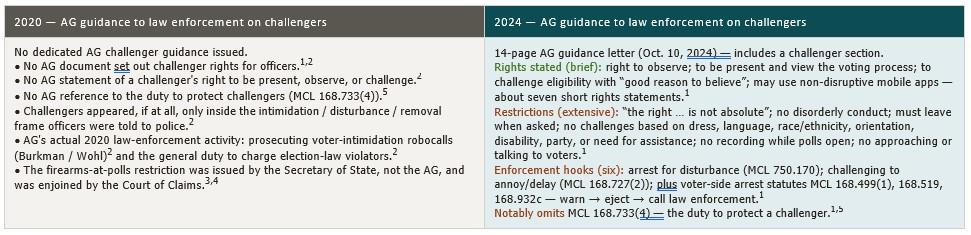
Analyzing what the Attorney General told law enforcement about poll challengers in 2020 runs into a basic finding: the AG issued no dedicated election-day guidance to law enforcement on poll challengers in 2020. There was no 2020 equivalent of the 14-page guidance letter the AG would later issue in October 2024.1 In 2020 the AG’s law-enforcement-facing footprint was confined to a narrow enforcement posture — prosecuting voter intimidation (the Burkman / Wohl robocall charges announced Oct. 1, 2020),2 backing the firearms posture at the polls (an open-carry restriction that was actually issued by the Secretary of State, not the AG, and was later enjoined),3,4 and the general statutory duty of prosecutors to charge election-law violators.2 Affirmative poll-challenger rights were neither stated nor protected in any AG law-enforcement material that year.
Measured strictly against the Attorney General's own guidance to law enforcement, challenger rights were emphasized to the exclusion of — indeed, to the near-total absence of — affirmative rights in 2020, because the AG addressed challengers only through the lens of intimidation, disturbance, and prosecution, never as participants holding rights. When the AG did finally speak to law enforcement about challengers in the 2024 letter, the treatment was real but lopsided: roughly seven brief rights statements against a far longer apparatus of prohibitions, expulsion triggers, and six separate arrest/enforcement hooks — while omitting the one statute (MCL 168.733(4)) that imposes a duty to protect challengers.[1] Across both cycles, the AG's law-enforcement guidance framed challengers primarily as potential disruptors to be warned, ejected, and prosecuted.
CORE FINDING
Side by side: AG law-enforcement guidance on challengers, 2020 vs. 2024
This compares only what the Attorney General placed before law enforcement — not Secretary of State / Bureau of Elections challenger manuals, which are a separate document set. The 2020 column reflects the absence of any dedicated AG challenger guidance; the 2024 column is drawn from the AG’s Oct. 10, 2024 law-enforcement guidance letter.1,2
Inside the 2024 AG letter: rights vs. restrictions on challengers
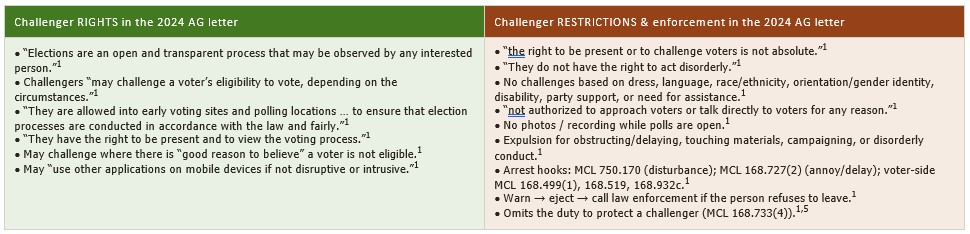
Because 2020 contains no AG challenger guidance to weigh, the only place the AG’s own balance can be measured is the 2024 letter. There, affirmative rights are present but compressed, while restrictions and enforcement mechanisms dominate the section in both length and operational detail.1
What this means for the “rights vs. restrictions” question
Confined strictly to the Attorney General’s guidance to law enforcement, the answer to whether challenger rights received balanced treatment is no — and the imbalance is starkest in 2020. In that cycle the AG provided officers with no affirmative statement of challenger rights at all; challengers entered the AG’s law-enforcement universe only as a category of person who might intimidate, disturb, or refuse to leave, and therefore be removed or charged.2 The affirmative-rights catalogue that did exist in 2020 lived in Secretary of State / Bureau of Elections challenger manuals — a separate document set the AG did not adopt or transmit to law enforcement.[2]
The 2024 letter is the first time the AG’s own guidance to law enforcement acknowledges challengers as rights-holders. Even there, the treatment tilts heavily toward restriction: the section opens by reminding officers that the right “is not absolute,” devotes most of its length to prohibitions and expulsion triggers, attaches six arrest/enforcement statutes, and omits the single provision — MCL 168.733(4) — that would have told officers they also have a duty to protect challengers in the discharge of their duties.[1,5] The net trajectory across both cycles is an AG posture that treats challenger rights as, at most, a brief preface to a detailed enforcement-and-removal framework. In this light, it is difficult not to include that the MI AG has sought to encourage conflicts between poll challengers aware of their rights and poll workers uncomfortable with such oversight. The net effect is to discourage oversight of election operations by poll challengers.
Citations
- Michigan of Attorney General, “Law Enforcement Guidance” (Oct. 10, 2024) — 14-page guidance letter, challenger section, https://www.michigan.gov/ag/-/media/Project/Websites/AG/releases/2024/October/Law-Enforcement-Guidance-101024-Final.pdf
- Campaign Legal Center, “Protecting Michigan Voters from Voter Intimidation” (Oct. 16, 2020) — documents AG’s 2020 enforcement posture (Burkman/Wohl charges; reliance on law enforcement for removal); challenger rules attributed to the Bureau of Elections, not the AG, https://campaignlegal.org/sites/default/files/2020-10/IntimidationMemo-MI-r2.pdf
- Michigan of State, “Benson announces ban of open carry of a firearm at voting locations” (Oct. 16, 2020) — firearms directive issued by the Secretary of State, https://www.michigan.gov/sos/resources/news/2020/10/16/benson-announces-ban-of-open-carry-of-a-firearm-at-voting-locations
- Bridge Michigan, “Judge: Michigan can’t ban open carry of guns on Election Day” (Oct. 27, 2020) — Court of Claims enjoins the 2020 open-carry directive, https://bridgemi.com/michigan-government/judge-michigan-cant-ban-open-carry-guns-election-day/
- Brennan Center for Justice, “The Michigan Election Interference Handbook” — MCL 733(4) duty to “protect a challenger” and prohibition on intimidating challengers, https://www.brennancenter.org/our-work/research-reports/michigan-election-interference-handbook