
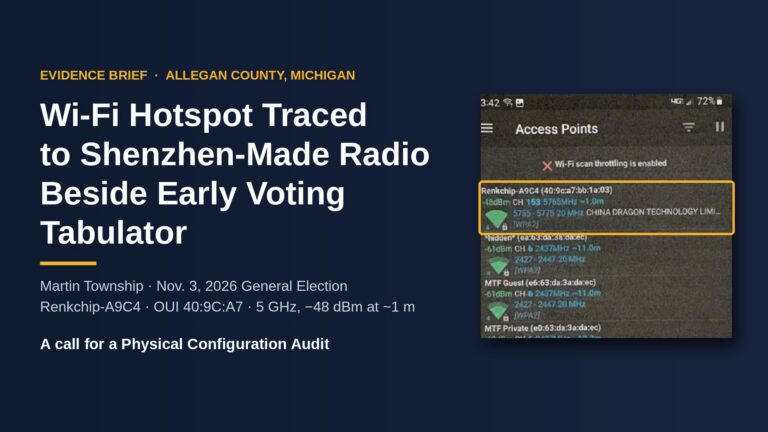
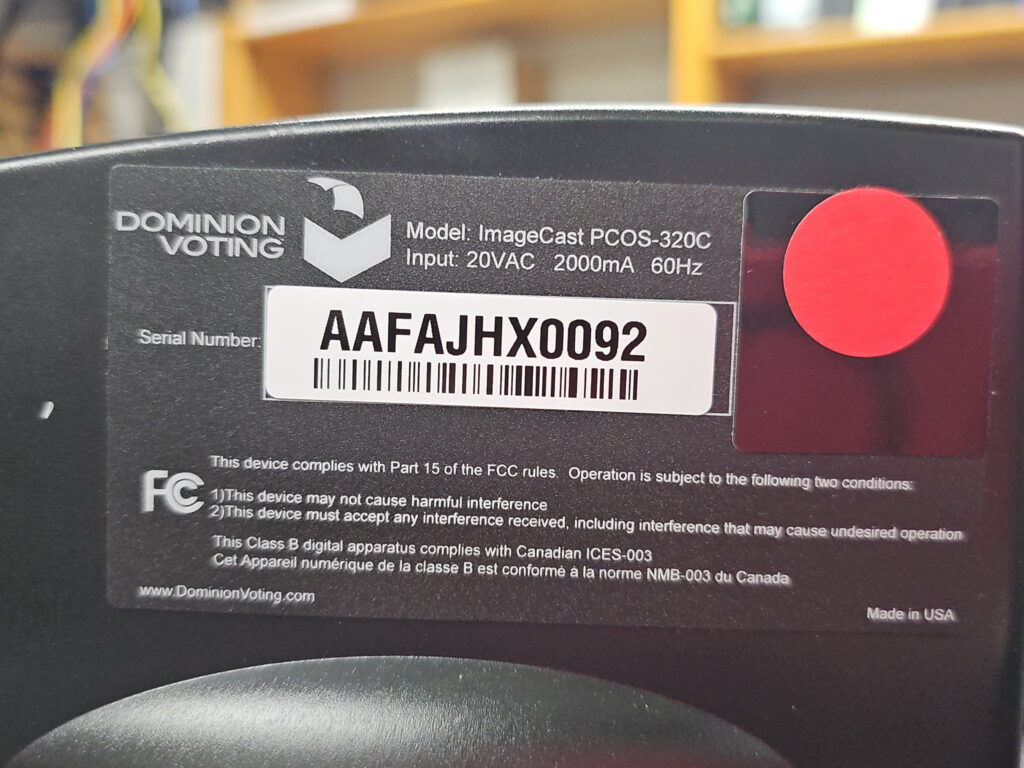
During early voting for the November 3, 2026 General Election, a poll worker named Tom Thornton[1] used an Android Wi-Fi analyzer to record a persistent 5 GHz wireless hotspot inside the Martin Township early voting site. The hotspot’s hardware address carries a manufacturer prefix registered to China Dragon Technology Limited of Shenzhen, China.[2] By walking the room and watching the signal strength, Tom traced the likely source to the site’s ImageCast Precinct (ICP) tabulator, model PCOS-320C, serial AAFAJHX0092. The signal was strongest within about one meter of the tabulator, and it was still broadcasting after the tabulator was moved into locked storage at the end of the day.
The federal certification for the voting system in use states that it uses no wireless technology, LAN or WAN.[3],[4] Michigan tells the public that its machines “cannot be connected to the internet while ballots are being tabulated.”[5] A live radio inside, attached to, or traveling with a tabulator during early voting would therefore be either (a) a configuration the state and federal certifications do not cover, or (b) an uncontrolled consumer device kept with certified election equipment. Either way it calls for a physical answer, not a press statement. On the facts recorded so far, a violation of the early voting equipment-security requirement in MCL 168.720j(10) is probable. The Allegan County Sheriff’s Office has been notified and is investigating, and the Clerk and State Representative Rachelle Smit have each requested a Physical Configuration Audit.
The model matters. The ImageCast Precinct is built in two otherwise identical versions: the PCOS-320C, with no internal modem, and the PCOS-321C, which adds an internal dial-up modem and supports external wireless modems. Michigan’s own contract with Dominion says the communications capability is the only functional difference between them. A label reading “PCOS-320C” therefore does not by itself establish what is inside the case, or what is attached to it. Only a physical inspection can. The finding also arises against a statewide concern about the provenance of tabulators assigned to early voting and absentee counting boards, which tabulate before polls close.
This brief sets out what was recorded, what the identifiers show, why the finding matters, and how a Physical Configuration Audit (PCA) of the tabulator and its accessories can settle it. It separates four kinds of support throughout:
Label | Meaning in this brief |
Public record | Government, laboratory, statutory, or registry source (footnoted) |
Field observation | Tom’s screenshots and annotations; not yet sworn or authenticated |
Inference | A conclusion drawn from the records and observations; stated with its basis |
Risk analysis | What a live radio path would make possible; not a claim that it occurred |
Status: Investigation and Audit Requests
- Law enforcement. The Allegan County Sheriff’s Office has been notified of this finding and is conducting an investigation.
- Clerk request to CISA. The [Martin Township / Allegan County — confirm] Clerk has asked the Cybersecurity and Infrastructure Security Agency (CISA) to conduct a Physical Configuration Audit of the equipment at issue.
- Legislative request. State Representative Rachelle Smit has also requested a Physical Configuration Audit.
- Statutory assessment. On the facts recorded to date, a violation of MCL 168.720j(10), the early voting equipment-security requirement, is probable.
- Results-secrecy exposure. Under MCL 168.720j(14), early voting results may not be generated or reported until after 8 p.m. on Election Day. Remote access to the tabulator before then would compromise that requirement.
The Detection
Who Detected It And How
Field observation. Tom served as a poll worker at the Martin Township early voting site. After a conversation with another poll worker, he sought to prove to himself that there was no internet connection. He installed a Wi-Fi analyzer app on his Android phone and captured the “Access Points” screen at intervals over several days. He annotated each printed capture by hand. The app lists each network’s name (SSID), hardware address (BSSID), received signal strength in dBm, channel and frequency, security mode, the vendor registered for the address prefix, and an estimated distance.
Two notes on the method should be stated up front. The app’s distance figures are calculated from the time the phone “pings” for a Wi-Fi source and the response from the source. The “ping” does not request or grant access much as any phone that has Wi-Fi enabled is constantly “pinging” for available hotspots but cannot connect unless the password is accepted. The distance figures are approximations, not measurements. Each screen also shows that Android “Wi-Fi scan throttling” was enabled, which limits how often the phone refreshes its scan. Neither limit affects the identifiers (SSID, BSSID, vendor, channel), which are read directly from the radio’s broadcast beacons.
What the Captures Show
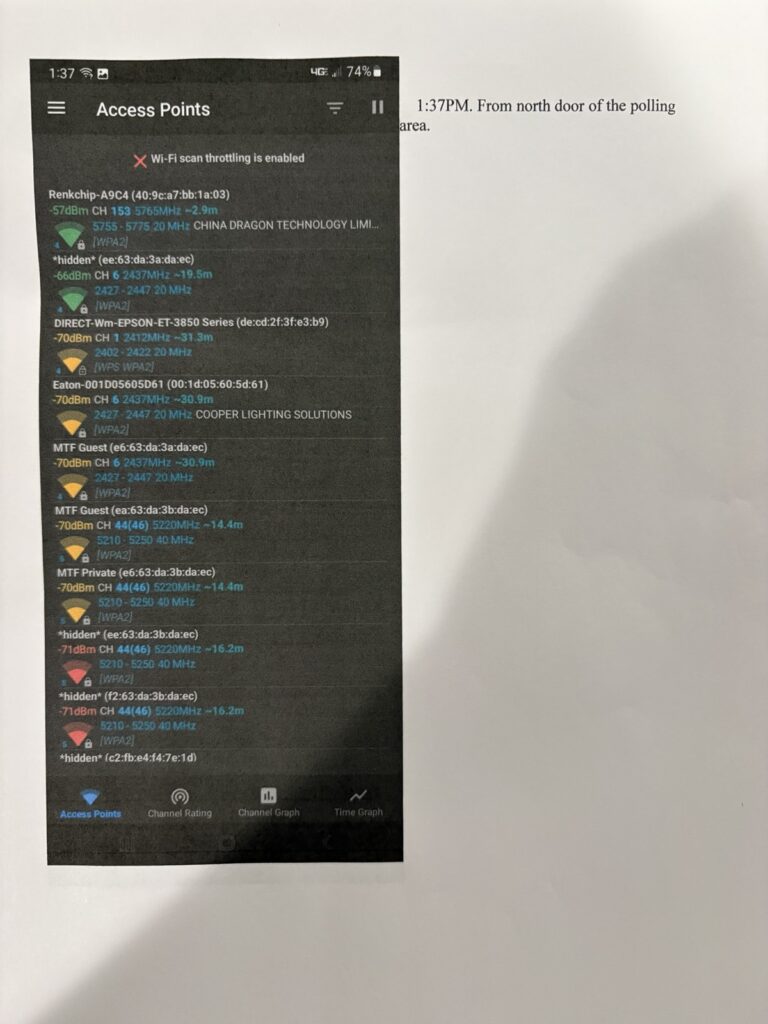
Field observation. The Observed Device appears with the same SSID, BSSID, channel, and encryption in every capture in which it is listed:
Exh. | Time / date shown | Signal | Est. distance | Tom’s annotation and context |
A-1 | 11:33 (date not on screen) | ≈ −59 dBm | ~3.7 m | “First capture made after installing and starting app.” “Distance is correct.” |
A-2 | 1:37 PM | −57 dBm | ~2.9 m | “From north door of the polling area.” |
A-3 | 3:42 PM | −48 dBm | ~1.0 m | Strongest reading; no annotation. |
A-4 | 4:00 PM, 10/31/2026 | −48 dBm | ~1.0 m | “4PM 10/31/2026.” |
A-5 | 4:24 PM | −80 dBm | ~41.4 m | “Tabulator had been moved to locked storage.” “This is the tabulator signal. Note distance is correct. Signal capture from second parking spot (‘Firemen only’).” |
A-6 | 9:28 AM, 11/02/2026 | Not in visible list | — | “Capture made 9:28 AM 11/02/2026 from north side of offices at Martin Township.” No early voting that day. The list is cut off, so absence from the full scan is not established. |
A-7 | 6:25 AM, 11/03/2026 | −54 dBm | ~2.1 m | Election Day, before polls opened. |
Inference. The time sequence and the phone’s falling battery level (78% → 74% → 72% → 72% → 71%) indicate that A-1 through A-5 were taken on one day, October 31, 2026. The original image files and their metadata will confirm this.
What the Signal Tracks to the ICP
Inference from field observation. Four features of the captures point to the tabulator, or something stored and moved with it, as the source:
- Proximity. The signal climbed from about −59 dBm to −48 dBm as Tom moved closer to the tabulator during the voting day, peaking at an estimated one meter.
- It moved with the tabulator. At 4:24 PM, after the tabulator had been moved to locked storage, the signal was still present from the parking lot at −80 dBm. The hotspot did not shut off when voting stopped for the day. Whatever produced it stayed powered and went where the tabulator went.
- Stable identity. The SSID, BSSID, and channel never changed across five days of captures. That rules out a passing phone or a visitor’s device.
- Election Day presence. At 6:25 AM on November 3, before polls opened, the same radio was again within about two meters of Tom. That means it was powered at the start of the day the early voting tabulators were to be closed out.
The other networks in the captures (“MTF Private,” “MTF Guest,” and hidden networks on Ubiquiti and related addresses) belong to the Martin Township Fire Department’s building Wi-Fi. They behave like fixed infrastructure and are not at issue here.
Identifying the Radio
The Hardware Address Points to Shenzhen, China
Public record. The first three bytes of a Wi-Fi hardware address (the OUI) are assigned by the IEEE to a specific manufacturer. The prefix 40:9C:A7 is registered to China Dragon Technology Limited, B4 Building, No. 3 First Industrial Zone, Nanpu Road, Baoan District, Shenzhen, China. The block was registered on September 20, 2023.[6] The Wi-Fi analyzer’s vendor field shows the same name on every capture.
Public record. Dominion tabulators photographed elsewhere in Michigan, including ImageCast Precinct 2 units in Barry County and in Saugatuck in Allegan County, carry network addresses beginning C4:19:8B, a prefix registered to Dominion Voting Systems Corporation of Toronto.[7],[8] The Observed Device does not use Dominion’s prefix. If it is physically part of the tabulator, it is a third-party radio, not a Dominion network interface.
The Network Name Points to a Wireless Display Module
Public record. The SSID format “RENKCHIP-XXXX” is the factory-default hotspot of Renkchip-brand wireless HDMI display adapters. The published manual tells users to join that hotspot with the password 12345678 and configure the device at 192.168.49.1. The adapter runs on 2.4 GHz and 5 GHz, supports AirPlay, Miracast, and DLNA, and can be joined to a router, after which it reconnects automatically whenever it is powered on.[9]
Inference. This is a general-purpose, two-way Wi-Fi radio with a known default password. It is not a passive or receive-only part. If it is connected to a tabulator’s video, USB, or internal bus, it gives an outside party a radio path to that unit. Even if it is not connected, a factory-default hotspot broadcasting next to a tabulator, and near the early voting pollbook laptops that are connected to the internet, is a security lapse in itself.[10]
Conflict with Certification
Public record. The EAC Scope of Certification for Democracy Suite 5.20, which lists the ImageCast Precinct PCOS-320C among its certified hardware, answers “NO” to Wide Area Network use of modems, Wide Area Network use of wireless, and Local Area Network use of wireless. It also states that “[a]ny use, configuration changes, revision changes, additions or subtractions from the described system are not included in this evaluation.”[11] The test laboratory marked the VVSG wireless-communications section not applicable because “[n]o wireless technology is utilized in this system.”[12] The Board of State Canvassers certified Democracy Suite 5.20 for Michigan on February 21, 2025.[13] Under MCL 168.795a(6), any change to an approved system must go back to the Board for approval.[14]
Public record. The ImageCast Precinct can be built and configured with communications hardware. Michigan’s voting-system contract with Dominion describes a modification that “adds dial-up and wireless results transmission capabilities to the ImageCast Precinct,” states that “[t]he ImageCast Precinct model 321-C contains an internal dial-up modem; wireless 3G modems are available as external devices,” and says the 321C uses a different Device Configuration File to enable transmission, with “[n]o other functional differences” between the two versions.[15] The voting system test laboratory’s Democracy Suite 5.20 test report, Revision 05, listed the ICP hardware as “PCOS-320A and PCOS-320C, PCOS-321C (with internal dialup modem)”; Revision 06 and the current EAC scope list only the PCOS-320A and PCOS-320C.[16],[17] A New Mexico test report for Democracy Suite 5.17S verified results transmission from ICP units through the PCOS-321C internal modem and through an external MultiTech cellular modem.[18] Because the same tabulator family exists in non-modem, internal-modem, and external-modem configurations, and the difference lies in internal hardware, attached devices, and the configuration file, a unit’s model label does not tell you which configuration it is in. Only a physical inspection can.
Public record. The Martin Township unit’s serial prefix, AAFAJ, matches the prefix of the PCOS-320C units the laboratory used in federal certification testing of earlier Democracy Suite releases (for example, AAFAJFM0061 and AAFAJFN0030).[19]
Inference. The unit appears to come from the same production line as the tested PCOS-320C baseline. That makes a Physical Configuration Audit straightforward: the internal boards, ports, attached devices, firmware hash (ICP Application 5.20.2.3), and Device Configuration File can be compared directly against the certified PCOS-320C configuration.
Inference. If the Renkchip radio is inside or connected to the Martin Township ICP, that unit is running in a configuration outside its EAC certification and outside the configuration the Board approved. That would bring it under MCL 168.795a(9).
Internal record (precedent). Communications hardware in Michigan tabulators is not new, and certificates have not been a reliable guide to it. A 2005–2007 Sequoia Voting Systems email archive shows that Michigan’s 2006 certification testing of the Sequoia system covered “the Insight transmitting the results back to WinEDS,” because “Michigan has no edges; it is only Insights and WinEDS.” In Ingham County “all Insights are equipped with a modem”; nine Insights in seven jurisdictions dialed into the county as “the one and only tally site,” and an Insight with a modem “will automatically try to dial and send the cartridge information when the polls are closed.”[20] In June 2007 Colorado’s Secretary of State ran a hash compare on Sequoia Edge2plus firmware and found “over 300 files in discrepancy list, half are on the trusted build files, but not on working copy of machine.”[21]
Inference. In both cases, field records and hash comparison revealed what the model number and certificate did not. The same reasoning supports a Physical Configuration Audit of the Martin Township ICP.
Probable Violation of MCL 168.720j(10) - A Felony
Public record. MCL 168.720j(10) requires the municipal clerk or early voting site supervisor, during the early voting period, to “take all necessary steps to secure the electronic voting equipment, ballot containers, blank ballots, and other election materials after the close of early voting each day until the opening of early voting on the following day, in accordance with guidance provided by the secretary of state.” Subsection (8)(g) separately requires each tabulator to be secured in a locked room.[22]
Inference. Capture A-5 shows the Observed Device still broadcasting from the area where the tabulator was locked up after voting ended for the day. A two-way Wi-Fi hotspot with a published factory-default password, left powered next to a tabulator overnight, gives anyone within radio range a way to reach it that a locked door does not stop. Locking the room satisfies (8)(g), but it does not amount to “all necessary steps to secure” the equipment under (10) while an uncontrolled radio stays live beside it. On the facts recorded so far, a violation of MCL 168.720j(10) is probable. If the radio is part of the tabulator (Explanation A), the unit would also fall outside the “authorized” equipment required by MCL 168.720j(1). The Physical Configuration Audit and the Sheriff’s investigation will determine which explanation applies. The equipment-security failure also directly threatens MCL 168.720j(14). That subsection provides that “[e]arly voting results must not be generated or reported until after 8 p.m. on election day,” and makes intentional disclosure of an early voting result before 8 p.m. a felony.[23] Early voting tallies build up inside the tabulator over nine or more days. Any remote access to that tabulator before 8 p.m. on Election Day would therefore compromise the protection subsection is meant to provide, because whoever had the access could read results that the law keeps sealed until the polls close. The live radio recorded at Martin Township, including at 6:25 AM on Election Day (A-7), created that exposure. Whether anyone actually used it to reach the tabulator or obtain results is a question for the Physical Configuration Audit, the passive RF survey, and the Sheriff’s investigation.
Statewide Context: Provenance of Tabulators Used Before Polls Close
Field observation. The Martin Township early voting tabulator is an ImageCast Precinct, model PCOS-320C, serial AAFAJHX0092, with a manufacturer’s label reading “Made in USA”. The country-of-origin concern described below involves a different model, the ImageCast Precinct 2, and does not apply to this unit’s label. It is set out here because it concerns the same category of equipment, tabulators assigned to pre-close tabulation, and supports the statewide inventory requested below.
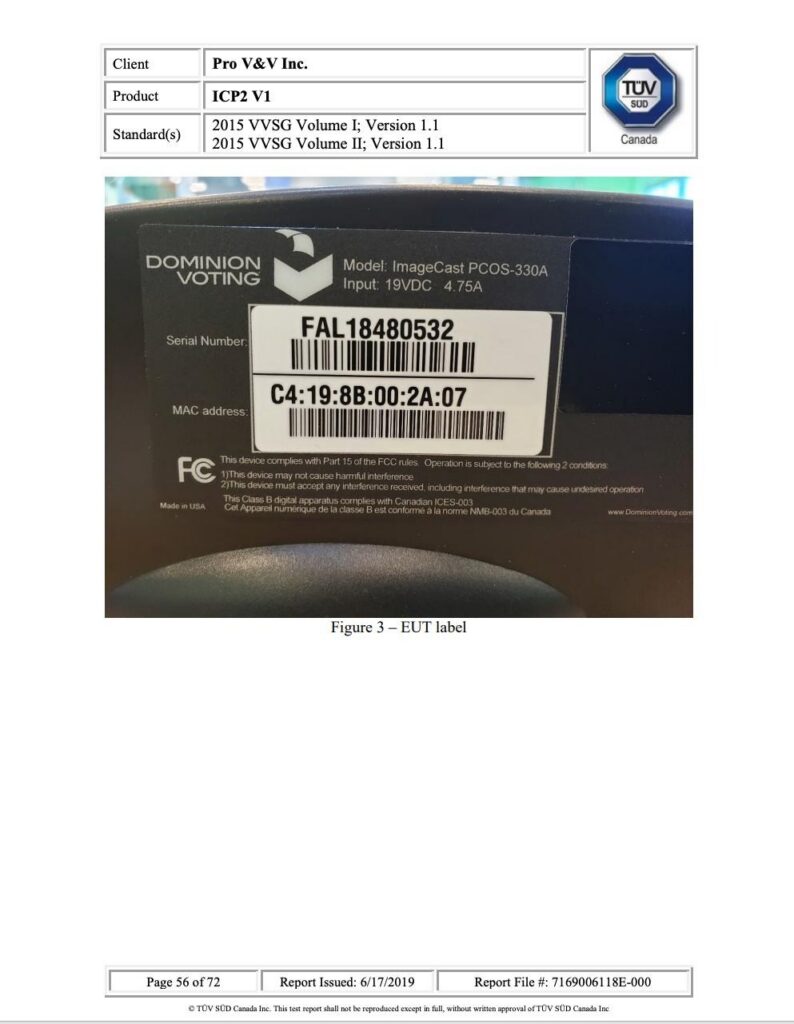
Public record. The ICP2 that was photographed during certification testing for the federally accredited laboratory, serial FAL18480532, carries a manufacturer’s label reading “Made in USA.”[24] On January 9, 2020, Dominion’s CEO told the Committee on House Administration: “Our products—our tabulated products have always been manufactured in the United States.”[25]
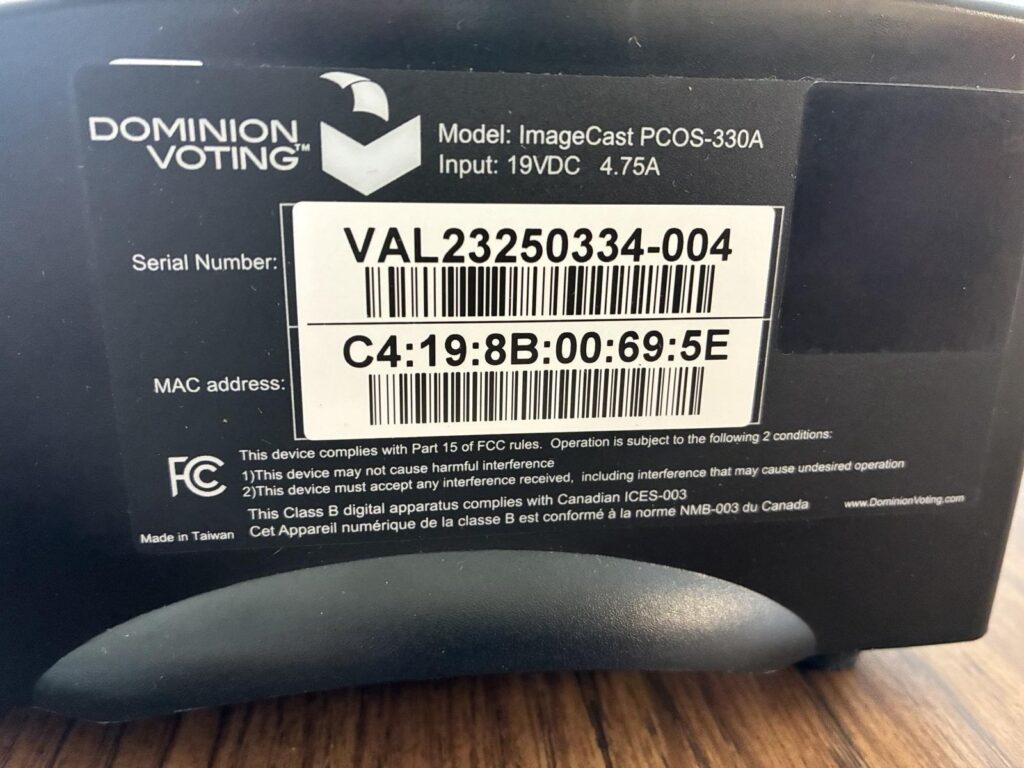
Field observation. ICP2 units of the same model (ImageCast PCOS-330A) with serial numbers beginning “VAL” and labels reading “Made in Taiwan” have been photographed in Michigan. They include VAL23250334-004 (MAC C4:19:8B:00:69:5E) in Barry County, photographed by Barry County Sheriff Dar Leaf, and VAL24280001-005 (MAC C4:19:8B:00:6B:E5) in Saugatuck, photographed by Allegan County Clerk Bob Genetski.[26] Apart from the serial and the country of origin, these labels match the tested unit’s “Made in USA” label in layout, including the FCC Part 15 and Canadian ICES-003 statements. ECB field reports indicate that this “Made in Taiwan” ICP2 configuration is found in jurisdictions all across Michigan and is typically used exclusively for early voting or for absent voter counting boards (AVCBs).
Public record. Both of those uses tabulate ballots before the polls close on Election Day. Early voting runs for at least nine days, and ballots are fed into the tabulator as they are cast. Cities and townships with at least 5,000 residents may run an AVCB that processes and tabulates absentee ballots on any of the eight days before an election, and any city or township may do so on the Monday before.[27] In both settings the tallies sit inside the tabulator for days, and results may not be generated or reported until polls close.[28]
Inference. Read as year and week of manufacture, the Michigan serials date to mid-2023 (VAL2325) and mid-2024 (VAL2428). That is the period when clerks were buying dedicated early voting tabulators after Proposal 2 of 2022; Grosse Ile Township, for example, approved the purchase of an ICP2 for early voting in July 2023.[29] Pro V&V’s equipment review in Maricopa County shows ICP2 production moving from FAL serials (2018–2019) to VAL serials (2021 onward), and the dash suffix on VAL units (“-004,” “-005”) appears to track a production configuration that no public change order fully defines.[30] On this reading, the units bought for pre-close tabulation came from a different production source, and possibly a different build, than the unit photographed during testing. The serial reading needs to be confirmed against the manufacturer’s serial-number schema.
Risk analysis. The concern is where these units are concentrated. Units whose origin and production configuration differ from the tested baseline are assigned to the pre-close window: tallies held for days, results that must stay secret until 8 p.m., and ballots that a recount cannot tell apart. A unit-level difference from the tested hardware is exactly what a Physical Configuration Audit is built to find. Saugatuck, where one of the “Made in Taiwan” units was photographed, is also in Allegan County.
Unresolved. Where the VAL-series units were made and by whom; whether that facility was disclosed to the EAC and audited; whether the ICP2 units tested for Democracy Suite 5.17 and 5.20 were FAL-series or VAL-series; and what the newer production configurations changed.[31]
Why Remote Access Before Polls Close Matters
Risk analysis. The radio’s existence does not prove that anyone used it. The point of this section is that a live radio path into a tabulator before polls close on Election Day would defeat the controls Michigan relies on to keep early voting honest. The capabilities below are what such a path would make possible.
Remote Manipulation of Vote Tallies
A two-way link to a tabulator during the nine days of early voting is an opening to change the stored tally, the ballot images, or the audit log before the closing inspectors print the results tape. Early voting tabulators stay in use, and stay powered or in storage, across many days.[32],[33] That gives far more exposure than a single Election Day.
Privileged Access to Early Results
Michigan law says early voting results “must not be generated or reported until after 8 p.m. on election day.” Disclosing an early voting result before then is a felony.[34],[35] The Bureau of Elections states that “[n]o election results are accumulated or tallied during the early voting period.”[36] A radio path into the tabulator would let someone read the running tally anyway. That person would learn, days before anyone else, how early voting is breaking compared with turnout and vote projections. Any shortfall against those projections would show exactly how many votes would be needed, and where.
Injecting Ballots Assigned to Low-Propensity Voters
Early results compared with projections become far more dangerous because of how early voting sites are equipped. Under Bureau of Elections procedures:
- The Early Voting Electronic Pollbook (EV EPB) is “connected to the internet” with “a secure, live connection to the QVF,” and inspectors use it to “record every voter who votes at an early voting site and update their voting history in real time.”[37]
- An early voting site “may also use a ballot on demand (BOD) printer instead of having preprinted ballots.”[38]
- The nightly check is a reconciliation that compares “the cumulative number of voters in the EV EPB and the number of ballots cast according to the tabulator public counter.”[39]
Risk analysis. Put together, these features describe a low-detection path for ballot injection at an early voting site. Poll workers who are working without effective bipartisan oversight, and who have access to the EV EPB and a ballot-on-demand printer, could:
- Select registered voters in the Qualified Voter File who rarely vote and are unlikely to vote this time (low-propensity voters);
- Record those voters as early voters in the EV EPB, which updates the QVF in real time;
- Print a ballot of the correct style on the BOD printer, mark it, and feed it into the tabulator.
Every control described above would be satisfied. The pollbook count and the public counter would match. The voter’s history would show a vote. The ballot would be a real, printed, tabulated paper ballot sealed in an approved container. Early results obtained over a radio link would tell the operator how many such ballots were “needed” to close the gap against projections. The Bureau’s manual specifies a Democratic and a Republican inspector for the election-night closing of early voting tabulators.[40] It does not specify the same party balance for the daily staffing of the site. Staffing balance at Martin Township on each early voting day should be verified from the records.
Why a Recount Would Not Detect It
Inference from public record. A Michigan recount recounts the ballots in the precinct’s sealed ballot containers, and its recountability rules turn on seals and poll-book records.[41] Injected ballots of the kind described in 6.3 are genuine paper ballots, tabulated and sealed in the normal way, with a matching pollbook entry for each one. A recount would count them again and get the same total. A recount checks whether ballots were counted correctly. It does not check whether the person credited with each ballot actually came in and cast it.
Detecting injection requires voter-level evidence that a recount never looks at:
- EV EPB audit trails showing which user account checked in each voter, and when;
- BOD printer logs (ballot style, count, and time of every printed ballot), compared with EV EPB check-ins;
- Tabulator event logs and ballot-image timestamps, compared with check-in times;
- Surveillance video and door-access logs for the voting room and the storage room;
- A canvass of a sample of low-propensity voters credited with voting early at Martin Township, asking whether they actually voted there.
Federal Researchers Flagged Call-Back Risk in 2020
Internal record. Redacted 2020 emails between DARPA staff and Georgia Tech researchers describe the same concern.[42] On October 21, 2020, Georgia Tech’s Manos Antonakakis wrote that if election devices have “a single call back to the manufacturer (for an update or telemetry),” then “you have all election networks … that use these devices, and everyone ‘else’ that is interested in them.” Angelos Keromytis replied that “if the voting machines do ping back and are online while deployed/in use, that makes them interesting,” and Antonakakis answered, “Already running an AR job.” In August 2020 Antonakakis wrote that “there is a group that has successfully penetrated these networks,” which he understood to be “actual election networks” (emphasis in original).[43]
Inference. A live, two-way Wi-Fi radio beside a tabulator is the kind of outbound path those researchers treated as an at-scale exposure, because one device type that calls out can expose every jurisdiction that uses it. Whether the Observed Device ever associated with a network or sent traffic is therefore a question to answer in the RF survey.
Unresolved. The emails are redacted, the networks are not identified, and attribution was preliminary. A reference to “Libraries WiFi” in the same thread concerned the voter registration database, not voting machines. The emails do not concern Martin Township or the ImageCast Precinct.
Possible Explanations and Hot to Tell Them Apart
Explanation | What it would mean | Test that resolves it |
A. Radio inside or connected to the ICP, its ballot box, cart, or case | Uncertified configuration; potential remote access path; MCL 168.795a(9) referral | Phase 3 internal inspection; board photos; radio FCC ID and chipset; firmware hash; Device Configuration File; confirm no internal or external modem |
B. Consumer Renkchip display adapter stored and moved with the tabulator but not connected to it | Equipment conforms, but a default-password hotspot was kept with certified equipment and near internet-connected EPBs | Phase 1 survey: move each item 15 m apart and see which one the signal follows; photograph and log the device |
C. Unrelated device that happened to share the storage area | No tabulator issue; storage practice question | Same as B; door-access and storage records |
Under every explanation, someone at the site powered and kept a Chinese-made radio next to the tabulator throughout early voting. The custodians should be able to say what it is, who brought it, and why it was there. Explanations B and C can be confirmed or ruled out without opening any seal.
Necessary Actions
The responsible authorities (the Martin Township Clerk, the Allegan County Clerk, the Michigan Department of State, the House Oversight Committee, and CISA, which the Clerk has asked to conduct the audit) should support the Allegan County Sheriff’s ongoing investigation and
- preserve the equipment and records now,
- identify the device broadcasting “Renkchip-A9C4” from 40:9c:a7:bb:1a:03,
- complete a Physical Configuration Audit of the Martin Township early voting ICP (PCOS-320C, serial AAFAJHX0092) and its accessories, confirming that it contains no internal modem and runs the certified PCOS-320C configuration, with findings classified as Conforms, Does Not Conform, or Indeterminate, and
- inventory the ImageCast Precinct and ImageCast Precinct 2 units assigned to early voting and absentee counting boards statewide. If the unit conforms and the radio is an unrelated accessory, that is a useful public assurance and a lesson about storage practice. If it does not conform, Michigan voters are owed that finding before the next election.
Because a violation of MCL 168.720j(10) is probable, these findings should also go to the Sheriff’s Office for its investigation.
References
[1] Trained as a Ground Radio Repairman in USMC 1972-1976 and worked 43 years as an electrician
[2] MAC Lookup, OUI 40:9C:A7, registered to China Dragon Technology Limited, B4 Building, No. 3 First Industrial Zone, Nanpu Road, Baoan District, Shenzhen 518100, CN (cited above). https://maclookup.app/macaddress/409ca7
[3] U.S. Election Assistance Commission, Certificate of Conformance and Scope of Certification, Democracy Suite 5.20, Cert. No. DVS- DemSuite5.20 (Feb. 4, 2025), networking table and scope limitation. https://www.eac.gov/sites/default/files/2026-10/DVS_5.20_Certificate_and_Scope_of_Conformance.pdf
[4] Pro V&V, Test Report TR-01-01-DVS-2023-01.06, Dominion Voting Systems D-Suite 5.20 (VVSG 1.0 §7.7: “No wireless technology is utilized in this system”; ICP firmware 5.20.2.3, hardware PCOS-320A and PCOS-320C). https://www.eac.gov/sites/default/files/2026-10/Dominion_Voting_Systems_D-Suite_5.20_Test_Report-Rev._06.pdf
[5] Michigan Department of State, Election Fact Center (“Machines cannot be connected to the internet while ballots are being tabulated”; “clerks and election workers will not see a running total of votes cast for candidates”). https://www.michigan.gov/sos/elections/election-fact-center
[6] MAC Lookup, OUI 40:9C:A7, registered to China Dragon Technology Limited, B4 Building, No. 3 First Industrial Zone, Nanpu Road, Baoan District, Shenzhen 518100, CN (cited above). https://maclookup.app/macaddress/409ca7
[7] MAC Lookup, OUI C4:19:8B, registered to Dominion Voting Systems Corporation, 215 Spadina Avenue, Toronto. https://maclookup.app/macaddress/c4198b
[8] Patrick Colbeck, Election Crime Bureau, Request for Investigation into Country of Origin for Electronic Voting Systems (referral to the U.S. Department of Justice, Oct. 6, 2026), citing Pro V&V’s 2025 Technology Equipment Review of Maricopa County’s Democracy Suite 5.17 equipment (23 FAL, 1 NAL, and 31 VAL ICP2 serials) and EAC Engineering Change Order 100843 (Apr. 18, 2022). Submitted by ECB; ElectionCrimeBureau.com. https://electioncrimebureau.com/
[9] Manuals+, Q1 Wireless Display Adapter User Manual (default hotspot “RENKCHIP-XXXX”, password 12345678, setup page 192.168.49.1; 2.4 GHz and 5 GHz; AirPlay, Miracast, DLNA; can be joined to a router and auto-reconnects on power-up). https://manuals.plus/m/26bd74ecf80fb7fe54a12f4dfd7ed10892a281886114eefd3e9a9515d40d2b6a
[10] Michigan Bureau of Elections, Election Officials’ Manual, Chapter 11: Early Voting, §§ VII–VIII (EV EPB has “a secure, live connection to the QVF” and is “connected to the internet”; inspectors “record every voter who votes at an early voting site and update their voting history in real time”; sites may use a ballot-on-demand printer; daily reconciliation compares the EV EPB count with the tabulator public counter; “No election results are accumulated or tallied during the early voting period”). https://www.michigan.gov/sos/-/media/Project/Websites/sos/01mcalpine/Early-Voting.pdf?rev=1117bc2fc32b4265b4ce14258126f07c&hash=3D7E75AACE549A4861D3756CEC2EB4F5
[11] U.S. Election Assistance Commission, Certificate of Conformance and Scope of Certification, Democracy Suite 5.20, Cert. No. DVS- DemSuite5.20 (cited above). https://www.eac.gov/sites/default/files/2026-10/DVS_5.20_Certificate_and_Scope_of_Conformance.pdf
[12] Pro V&V, Test Report TR-01-01-DVS-2023-01.06, Dominion Voting Systems D-Suite 5.20 (cited above). https://www.eac.gov/sites/default/files/2026-10/Dominion_Voting_Systems_D-Suite_5.20_Test_Report-Rev._06.pdf
[13] Michigan Board of State Canvassers, Signed Minutes, Feb. 21, 2025 (certifying Dominion Democracy Suite 5.20 for use in Michigan). https://www.michigan.gov/sos/-/media/Project/Websites/sos/BSC-Meeting-Minutes/2025/February-21-2025-BSC-Signed-Meeting-Minutes.pdf
[14] MCL 168.795a(6) (any improvement or change to an approved electronic voting system must be submitted to the Board of State Canvassers) and (9) (disapproval). https://www.legislature.mi.gov/Laws/MCL?objectName=mcl-168-795a
[15] State of Michigan, Contract No. 071B7700117 with Dominion Voting Systems (Democracy Suite 5.0-S modification adds “dial-up and wireless results transmission capabilities to the ImageCast Precinct”; “The ImageCast Precinct model 321-C contains an internal dial-up modem; wireless 3G modems are available as external devices”). https://www.michigan.gov/-/media/Project/Websites/dtmb/Procurement/Contracts/MiDEAL-Media/008/7700117.pdf?rev=3ef03b2a979f41b583e601b15eec60e2
[16] Pro V&V, Test Report for EAC 2005 VVSG Certification Testing, Dominion D-Suite 5.20, Rev. 05 (ICP firmware 5.20.2.3; hardware “PCOS-320A and PCOS-320C, PCOS-321C (with internal dialup modem)”). https://www.eac.gov/sites/default/files/2025-02/Dominion%20Voting%20Systems%20D-Suite%205.20%20Test%20Report-Rev.%2005.pdf
[17] Pro V&V, Test Report TR-01-01-DVS-2023-01.06, Dominion Voting Systems D-Suite 5.20 (VVSG 1.0 §7.7: “No wireless technology is utilized in this system”; ICP firmware 5.20.2.3, hardware PCOS-320A and PCOS-320C). https://www.eac.gov/sites/default/files/2026-10/Dominion_Voting_Systems_D-Suite_5.20_Test_Report-Rev._06.pdf
[18] Pro V&V, Test Report, Dominion D-Suite 5.17S (New Mexico), documenting results transmission from ICP units via the PCOS-321C internal dial-up modem and an external MultiTech cellular modem, and from ICP2 units via external USB modems, to the ImageCast Listener. https://www.sos.nm.gov/wp-content/uploads/2025/07/DVS-D-Suite-5.17S-VSTL-Report.pdf
[19] Pro V&V, Test Report TR-01-01-DVS-2017-02.01 Rev. B, Dominion D-Suite 5.5 (ImageCast Precinct Optical Scanner PCOS-320C, serials AAFAJFM0061, AAFAJFN0030, AAFAJGI6764, AAFAJEL0352). https://www.eac.gov/sites/default/files/voting_system/files/Dominion_Voting_Systems_D-Suite_5.5_Test_Report_Rev_B.pdf
[20] Sequoia Voting Systems email archive (mailbox of Sequoia staff member Chris York, 2005–2007; Aid4Mail export dated June 2, 2021; unauthenticated): Raymond Bryan to Chris York, “Michigan Certification Testing” (May 30, 2006), Certifications/Michigan/2006/53668dd56e21b86e6a0e1eeefc303489.pdf; Ingham County Insight modem correspondence (Oct. 3, 2006), Inbox/414c27268ae48ca9ccc105b98396d5d6.pdf and Inbox/0c324b931922cefeebf1be391e80d132.pdf. https://www.dropbox.com/scl/fo/061i5n3s43q2lv5ly2b1z/AClpXjDvDjKk71vemgb2-tA?rlkey=a9uhftp7ghjxrzfyuxrplrr7q&dl=0
[21] John Gardner, Colorado Secretary of State, “Status Update on trusted build and issues” (June 15, 2007) (Edge 2 Plus firmware row), same archive, Certifications/Colorado/2007/05a7b40591c0c0717eb2ba8c919cdd08.pdf. https://www.dropbox.com/scl/fo/061i5n3s43q2lv5ly2b1z/AClpXjDvDjKk71vemgb2-tA?rlkey=a9uhftp7ghjxrzfyuxrplrr7q&dl=0
[22] MCL 168.720j(1), (8)(g), (10), and (14). https://www.legislature.mi.gov/Laws/MCL?objectName=mcl-168-720j
[23] MCL 168.720j(1), (8)(g), (10), and (14). https://www.legislature.mi.gov/Laws/MCL?objectName=mcl-168-720j
[24] TÜV SÜD Canada Inc., EMC/EMI Test Report No. 7169006118E-000 for Pro V&V, “ICP2 V1,” 2015 VVSG Vol. I & II v1.1 (issued June 17, 2019), p. 56, Figure 3 – EUT label (Model ImageCast PCOS-330A; Serial FAL18480532; MAC C4:19:8B:00:2A:07; “Made in USA”). https://www.eac.gov/sites/default/files/voting_system/files/Attachment_A-2_Report_File_7169006118E-00.pdf
[25] Committee on House Administration, Hearing, “2020 Election Security—Perspectives from Voting System Vendors and Experts” (Jan. 9, 2020), testimony of John Poulos, President and CEO, Dominion Voting Systems (transcript). https://www.congress.gov/event/116th-congress/house-event/LC65587/text
[26] Patrick Colbeck, Election Crime Bureau, Request for Investigation into Country of Origin for Electronic Voting Systems (referral to the U.S. Department of Justice, Oct. 6, 2026), citing Pro V&V’s 2025 Technology Equipment Review of Maricopa County’s Democracy Suite 5.17 equipment (23 FAL, 1 NAL, and 31 VAL ICP2 serials) and EAC Engineering Change Order 100843 (Apr. 18, 2022). Submitted by ECB; ElectionCrimeBureau.com. https://electioncrimebureau.com/
[27] Michigan Department of State, FAQ: Elections and Voting (AVCBs in cities and townships of 5,000 or more may “process and tabulate absentee ballots during any of the eight days before an election”; any city or township may do so on the Monday before). https://www.michigan.gov/sos/faqs/elections-and-campaign-finance/elections-and-voting
[28] MCL 168.720j(14) (cited above) and Michigan Department of State, Election Fact Center (cited above). https://www.legislature.mi.gov/Laws/MCL?objectName=mcl-168-720j
[29] Township of Grosse Ile, Board agenda item, “Early Voting Tabulator and Ballot Box” (July 24, 2023) (approving purchase of an ImageCast Precinct 2 tabulator from Dominion for $6,450 following passage of Proposal 2022-2). https://grosseile.civicweb.net/document/46889/
[30] Patrick Colbeck, Election Crime Bureau, Request for Investigation into Country of Origin for Electronic Voting Systems (cited above), findings 17 and 19–20 (Maricopa FAL/NAL/VAL serials; ECO 100843 and Production Configuration 4; no public ECO for Configuration 5). https://electioncrimebureau.com/
[31] Patrick Colbeck, Election Crime Bureau, Request for Investigation into Country of Origin for Electronic Voting Systems (cited above), finding 21 and Part VI. https://electioncrimebureau.com/
[32] MCL 168.720j(8)(g), (10), (11)(b), and (14) (tabulators secured in a locked room; equipment secured each night; totals generated after polls close; “Early voting results must not be generated or reported until after 8 p.m. on election day”; intentional disclosure is a felony). https://www.legislature.mi.gov/Laws/MCL?objectName=mcl-168-720j
[33] Michigan Bureau of Elections, Election Officials’ Manual, Chapter 11: Early Voting, §§ VII–VIII (cited above). https://www.michigan.gov/sos/-/media/Project/Websites/sos/01mcalpine/Early-Voting.pdf?rev=1117bc2fc32b4265b4ce14258126f07c&hash=3D7E75AACE549A4861D3756CEC2EB4F5
[34] MCL 168.720j(8)(g) (cited above). https://www.legislature.mi.gov/Laws/MCL?objectName=mcl-168-720j
[35] MCL 777.11d (sentencing guidelines listing MCL 168.720j(14), “Disclosing an election result from an early voting site before election day,” as a Class E public-trust felony, 5-year statutory maximum). https://legislature.mi.gov/Laws/MCL?objectName=MCL-777-11D
[36] Michigan Bureau of Elections, Election Officials’ Manual, Chapter 11: Early Voting, §§ VII–VIII (cited above). https://www.michigan.gov/sos/-/media/Project/Websites/sos/01mcalpine/Early-Voting.pdf?rev=1117bc2fc32b4265b4ce14258126f07c&hash=3D7E75AACE549A4861D3756CEC2EB4F5
[37] Michigan Bureau of Elections, Election Officials’ Manual, Chapter 11: Early Voting, §§ VII–VIII (cited above). https://www.michigan.gov/sos/-/media/Project/Websites/sos/01mcalpine/Early-Voting.pdf?rev=1117bc2fc32b4265b4ce14258126f07c&hash=3D7E75AACE549A4861D3756CEC2EB4F5
[38] Michigan Bureau of Elections, Election Officials’ Manual, Chapter 11: Early Voting, §§ VII–VIII (cited above). https://www.michigan.gov/sos/-/media/Project/Websites/sos/01mcalpine/Early-Voting.pdf?rev=1117bc2fc32b4265b4ce14258126f07c&hash=3D7E75AACE549A4861D3756CEC2EB4F5
[39] Michigan Bureau of Elections, Election Officials’ Manual, Chapter 11: Early Voting, §§ VII–VIII (cited above). https://www.michigan.gov/sos/-/media/Project/Websites/sos/01mcalpine/Early-Voting.pdf?rev=1117bc2fc32b4265b4ce14258126f07c&hash=3D7E75AACE549A4861D3756CEC2EB4F5
[40] Michigan Bureau of Elections, Election Officials’ Manual, Chapter 11: Early Voting, §§ VII–VIII (cited above). https://www.michigan.gov/sos/-/media/Project/Websites/sos/01mcalpine/Early-Voting.pdf?rev=1117bc2fc32b4265b4ce14258126f07c&hash=3D7E75AACE549A4861D3756CEC2EB4F5
[41] MCL 168.871 (recount of the ballots of a precinct; recountability conditioned on ballot-container seals and poll-book records). https://codes.findlaw.com/mi/chapter-168-michigan-election-law/mi-comp-laws-168-871/
[42] DARPA–Georgia Tech email set (folder “GA Tech Egress Emails,” redacted; unauthenticated): Manos Antonakakis and Angelos Keromytis, “Re: Election devices registered manufacturers” (Oct. 21, 2020), GA Tech Egress Emails/Re- Election devices registered manufacturers_Redacted.pdf. https://www.dropbox.com/scl/fo/061i5n3s43q2lv5ly2b1z/AClpXjDvDjKk71vemgb2-tA?rlkey=a9uhftp7ghjxrzfyuxrplrr7q&dl=0
[43] Manos Antonakakis and Ian Crone (DARPA), “Re: Great brief” (Aug. 3–6, 2020), GA Tech Egress Emails/Re- Great brief 2_Redacted.pdf. https://www.dropbox.com/scl/fo/061i5n3s43q2lv5ly2b1z/AClpXjDvDjKk71vemgb2-tA?rlkey=a9uhftp7ghjxrzfyuxrplrr7q&dl=0