

Established Fact
Patent US 7,549,049 proves that some of the greatest threats to election integrity aren’t software bugs—they are intentional design features. Internet-based voting systems that lack a verifiable, physical paper trail continue to represent an unacceptable risk to secure elections. It is concerning for the following reasons:
- It Provides a Built-In Blueprint for Ballot Stuffing The exact mechanism designed to test the system is structurally identical to a ballot-stuffing attack. An insider or a hacker who breaches the voter creation subsystem could generate fake voter IDs with pre-selected ballot choices and inject them into a live election. Because the software is intentionally designed to accept these “test” submissions as real, the fraudulent votes would be computationally indistinguishable from legitimate ones.
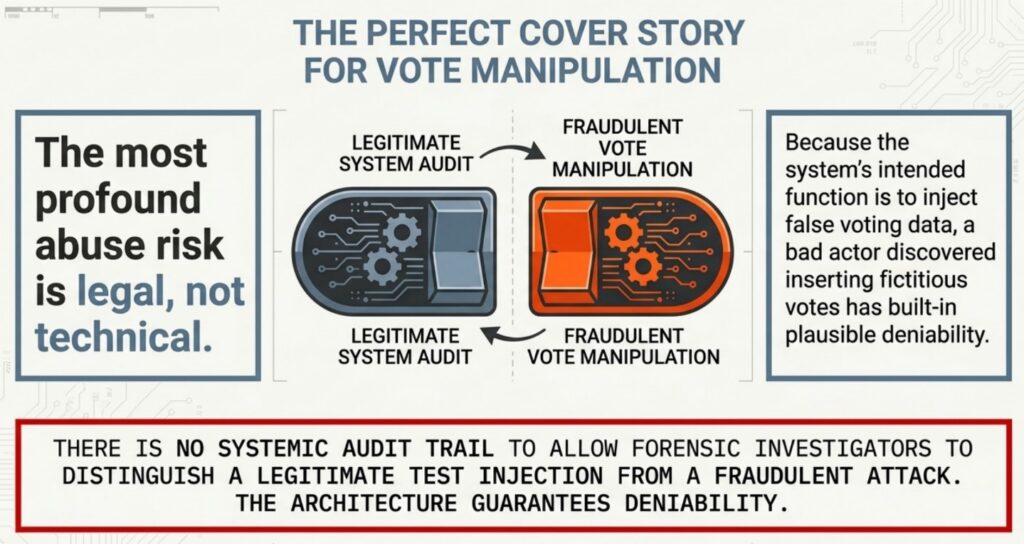
- It Offers Legal Cover for Fraud Perhaps the most profound risk is legal. If a malicious actor were caught injecting fake votes into this system, the patent provides them with the ultimate cover story. They could simply claim they were conducting a legitimate, patented “dynamic audit”. Because the audit trail relies entirely on manual, out-of-band records, forensic investigators would have no systemic way to prove if a “test” injection was legitimate or a malicious attack.
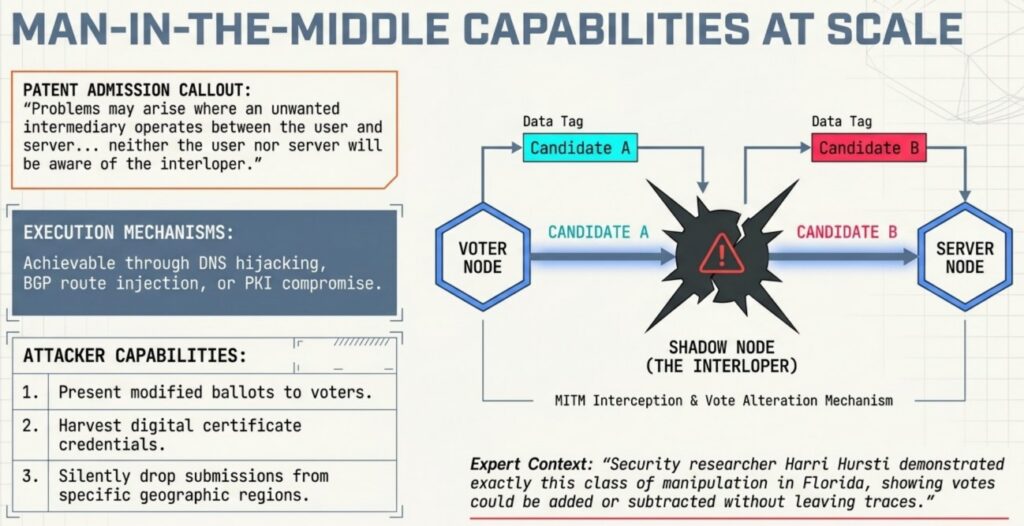
- A Centralized Single Point of Failure This architecture completely relies on a single “Central Hosting Facility” to manage voter registration, ballot delivery, and vote storage. Furthermore, its security relies on Public Key Infrastructure (PKI) and roaming digital certificates to authenticate voters. If a hacker, corrupt insider, or nation-state compromises this central server or the third-party PKI authority, they would gain global, undetected access to alter ballot definition files, impersonate voters, or manipulate tabulation results before local officials ever download them.
- It Evades Standard Election Audits Standard election audits, like checking the machine poll tapes against central tallies, fail entirely against this architecture. If the central server or the electronic ballot definition files are poisoned, the system will output manipulated results that perfectly match its own internal, manipulated data
Patent US 7,549,049: Core Facts and Government Interests
The patent “Dynamic Auditing of Electronic Elections” serves as a foundational document for the internet-based election architecture developed by Accenture.
- Timeline: Filed July 8, 2005; Issued June 16, 2009.
- Inventors: John J. Bogasky and Carl Almond.
- Assignee: Accenture Global Services GmbH, incorporated in Schaffhausen, Switzerland.
- Funding Mechanism: The invention was supported by Department of Defense (DOD) orders (DOD-FVAP-2002-C-2147M and DOD-FVAP-2004-C-2285M).
- Contracting Conduit: These orders were governed by the NIH-CIOSP Contract #263-01-D-0071. This indicates that a multi-billion dollar NIH IT procurement vehicle was utilized to fund a DOD military voting system.
- Intellectual Property Rights: While the U.S. government retains “certain rights” in the invention, the commercial rights and patent ownership reside with the Swiss-incorporated Accenture subsidiary.
Key Investigative Questions
- Extent of Government Control: Under the Bayh-Dole Act, the “certain rights” retained by the government are often limited to a nonexclusive license. Does this permit Accenture to license taxpayer-funded voting technology to any foreign entity at its own discretion?
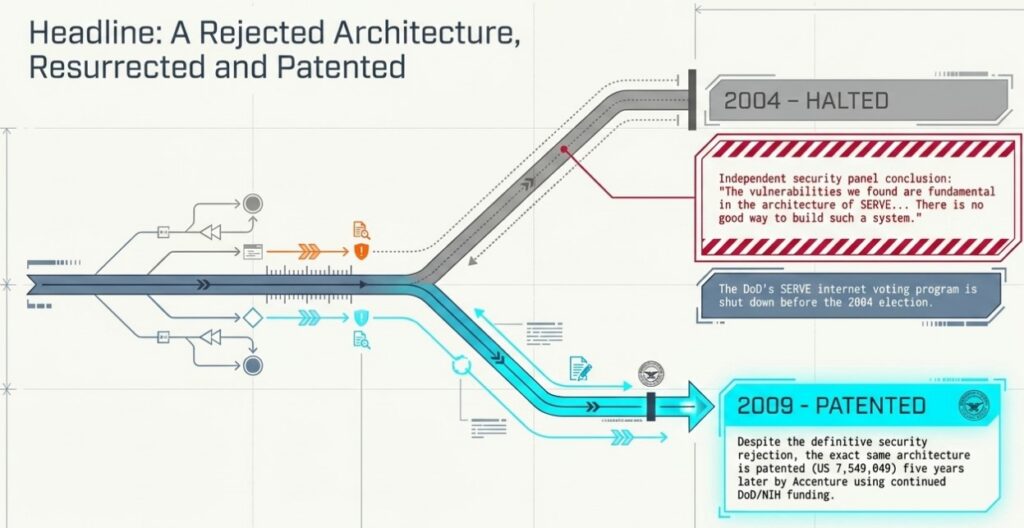
- Repurposing of SERVE: Why did active government funding (as evidenced by the 2004 contract order in the patent) continue after the SERVE program was publicly cancelled due to security risks?
- The NIH Procurement Conduit: What was the rationale for using an NIH IT contract vehicle (CIO-SP) for a DOD voting project? This unconventional arrangement potentially reduced direct Congressional oversight of the program’s development.
- Acquisition of election.com: In 2003, Accenture acquired election.com to enter the election technology market. The full scope of voter data and system access inherited through this acquisition remains un-audited by public authorities.
Citations
Primary Patents & Federal Documentation
- Bogasky, J. J., & Almond, C. (2009). Dynamic Auditing of Electronic Elections (U.S. Patent No. 7,549,049B2). U.S. Patent and Trademark Office.
- Cybersecurity and Infrastructure Security Agency (CISA). (2020). Emergency Directive 21-01 (SolarWinds Sunburst supply chain attack).
Academic & Technical Security Analyses
- Aviv, A. J., et al. (2008). Security Evaluation of ES&S Voting Machines and Election Management Systems. USENIX EVT.
- Checkoway, S., et al. (2009). Computer Scientists Take Over Electronic Voting Machine. USENIX / UC San Diego / U Michigan / Princeton.
- Halderman, J. A., & Springall, D. (2021, unsealed 2023). Security Analysis of Georgia’s ImageCast X Ballot Marking Devices.
- Halderman, J. A., et al. (2024). DVSorder vulnerability in Dominion ballot scanners. USENIX Security.
- Jefferson, D., Rubin, A. D., Simons, B., & Wagner, D. (2004). A Security Analysis of the Secure Electronic Registration and Voting Experiment (SERVE). ACM.
- Princeton Center for Information Technology Policy (CITP). (2026, January 16). Internet voting is insecure and should not be used in public elections.
Investigative & Media Reports
- Black Box Voting. (2005, December 13). Report on Diebold Voting Machine Test (Hursti Hack, Leon County FL).
- CNN. (2023, August 13). Georgia prosecutors have messages linking Trump team to Coffee County voting system breach.
- CyberScoop. (2018, July 17). ES&S voting machine remote access.
- CyberScoop. (2024, April 26). Cyberattack hits Georgia county at center of voting software breach.
- KrebsOnSecurity. (2020, December 14). U.S. Treasury, Commerce Depts. Hacked Through SolarWinds Compromise.
- Nextgov. (2004). Security analysts recommend scrapping online voting plans.
- PBS NewsHour. Here’s how hackers could mess with electronic voting.
- The New York Times. (2003, July 8). Technology Briefing Software: Accenture to Develop Voting System.
- The Outline. (2018, July 17). U.S. voting machines were vulnerable to remote hacking for six years.
- Washington Technology. (2003, October). Accenture elects VeriSign for e-voting.
- Yahoo Finance. Vote Leave linked AI firm.