
Established Fact
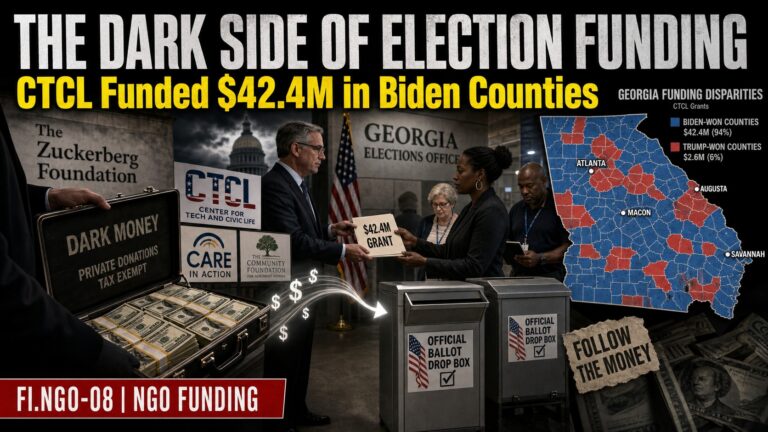
In Georgia, over 94% of CTCL funds — approximately $42.4 million — flowed to 17 Biden-won counties, while Trump-won counties (26 of 128) received less than 6% of statewide grant dollars., Simultaneously, Georgia participated in ERIC, which generated lists of “Eligible but Unregistered” (EBU) individuals from state voter roll and DMV data. Documents obtained from the Georgia Secretary of State’s office through public records requests reveal that this EBU data was transferred from ERIC to CEIR — the Center for Election Innovation and Research, founded and led by ERIC co-founder David Becker and funded in 2020 with approximately $70 million from Mark Zuckerberg — which then created registration outreach mailing lists returned through ERIC to state officials.,, The concurrent deployment of private CTCL grants in the state’s most heavily Democratic counties and the routing of state voter data through a privately operated registration-targeting infrastructure raised questions about whether nominally neutral election-administration systems were being used in ways that aligned more closely with one political coalition than the other.
Citations
Capital Research Center, Parker Thayer & Hayden Ludwig, “UPDATED: Shining a Light on ‘Zuck Bucks’ in the 2020 Battleground States” (updated May 28, 2024), available at https://capitalresearch.org/article/shining-a-light-on-zuck-bucks-in-key-states/ (“CTCL gave grants to 17 of the 31 counties Biden won in Georgia. Together, these 17 counties received $42.4 million, or over 94 percent of all CTCL funds in the Peach state. CTCL gave grants to 26 of the 128 counties Trump won statewide. But these 26 counties only received $2.6 million from CTCL — less than 6 percent of all grants distributed across Georgia.”). “See also” CTCL Grant Spreadsheet (underlying disclosed data), https://capitalresearch.org/app/uploads/CTCL-Grants-2020-AZ-NV_fixed.xlsx.
Atlanta Journal-Constitution, Mark Niesse, “Georgia panel approves bill to restrict ‘Zuckerbucks’ elections money” (Feb. 28, 2023), available at https://www.ajc.com/politics/georgia-panel-approves-bill-to-restrict-zuckerbucks-elections-money/YUOTTRKKKNA6XPO2S7GW7ACZWY/ (reporting “an estimated $43 million to Georgia counties during the coronavirus pandemic in 2020” as the basis for Georgia’s legislative ban on private election funding). In May 2023, Governor Brian Kemp signed legislation prohibiting local governments from accepting direct private funding for election administration.
Electronic Registration Information Center (ERIC), “Frequently Asked Questions” (Oct. 28, 2024), at 4–5, available at https://ericstates.org/wp-content/uploads/documents/ERIC-FAQ.pdf (“Eligible but Unregistered Report: Identifies individuals who appear to be eligible but who are not yet registered by matching voter registration data against MVD data…. At least once every two years members must use the EBU Report to send voter registration information to individuals they believe may be eligible to vote but who are not registered.”). Member states including Georgia contractually agreed to send registration outreach mailings to individuals appearing on ERIC’s EBU lists. “See also” ERIC, “How ERIC Works”, https://ericstates.org/how-does-it-work/.
[1] Verity Vote, “Threats to Election Integrity: ERIC-CEIR-REVERE” (Aug. 2022), at [Figure 15–16], available at https://verityvote.us/wordpress/wp-content/uploads/2022/08/national-ERIC-data-sharing_VerityVote.pdf . Verity Vote reports that an email obtained via public records request from the Georgia Secretary of State’s office — authored by Jenny Lovell, then research manager of CEIR — explains that Georgia EBU data “should be sent to ERIC for transfer to CEIR” and that “transfer process is reversed so GA can download the mailing lists from ERIC.” The report characterizes CEIR’s output as “targeted mailing lists” created from EBU data: “CEIR is creating targeted mailing lists from the EBU data.” A separate Georgia FOIA document (referenced at p. 1285 of the FOIA production) contains a statement by CEIR founder David Becker describing CEIR’s REVERE tool as enabling states to “draw on phone numbers and email addresses contained in the voter file, and send texts, emails, and even voicemails to any set of voters.”
Email from ERIC Executive Director Shane Hamlin to Rhode Island Elections Director Rob Rock (Jan. 12, 2021), described in Public Interest Legal Foundation, “ERIC Caught Sharing Voter Data With CEIR” (Mar. 22, 2023), archived and reported by Election Fairness Institute, available at https://electionfairnessinstitute.org/eric-caught-sharing-voter-data-with-ceir/ . In response to a Rock email titled “EBU Follow-Up Data Request,” Hamlin confirmed: “Yes, you’re good to continue working with CEIR. CEIR signed an NDA [non-disclosure agreement] with ERIC for the purpose of assisting ERIC and ERIC members with independent research [into] ERIC’s effectiveness,” and “This should be the same process you used to provide the EBU list to CEIR.” “See also” Heritage Foundation, Hans A. von Spakovsky, “Maintaining Accurate Voter Registration Rolls: The Need to Rehabilitate the Electronic Registration Information Center” (Apr. 19, 2023), available at https://www.heritage.org/election-integrity/report/maintaining-accurate-voter-registration-rolls-the-need-rehabilitate-the
Center for Election Innovation and Research, *CEIR 2020 Voter Education Grant Program* (Mar. 16, 2021), available at https://electioninnovation.org/research/ceir-2020-voter-education-grant-program/