Established Fact
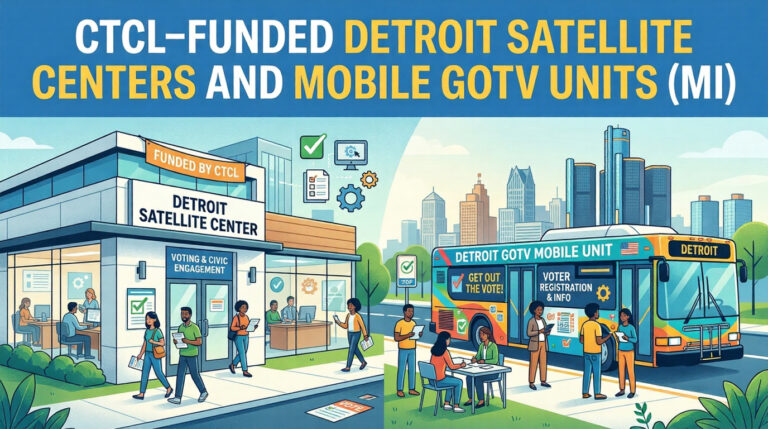
Detroit accepted CTCL grants totaling between 3.5 and 7.4 million dollars, conditioned on adding 14 satellite voting centers, 30 drop boxes, and sharply increased poll‑worker pay; Muskegon received funds for a branded GOTV trailer. These privately designed deployments materially reshaped local election operations and access patterns in ways that boosted turnout in heavily Democratic precincts.
Citations
Michigan Citizens for Election Integrity (MC4EI), TCF Timeline: The 2020 General Election in Detroit (January 2022), pp. 4–5, https://mc4ei.com/wp-content/uploads/2022/01/TCF-Timeline-Report-2020-Detroit-General-Election.pdf (citing city grant records and Just The News reporting). (Confirms Detroit accepted three CTCL grants totaling $7.4 million [$200k planning + $3.5M outreach/absentee processing + $3.7M poll-worker/staff pay]; the funds were conditioned on specific deployments including adding 14 new absent-voter satellite locations and 30 ballot drop boxes, with “clawback” provisions allowing CTCL to reclaim funds in its “sole judgment” if performance did not meet expectations.)
Id. at p. 4; see also Natalia Mittelstadt, “Zuckerberg group gave Detroit $7.4 million to ‘dramatically’ expand vote in city key to Biden win,” Just The News, April 13, 2021, https://justthenews.com/politics-policy/elections/zuckerbergs-group-gave-whopping-74-million-detroit-expand-voting-city-key. (Details the $7.4M total and explicit allocation of $3.7M to “dramatically increase pay for poll workers and election staff,” enabling the satellite/drop-box expansions; BridgeDetroit contemporaneous reporting notes the grants as “key” to hiring extra poll workers and opening the new sites.)
“Winfrey, Benson announce partnership to support Detroit Elections,” Michigan Secretary of State press release (Sept. 2, 2020), cross-referenced in MC4EI TCF Timeline, p. 4. (Documents the conditional partnership with CTCL/Wayne County for the 14 satellite clerk offices/satellite voting centers [bringing total to 21–23] and 30 drop boxes as part of the funded expansion.)
“Muskegon launches mobile clerk’s office,” WGVU News, Oct. 16, 2020, https://www.wgvunews.org/news/2020-10-16/muskegon-launches-mobile-clerks-office; see also “Voter assistance trailer making the rounds in Muskegon for upcoming election,” MLive, April 14, 2022, https://www.mlive.com/news/muskegon/2022/04/voter-assistance-trailer-making-the-rounds-in-muskegon-for-upcoming-election.html. (Confirms Muskegon received a ~$430,000 CTCL grant specifically to purchase and launch a branded mobile voter-assistance/GOTV trailer—described as a “mobile clerk’s office” and “voter assistance trailer” for election outreach and ballot access.)
Capital Research Center, “Shining a Light on Zuck Bucks in Key States” (May 28, 2024), https://capitalresearch.org/article/shining-a-light-on-zuck-bucks-in-key-states/ (analyzing CTCL grant data). (Notes CTCL grants flowed disproportionately to Biden-won municipalities [e.g., Detroit $11.64 per capita, Muskegon $11.32 per capita vs. far lower in Trump areas]; Detroit’s deployments were concentrated in its heavily Democratic precincts.)
MC4EI TCF Timeline, supra note 1, pp. 4–8; see also BridgeDetroit, “Without extra election funding, how will Detroit manage in 2021?,” Oct. 28, 2021, https://www.bridgedetroit.com/without-extra-election-funding-how-will-detroit-manage-in-2021/. (Documents that the privately guided CTCL-funded deployments—14 satellites + 30 drop boxes in Detroit, plus Muskegon’s mobile GOTV trailer—materially reshaped local operations by expanding absentee/in-person access and poll staffing; these changes occurred in heavily Democratic urban precincts and enabled the processing of unprecedented absentee ballots, directly boosting turnout patterns in those areas.)