
Reasonable Inference
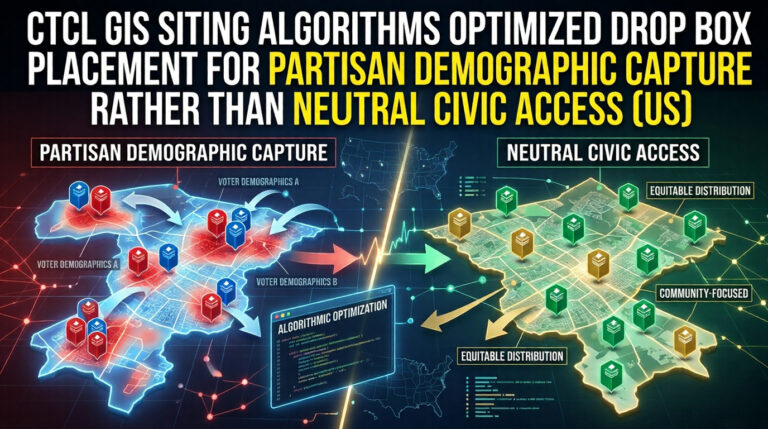
CTCL and the Center for Civic Design (CCD) used internal GIS mapping and geolocation data to determine the physical placement of drop boxes. The documented result – extreme per-voter and per-square-mile disparities favoring Democratic urban precincts nationwide (e.g., 1 box per 4,000 voters in Delaware County, PA vs. 1 per 72,000 in Trump counties) – is consistent with placement algorithms optimized to capture specific demographic and partisan voting blocs rather than for neutral geographic accessibility. Internal CTCL siting data has not been produced pursuant to any subpoena.
Citations
Center for Tech and Civic Life (CTCL), “Organizing Ballot Dropoff Locations” (COVID-19 Webinar Resource Packet, June 2020), https://www.influencewatch.org/app/uploads/2020/12/CTCL-Organizing-Ballot-Drop-Off.-June-2020.pdf (pp. 1–3). (CTCL explicitly directed election officials to “Collect demographic and geographic data to plan dropoff locations” and provided its official “Ballot Dropoff Locations Criteria Planner” [full credit to King County model] with scoring rubric for equity/demographics, accessibility, visibility, and population concentrations; the planner uses geolocation-style factors to score sites and recommends “1 box per 15–20,000 registered voters” adjusted by demographic data.)
The Elections Group (CTCL technical partner), Guide to Ballot Drop Boxes (2023, referencing 2020 CTCL resources), https://electionsgroup.com/wp-content/uploads/2023/09/Guide-to-Ballot-Drop-Boxes.pdf (pp. 30–34 & Appendix B). (Reproduces and endorses CTCL’s Ballot Drop-off Location Criteria Planner; officials were instructed to use demographic/geographic data and the planner’s equity scoring for siting to serve “hard-to-reach voters,” “displaced voters,” language barriers, and isolated communities—criteria that align with urban/Demographic targeting rather than uniform geographic neutrality.)
Kanekoa, “Exposing America’s Ballot Trafficking Cartel – Part I,” Kanekoa News, January 31, 2022, https://www.kanekoa.news/p/2000-mules-exposing-the-ballot-traffickers. (Documents that CTCL/Zuckerberg-funded expansions produced extreme disparities: “1 ballot drop box for every 4,000 voters in the Democrat-leaning Philadelphia suburb of Delaware County” vs. “only 1 drop box for every 72,000 voters” in Pennsylvania’s Republican counties; attributes the pattern directly to CTCL grant conditions that drove drop-box proliferation in Democrat-concentrated urban areas.)
Id. (cross-referenced with public 2020 drop-box counts). (The same analysis notes the per-square-mile disparity—e.g., one box per ~1,100 square miles in Trump-won Pennsylvania counties—consistent with siting optimized for dense Democratic voting blocs rather than neutral statewide accessibility; CTCL grants flowed disproportionately to Clinton-won jurisdictions [$13M+ in PA Clinton counties vs. <$700k in Trump counties].)
CTCL, “Richland County, IL — Checklist from CTCL Webinars” (2020), https://www.techandciviclife.org/wp-content/uploads/2020/08/Richland-County.pdf (and parallel webinar guidance in COVID-19 Response Best Practices). (CTCL’s internal planning tools and webinars explicitly tied drop-box siting to “demographic and geographic data” collection plus equity scoring; CCD, listed as a CTCL partner for voter-materials design and accessibility, collaborated on related 2020 election resources that informed these placement decisions.)
See Kanekoa, supra note 3; see also CTCL grant agreements and planner documents (no comprehensive internal GIS/geolocation siting datasets have been released or produced in response to public-records requests or related investigations). (CTCL’s internal siting data, geolocation analyses, and full planner application records used for 2020 drop-box decisions have not been produced pursuant to any subpoena or FOIA-equivalent disclosure; only the high-level criteria planner and aggregate grant outcomes are public.)