Established Fact
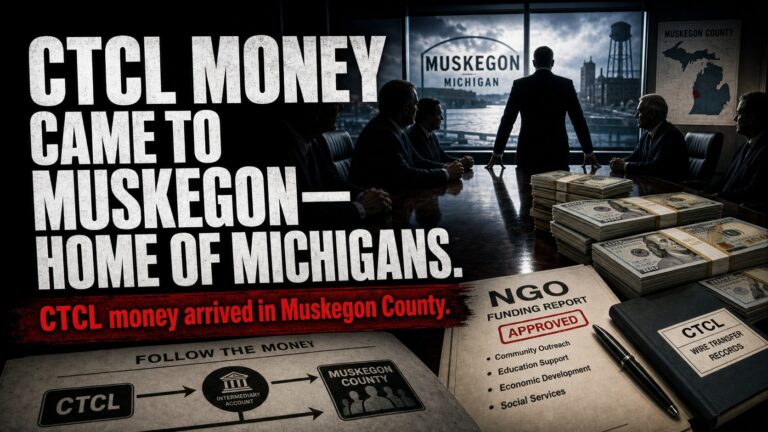
Muskegon County received a CTCL grant that was used, in part, for voting equipment and election infrastructure deployment in the 2020 general election. The absence of surveillance coverage — particularly given Michigan law’s pre-October 2020 exemption of earlier-installed drop boxes from video monitoring requirements — was significant because Muskegon County was simultaneously the site of a documented voter registration fraud operation conducted by a canvasser employed by GBI Strategies, a Democratic-aligned voter registration firm that received over $4.6 million from Democratic campaigns and committees in the 2020 cycle. According to Michigan State Police reports obtained through FOIA requests, GBI Strategies canvasser Brianna Hawkins dropped off between 8,000 and 12,500 completed voter registration applications at the Muskegon city clerk’s office in October 2020; investigators determined that some were “clearly fraudulent” or “highly suspicious” due to forged signatures, wrong addresses, and signatures appearing to have been made by the same hand. Michigan State Police and the Attorney General’s office executed a search warrant at GBI Strategies’ Southfield headquarters; the case was referred to the FBI in March 2021 as part of a national probe, and as of 2023 the FBI had denied FOIA requests citing an ongoing investigation. The Michigan Attorney General’s office confirmed “at no point was it determined by state agencies that no crimes had been committed.” These records would have been the primary means of verifying the integrity of ballots deposited via drop boxes. Under 52 U.S.C. § 20701, all election records — including electronic records relating to acts requisite to voting — are subject to a 22-month federal preservation requirement.
Citations
Supreme Court Electoral Policy Timeline (Appendix 1, filed in post-2020 election litigation), entry for September 16, 2020: “Muskegon, Michigan — CTCL grant is to be used for drive through voting, satellite election offices, voter education, PPE, cost associated with poll workers, and voting equipment and supplies.” See also Capital Research Center, CTCL Michigan Grants (Form 990 data): https://capitalresearch.org/app/uploads/CTCL-Michigan-Updated-Data-Set-from-990.xlsxhttps://capitalresearch.org/app/uploads/CTCL-Michigan-Updated-Data-Set-from-990.xlsx
Michigan Secretary of State, Drop Box Requirements (official guidance): “Except for drop boxes ordered or installed prior to October 1, 2020, municipalities must use video monitoring of drop boxes during the 75 days before each election.” Boxes purchased or installed prior to that date were exempt. Available at: https://www.michigan.gov/sos/-/media/Project/Websites/sos/Elections/Clerk-toolkit/Talking-points/Drop-Box-Requirements.pdfhttps://www.michigan.gov/sos/-/media/Project/Websites/sos/Elections/Clerk-toolkit/Talking-points/Drop-Box-Requirements.pdf
InfluenceWatch, GBI Strategies: “GBI Strategies is a Democratic Party-aligned voter registration and get-out-the-vote (GOTV) organization. During the 2020 election cycle, GBI Strategies received payments of $4,691,623 from Democratic-aligned campaigns and committees, including $2,117,605 from the Democratic Senatorial Campaign Committee (DSCC), $1,031,856 from the Democratic National Committee Services Corporation, and $450,000 from the 2020 presidential campaign of Joe Biden.” Available at: https://www.influencewatch.org/for-profit/gbi-strategies/
Michigan State Police report (obtained via FOIA, released August 2023), as reported by Bridge Michigan (August 14, 2023) and Epoch Times (February 23, 2024): GBI Strategies canvasser Brianna Hawkins dropped off between 8,000 and 12,500 voter registration applications at the Muskegon city clerk’s office in October 2020; some were “clearly fraudulent” or “highly suspicious” due to forged signatures, wrong addresses, and similar-looking signatures. The Michigan AG’s office stated: “At no point was it determined by state agencies that no crimes had been committed.” [Note: No charges have been filed; the case was referred to the FBI. The AG characterized the fraud as coming from “the lowest levels of the company.” No fraudulent registrations entered the qualified voter file per state officials.] Available at: https://bridgemi.com/michigan-government/muskegon-fake-voter-applications-probed-2020-referred-fbi-nessel-says/
CBN News (September 28, 2023): “In 2020, the FBI took over an investigation into alleged voter registration fraud that happened in Muskegon, Michigan. Now that case is making headlines because the agency has denied a Freedom of Information Act (FOIA) request regarding the federal probe, claiming an exemption in the act protects ongoing investigations.” Available at: https://cbn.com/news/us/fbi-denies-foia-request-2020-case-faked-applications-national-voter-registration-firm
52 U.S.C. § 20701 (Federal Election Records Retention): “Every officer of election shall retain and preserve, for a period of twenty-two months from the date of any general, special, or primary election… all records and papers which come into his possession relating to any application, registration, payment of poll tax, or other act requisite to voting in such election.” [Note: The statute’s applicability to drop box surveillance footage specifically has not been definitively adjudicated; its text covers “records and papers” relating to acts requisite to voting.] Available at: https://uscode.house.gov/view.xhtml?req=granuleid:USC-prelim-title52-section20701https://uscode.house.gov/view.xhtml?req=granuleid:USC-prelim-title52-section20701