
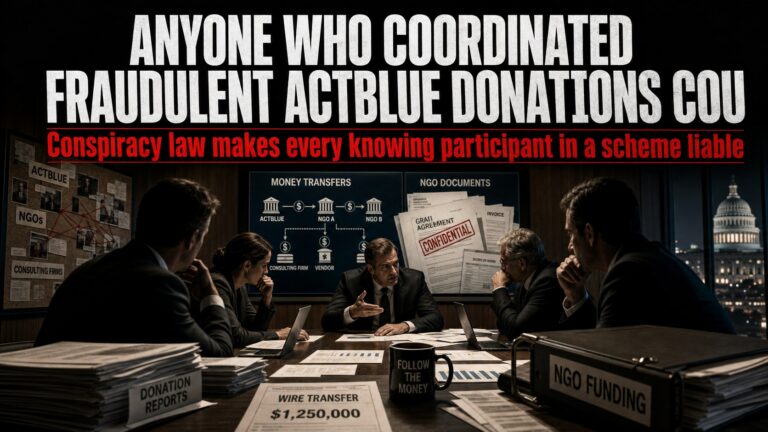
Reasonable Inference
If two or more persons coordinated to submit fraudulent contributions through ActBlue — whether through straw donor schemes, identity misappropriation, or foreign contribution routing — each is subject to conspiracy liability under 18 U.S.C. § 371, independent of whether the underlying offense was completed or whether each participant personally committed every element of the offense. Under settled conspiracy doctrine, co-conspirators are liable for acts taken by any member of the conspiracy in furtherance of its object.
Citations
Pinkerton v. United States, 328 U.S. 640, 646–47 (1946) (holding that a party to a conspiracy is liable for the substantive offense committed by a co-conspirator in furtherance of the conspiracy, even if he did not participate in its commission); accord Salinas v. United States, 522 U.S. 52, 63–64 (1997) (“A conspiracy may exist even if a conspirator does not agree to commit or facilitate each and every part of the substantive offense. . . . it suffices that he adopt the goal of furthering or facilitating the criminal endeavor”).
“Section 1028(a)(7) criminalizes the knowing transfer, possession, or use, without lawful authority, of a means of identification of another person with the intent to commit, or to aid or abet, any unlawful activity that constitutes a violation of Federal law…” (DOJ explicitly lists this as the primary “identity theft” provision used when PII is misused to facilitate another federal offense). https://www.justice.gov/archives/jm/criminal-resource-manual-1502-prosecuting-violations-18-usc-1028