
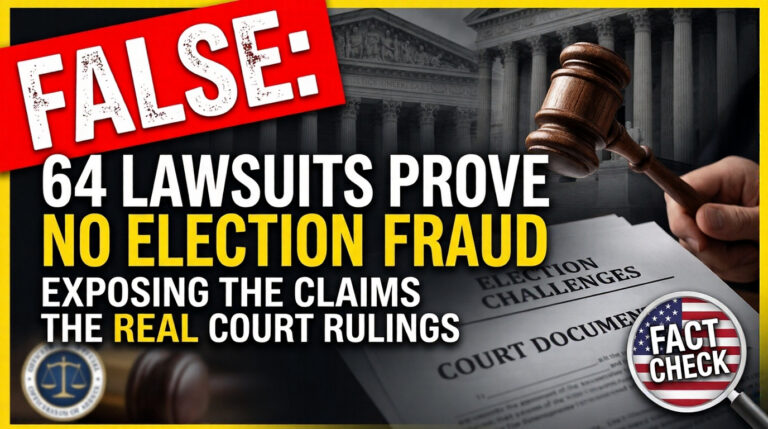
In the wake of the 2020 election, 64 election lawsuits were filed by the Trump campaign and their supporters. The popular narrative surrounding these lawsuits is that they were dismissed because they did not present substantive evidence of election fraud.
“Over 60 separate lawsuits brought by President Trump’s campaign and its supporters across the country attempting to challenge the legitimacy of the election results have failed. With these, courts have rejected baseless allegations of widespread voter fraud raised to overcome the election results” – Coomer v Lindell
A closer examination reveals that this assertion and similar assertions made in other legal proceedings and media reports omit important facts.
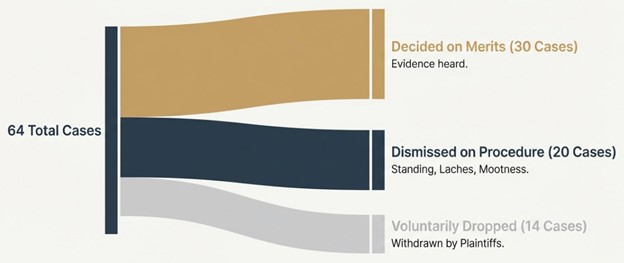
Of the 64 total election lawsuits filed,
- 20 cases (31%) were dismissed for procedural reasons (e.g. standing)
- 14 cases (22%) were voluntarily withdrawn by plaintiffs
- 30 cases (47%) were ostensibly decided upon the merits
Of the 20 cases dismissed on procedural reasons, the U.S. Supreme Court ruling in Bost v Illinois would have removed the “no standing” barrier from plaintiffs.
Of the 14 cases voluntarily withdrawn by the plaintiffs, many did so under threat of sanctions that threatened the livelihood of the plaintiff legal teams. In fact, many of the lawyers who persisted in bringing these election lawsuits to trial were indeed targeted by various forms of lawfare including sanctions.
Of the 30 remaining cases reportedly decided upon the merit, the vast majority were limited to open source and eyewitness accounts that often did not have access to substantive audit trail records. To compound matters, significant election processes such as the tallying of the votes were executed by Non-Government Organizations not subject to open records requests. Without a substantive discovery phase, plaintiffs were at a significant disadvantage in pressing their concerns particularly in light of the time constraints inherent with challenging election results. In such cases, judges evaluated evidence without ordering discovery, often because they found the plaintiffs’ initial evidence (affidavits, expert reports) to be speculative or inadmissible hearsay. In practical terms, the judge presided over a perfunctory “he said, she said” trial that featured negligible if any opportunity to refute the assertions made. In these cases, the testimony of the election officials was asserted to have more credibility than that of election observers, often hampered by onerous COVID rules that impaired more substantive observation.
Three of the 30 cases reportedly decided upon their merit did feature some form of discovery. A closer examination of the three cases reveals that the merit of the “no merit” is questionable at best.
- Ward v. Jackson (Arizona): The court ordered the inspection of 1,626 ballots (100 mail-in ballots, 100 duplicate ballots, and 1,526 additional duplicate ballots voluntarily provided by the county). This inspection was followed by a two-day trial.
- Favorito v. Cooney (Georgia): A court initially issued an order to unseal absentee ballots for inspection to detect possible fraud
- Bailey v. Antrim County (Michigan): A judge granted a preliminary injunction allowing the plaintiff to conduct a forensic inspection of the county’s precinct tabulating machines, thumb drives, and memory cards.
Bailey v Antrim featured the most wide-ranging discovery of the three. Contrary to popular assertions that it was dismissed on the merit of the evidence, it was dismissed on the basis that all of the remedies sought had been satisfied by the defense. In fact, Judge Kevin Elsenheimer specifically asserted that he did not dismiss it on the basis that there were not issues with the elections.
In short, the courts have invariably ruled in favor of election officials who assert how elections are SUPPOSED to be executed as opposed to observers testifying as to how the elections were ACTUALLY conducted. Courts never pressed for election officials to provide evidence in support of their assertions. If that would have happened, it would have been evident to all that the chain of custody for election records had been destroyed…often deliberately at the orders of the election officials.
Citations
Lost, Not Stolen Report: https://lostnotstolen.org/wp-content/uploads/2022/07/Lost-Not-Stolen-The-Conservative-Case-that-Trump-Lost-and-Biden-Won-the-2020-Presidential-Election-July-2022.pdf | Lost Not Stolen.
Bost v. Illinois State Board of Elections, No. 24-568, 607 U.S. _ (Jan. 14, 2026). Chief Justice Roberts delivered the opinion for a 7–2 Court (5-justice majority + Barrett/Kagan concurring in judgment; Jackson/Sotomayor dissenting). The Supreme Court opinion reversed the Seventh Circuit (114 F.4th 634 (2024)), which had affirmed the N.D. Illinois dismissal for lack of standing (684 F. Supp. 3d 720 (N.D. Ill. 2023))., https://www.supremecourt.gov/opinions/25pdf/24-568_gfbh.pdf