
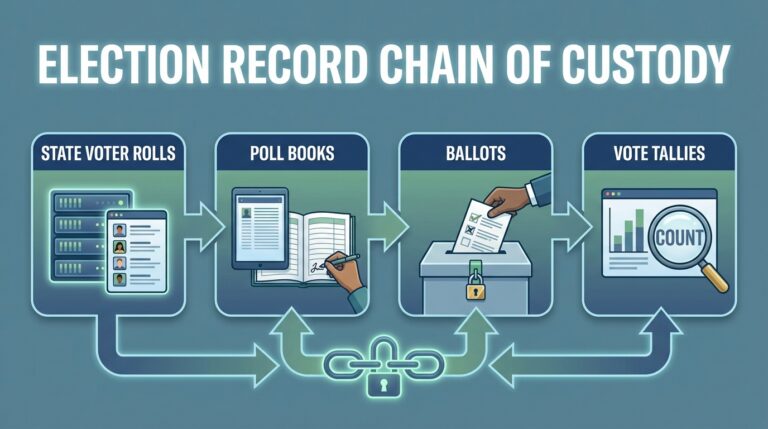
Elections do not run on slogans; they run on evidence. At the center of that evidence is chain of custody – the documented, continuous control of ballots, machines, poll books, media, and the digital records that support reported results. When that chain is clear, complete, and independently reviewable, election officials can actually prove that materials were protected, procedures were followed, and outcomes can be trusted. When it is missing or broken, there is simply no meaningful support for any assertion that an election was conducted with integrity, no matter how often the word “secure” is repeated.
In every other context where evidence matters – from criminal trials to financial audits – a broken chain of custody can get the evidence tossed out or the entire proceeding called into question. Yet in elections, the media and many pundits have subtly flipped the script: instead of demanding that officials show their documentation and logs to substantiate the results, they often demand that citizens and observers “prove” something went wrong, even when officials cannot produce a full, verifiable paper trail. The burden of proof has been shifted away from the government actors who control the evidence and onto the public that is merely allowed to watch from a distance, if at all.
State Voter Registration File
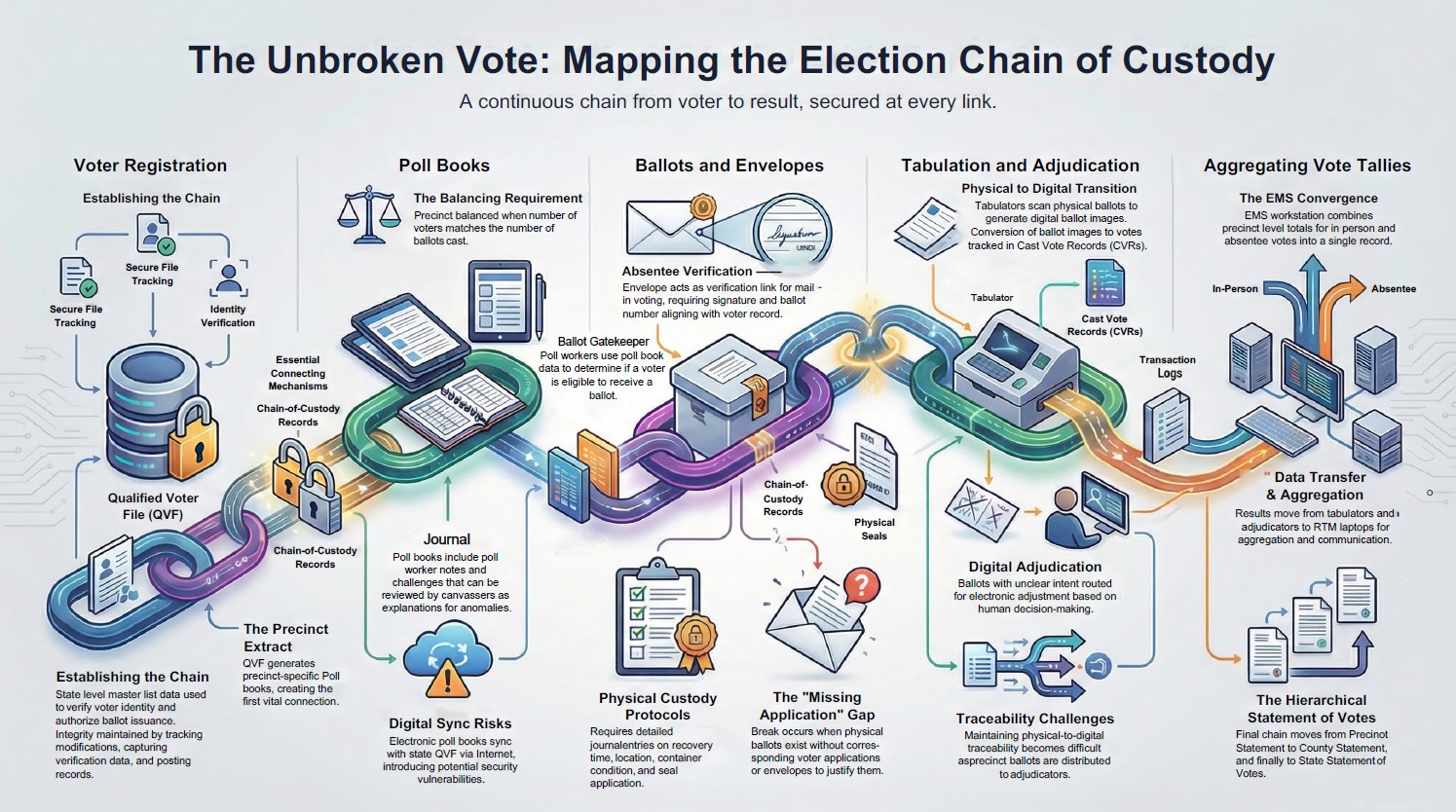
In any high-integrity system, the output is only as reliable as the initial input. The State Voter Registration File (aka Qualified Voter File) serves as the “source of truth” and the foundational pillar for the entire election lifecycle. As a forensic auditor, I view the QVF as the first link in the chain; its integrity is a non-negotiable prerequisite for all downstream validity. If this master record—the state-level database of registered voters—is compromised by unauthorized entries or poor maintenance, the system is fundamentally breached before a single ballot is issued.
To maintain this foundation, the following critical control functions must be strictly audited:
- Modification Tracking: Comprehensive logging of every database change to ensure accountability and detect unauthorized alterations to voter status.
- Identity Verification Protocols: Robust mechanisms to capture and verify registrant data against authoritative government records (e.g., DMV or Social Security Administration).
- Statutory List Maintenance: Rigorous, ongoing database reconciliation to perform “hygiene” by removing records for deceased individuals or those who have relocated outside the jurisdiction.
The forensic “So What?” regarding the QVF lies in its relationship with the Poll Book. Because the Poll Book is a “precinct-specific extract” of the QVF, any corruption in the master file transforms the Poll Book from a gatekeeping tool into a mechanism for unauthorized entry. Without a verified master list, the localized records used on election day cannot accurately regulate ballot allocation, creating a systemic failure in the chain of custody.
As these records transition from static database entries to active tools at the precinct level, the focus shifts to the localized deployment of the voter record.
The Gatekeeper: Poll Book Operations and Balancing
The Poll Book is the primary operational record governing voter eligibility at the point of action. From an audit perspective, it serves as the control mechanism that tracks participation and prevents dual voting. The strategic importance of “balancing” cannot be overstated; it is the mathematical proof required to validate the precinct’s operations.
The shift toward digital systems has significantly altered the risk profile of this stage:
Operational Function | Chain of Custody Risks |
Physical Poll Books: Manual logging of voter participation and ballot issuance using paper registers. | • Human transcription errors. • Volatility of physical records (loss/damage). • Difficulty in real-time cross-precinct reconciliation. |
Electronic Poll Books: Digital systems for check-in, often syncing with the state QVF in real-time. | • Expanding the Attack Surface: Internet connectivity introduces non-deterministic variables. • Database Desynchronization: Potential for MitM (Man-in-the-Middle) interception. • Malware Vulnerability: Risk of unauthorized modification of the “checked-in” status. |
Balancing is a mathematical necessity for a high-integrity election. Forensic standards require that the number of ballots issued (per the poll book) must match the number of physical ballots cast with zero variance. If a precinct is “unbalanced,” it signals a critical failure in the chain of custody, suggesting that ballots were either added, discarded, or improperly recorded.
To protect the integrity of the record before it enters the physical processing phase, poll books must be physically and digitally sealed at the close of operations to prevent post-election record manipulation.
Physical Evidence: Ballots and the Absentee Verification Link
Physical ballots and their associated envelopes represent the “primary artifacts” of voter intent. A forensic analysis requires a verifiable, one-to-one link between the physical vote and a verified identity. If this link is severed, the ballot loses its legal standing as a representative of a qualified voter’s will.
For absentee voting, the verification chain must follow a rigid sequence:
- Signature Alignment: Manual or automated comparison of the envelope signature against the signature of record in the QVF.
- Ballot Number Verification: Matching the unique ballot identifier to the specific entry in the poll book.
- Voter Record Synchronization: Confirmation that all data points converge on a single, qualified entry in the state database.
Proper custody of physical artifacts requires a rigorous metadata checklist. Every journal entry must include: Recovery Location, Timestamp, Physical Condition of Container/Seal, and Chain-of-Custody Sign-off. Within a forensic framework, the existence of a ballot without a corresponding application or envelope is not merely a “break” in the chain—it is a fatal forensic exception that invalidates the artifact.
Once verified and collected, these physical artifacts move toward the Physical-to-Digital Gateway: the tabulators.
Digital Conversion: Tabulation and Adjudication
The transition from physical paper to digital tallies is the most technically complex phase of the election. This “Digital Conversion” introduces significant risks, particularly when human intervention is required to interpret voter intent.
The industry utilizes specific hardware to act as the Physical-to-Digital Gateway:
- ImageCast Precinct (ICP): Localized tabulators for in-person voting.
- ImageCast Central (ICC): High-speed units for bulk processing of absentee ballots.
These machines generate Cast Vote Records (CVRs)—digital scans and data strings representing the voter’s marks. A critical audit gap in modern oversight is the frequent failure to review CVRs. As a forensic auditor, I characterize the CVR as the only digital evidence of the voter’s actual intent; ignoring them is a failure of protocol.
The Adjudication process represents a “black box” in the chain. When a tabulator cannot determine intent, the digital image is routed to an Adjudicator Workstation or is manually adjudicated by poll workers presumably with bipartisan oversight. Here, the tally is “adjusted” based on human decision-making. This stage often lacks physical traceability; once precinct-specific batches are distributed digitally to adjudicators, the link back to the original physical batch is effectively severed, creating a high-priority vulnerability.
Following adjudication, these disparate digital tallies are prepared for aggregation through the Results Transfer Manager.
Aggregation and Final Statements of Votes
The final aggregation of results occurs at the Results Transfer Manager (RTM) and the Election Management System (EMS). The EMS is the high-stakes Single Point of Failure for the entire jurisdiction; it is the unique node where all precinct-level data converges to form the final result.
The hierarchy of record progression is critical for maintaining the tally’s integrity as it scales:
- Precinct Statement of Votes
- County Statement of Votes
- State Statement of Votes
Forensic threat modeling at this stage focuses on the movement of “Results Media” (flash drives and ethernet transfers). The use of these methods to move Statement of Votes data creates a digital link that must be meticulously logged. Any failure to document the chain of custody for these flash drives, or to secure the ethernet transfer points, threatens the link between the localized tally and the state’s final certified results.
This pathway concludes with the synthesis of all records into a final, verifiable audit trail.
The Audit Trail: Synthesizing Physical and Digital Records
The election record chain of custody is an “adult version of telephone.” If a single link is broken—be it a missing transfer log, a compromised seal, or an unexamined digital record—the integrity of every downstream artifact is compromised. To confirm the validity of an election, the “message” must be traceable from the initial registration back to the final statement of votes without interruption.
An unbroken chain of custody requires the following connecting mechanisms:
- Chain-of-Custody Records: Formal, signed logs documenting every instance of sealing, unsealing, and transfer of evidence.
- Transaction Logs: The chronological digital “heartbeat” from poll books, adjudicators, RTM laptops, and EMS servers.
- Cast Vote Records (CVRs): The primary digital evidence of voter intent generated at the point of tabulation.
- Physical Seals: Tamper-evident devices providing physical security for hardware and ballot containers.
Final Assessment: A simple recount of paper ballots is procedurally insufficient to verify an election. A true forensic assessment requires the simultaneous review of physical artifacts and electronic records, such as Transaction Logs and CVRs. Only through this synthesis can we verify that the chain remains unbroken from the state voter rolls back to the final declared tally.