
Reasonable Inference
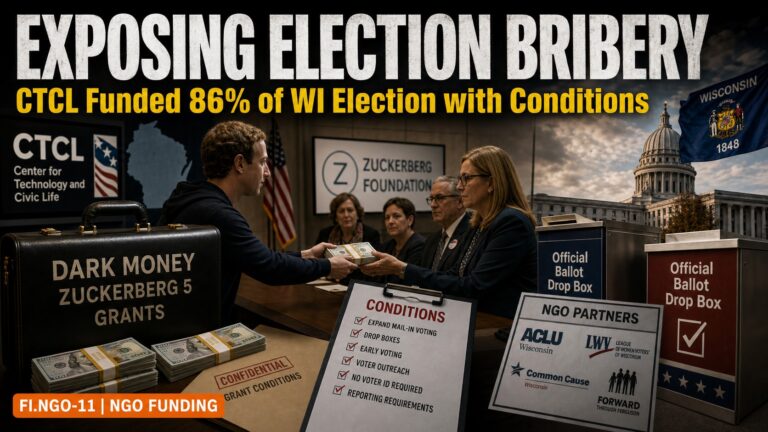
In Wisconsin, CTCL provided approximately $8.8 million to the five largest cities — Milwaukee, Madison, Green Bay, Racine, and Kenosha — representing roughly 86% of all CTCL funds distributed in the state. The grants were conditioned on adherence to the “Wisconsin Safe Voting Plan,” a detailed operational framework that included claw-back provisions requiring repayment if cities deviated from the approved plan, requirements for absentee and in-person voting infrastructure, outreach programs targeting “communities of color,” and — in Green Bay specifically — the use of privately funded “voter navigators” tasked with assisting voters in uploading photo ID, completing ballots, and complying with certification requirements. The Wisconsin Office of Special Counsel, in its Second Interim Report, concluded that this arrangement “facially violates Wisconsin law prohibiting election bribery” under Wis. Stat. § 12.11, which prohibits offering “anything of value” in connection with election administration — applying that prohibition to the transfer of private funds to city officials conditioned on performing election duties in a prescribed manner.
Citations
Wisconsin Institute for Law & Liberty (WILL), Finger on the Scale: How Private Money and Government Partnership Boosted Democratic Turnout in 2020Finger on the Scale: How Private Money and Government Partnership Boosted Democratic Turnout in 2020 (June 2021), p. 3 (Executive Summary): “The largest five cities in the state (Milwaukee, Madison, Green Bay, Kenosha, and Racine) received nearly 86% of all CTCL grant funds in Wisconsin”; p. 11 (same); Table 3 (city-by-city figures: Milwaukee $3,409,500; Green Bay $1,600,000; Racine $1,699,100; Madison $1,271,788; Kenosha $862,799; total $8,843,187). Available at: https://will-law.org/wp-content/uploads/2021/06/WillLawFINGER-ON-THE-SCALE.6.pdf . The rounded figure “$8,800,000” also appears in the chapter title of the OSC Second Interim Report.
WILL, Finger on the Scale, p. 5 (claw-back provision): “CTCL stipulates, among other things, that the municipalities must hold to the ‘Wisconsin Safe Voting Plan’ or ‘CTCL may discontinue, modify, withhold part of, or ask for the return of all or part of the grant funds.'” Wisconsin Office of Special Counsel (OSC), Second Interim Report of the Special Counsel (Michael Gableman), pp. 26–27 (claw-back provisions quoted verbatim): “Any amount reduced or not provided in contravention of this paragraph shall be repaid to CTCL up to the total amount of this grant.” OSC Report, p. 20 (“communities of color” language from initial grant requirements); pp. 33–34 (WSVP targeting “voters of color, low-income voters,” “African immigrants, LatinX residents, and African Americans,” “Hmong, Somali and Spanish-communities”). OSC Report, p. 38 (Green Bay voter navigators): “In Green Bay, the City would use the private money to fund bilingual LTE ‘voter navigators’ to help Green Bay residents properly upload a valid photo ID, complete their ballots, comply with certification requirements, offer witness signatures, and assist voters prior to the elections.” OSC Report available at: https://bloximages.chicago2.vip.townnews.com/madison.com/content/tncms/assets/v3/editorial/6/49/64989810-acbc-5ce7-bdc1-f56d37e7c923/621e4cdc386e7.pdf
OSC Second Interim Report, Chapter 1 title (p. 17): “The Center for Tech and Civic Life’s $8,800,000 Zuckerberg Plan Grant with the Cities of Milwaukee, Madison, Racine, Kenosha and Green Bay (the Zuckerberg 5) Facially Violates Wisconsin Law Prohibiting Election Bribery.” OSC Report, p. 18: “The CTCL agreement facially violates the election bribery prohibition of Wis. Stat. § 12.11 because the participating cities and public officials received private money to facilitate in-person or absentee voting within such a city.” Wis. Stat. § 12.11 defines the prohibited consideration as “anything of value” — including “any amount of money.” Note: The “facially violates” conclusion is the legal opinion of the OSC, appointed by the Wisconsin State Assembly; it does not represent a judicial determination. No Wisconsin court has adopted this interpretation; related legal challenges were dismissed on standing grounds without reaching the merits.