
Investigation by the House Committee on the Judiciary and the Select Subcommittee on the Weaponization of the Federal Government has revealed a coordinated effort by federal agencies to monitor and censor the online speech of American citizens. Central to this operation is the Cybersecurity and Infrastructure Security Agency (CISA) and the National Science Foundation (NSF), which utilized non-governmental entities as proxies to bypass First Amendment restrictions.
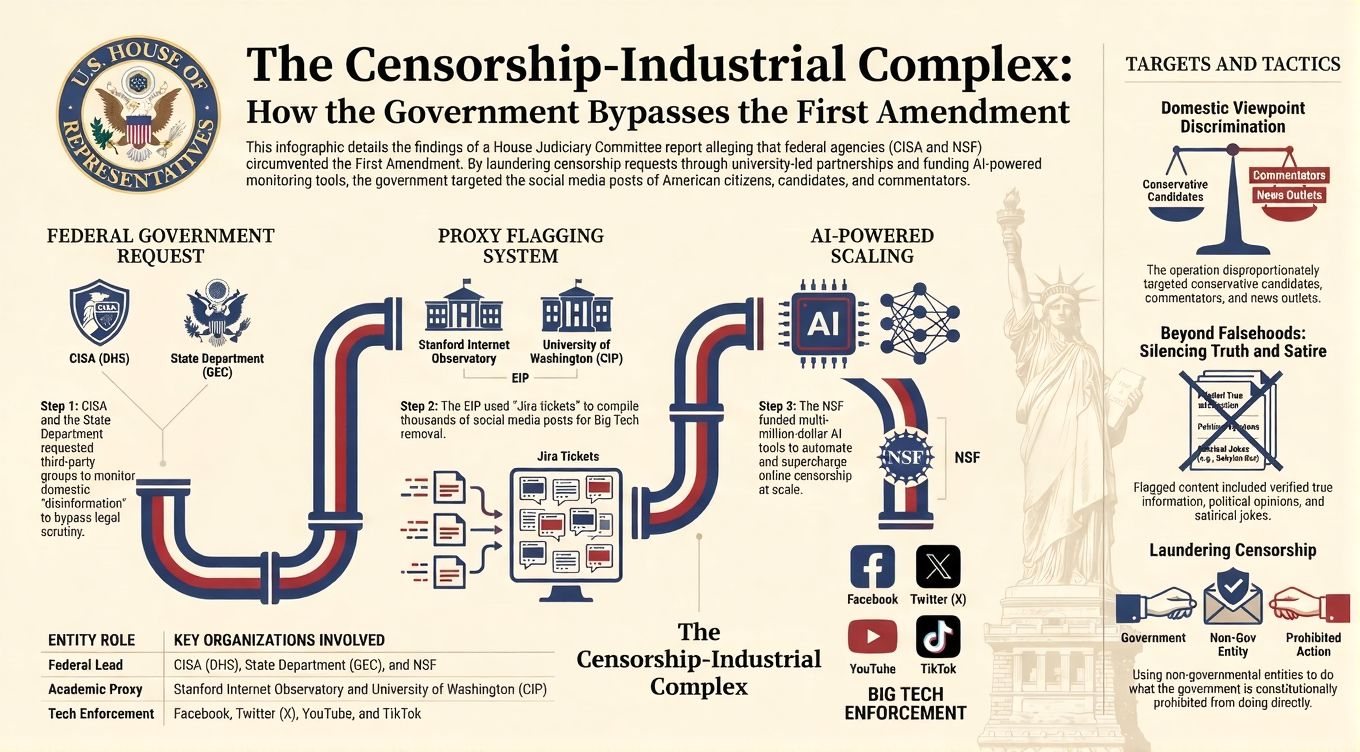
The primary vehicle for this activity was the Election Integrity Partnership (EIP), a consortium of academic and research institutions created at the request of CISA to “fill the gap” where the government lacked legal authority to censor domestic speech. This “censorship-industrial complex” facilitated the flagging of thousands of social media posts, targeting true information, satire, and political opinions. The investigation finds that while the stated goal was to combat foreign influence, the actual focus was the suppression of domestic speech, disproportionately targeting conservative viewpoints and high-profile political figures during the 2020 election cycle.
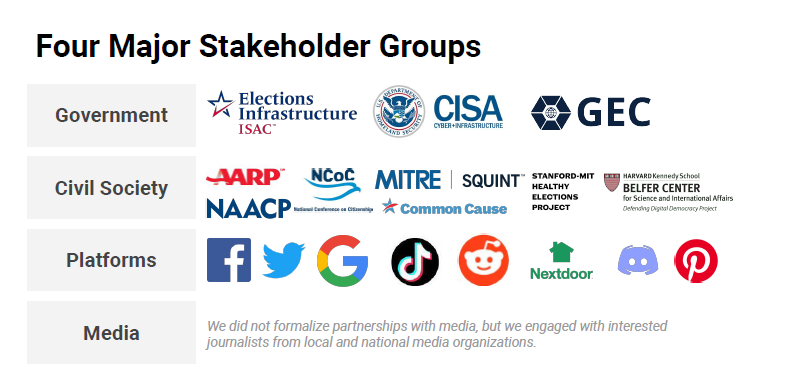
The Election Integrity Partnership (EIP): A Censorship Consortium
The EIP was established in the summer of 2020 as a collaborative project to develop real-time misinformation response capabilities. Its creation was driven by the realization that no federal agency possessed the authority to monitor or censor domestic election-related speech.
Composition and Leadership
The EIP consisted of four founding members:
- Stanford Internet Observatory (SIO): Led by Alex Stamos and Renée DiResta.
- University of Washington’s Center for an Informed Public (CIP): Focused on “strengthening democratic discourse.”
- Graphika: A digital intelligence company specializing in social media network analysis.
- The Atlantic Council’s Digital Forensic Research Lab (DFRLab): Dedicated to studying disinformation and building “digital resilience.”
Operational Mechanism: The Jira Ticketing System
The EIP utilized a centralized reporting system powered by Jira Software to track and share “misinformation” reports. The process functioned as follows:
- Submission: “External stakeholders,” including CISA, the State Department’s Global Engagement Center (GEC), and government-funded non-profits, submitted reports to the EIP.
- Analysis: EIP analysts scoured multiple social media platforms (Twitter, Facebook, YouTube, TikTok, Reddit) for similar content.
- Flagging: Compiled links were sent directly to Big Tech platforms.
- Recommendations: The EIP provided specific censorship recommendations, such as removing posts, reducing “discoverability,” or suspending accounts.
CISA: The Nerve Center of Federal Censorship
Originally designed to protect critical infrastructure from cyber threats, CISA expanded its mission to include the mitigation of “Misinformation, Disinformation, and Malinformation” (MDM).
Evolution of the Task Force
- CFITF: The Countering Foreign Influence Task Force was initially established to monitor foreign threats.
- MDM Team: In 2021, CISA transitioned the CFITF into the MDM Team to provide “flexibility” to focus on both foreign and domestic actors.
- Rumor Control: CISA Director Christopher Krebs testified that for “Rumor Control” initiatives, the agency did not distinguish between foreign and domestic origins, stating, “narratives are narratives.”
The “Switchboarding” Operation
CISA engaged in “switchboarding,” a resource-intensive process of referring content removal requests from state and local election officials to social media platforms. Internally, CISA lawyers recognized the constitutional risks, leading to the development of evolving legal disclaimers.
Disclaimer Phase | Key Feature |
|---|---|
Initial (March 2020) | Stated CISA was not the “originator” but noted information may be shared with law enforcement. |
Revised (Sept 2020) | Affirmed DHS does not seek the ability to remove info, yet maintained the threat of law enforcement sharing. |
Limited (Oct 2020) | Narrowed to CISA only; removed paragraphs regarding follow-up communications. |
The Law Enforcement Threat: The investigation notes that CISA’s disclaimers specifically mentioned sharing information with law enforcement or intelligence agencies (like the FBI). Former Facebook executive Alex Stamos testified that dealing with the FBI is inherently coercive, as executives understand that “law enforcement agencies have coercive powers” and can punish companies for activity they previously deemed appropriate.