

Modern election record chain of custody involves a significant number of links. Each of these links has an important role in the prevention of fraud. CISA frames chain of custody as a security and risk‑mitigation process for critical infrastructure systems, not just an evidentiary concept for law enforcement. It defines chain of custody as documenting, for every handoff, who handled an asset, when, where, and for what purpose, so movement and control can be tracked throughout the asset’s lifecycle. CISA emphasizes that maintaining chain of custody reduces opportunities for malicious tampering, increases transparency, and strengthens accountability for actions taken on physical or digital assets. For elections, CISA highlights that chain‑of‑custody procedures must cover items like ballots, election materials, and serialized equipment to ensure they remain secure, tamper‑evident, and fully accounted for across all stages of the election process.

A clear election record chain of custody is essential because it shows, step by step, who handled ballots, machines, and records, when they handled them, and what they did at each stage. This documented trail makes it possible to detect tampering or mistakes, prove that only authorized people had access, and demonstrate that all valid votes were securely counted, which in turn gives voters a concrete basis to trust the reported results rather than relying on blind faith.
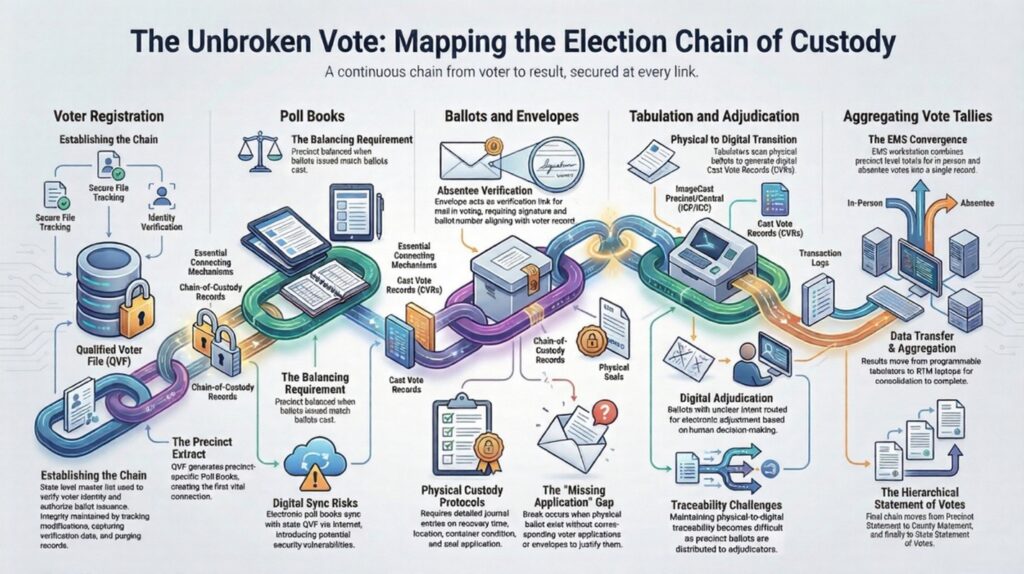
The election record chain of custody depicted below reveals the entire lifecycle of a ballot, showing how custody must remain continuous from registration through final tabulation. It begins with voter registration databases, then moves through poll books and check‑in, issuance and handling of ballots and envelopes, and the physical transport and storage of voted ballots. The chain continues into tabulation and adjudication, where paper and digital records must remain synchronized and traceable, and concludes with aggregation of vote tallies inside election‑management systems and the production of official results reports. At each stage, there are specific custody vulnerabilities—such as gaps between applications and ballots, digital‑record risks, and traceability challenges—and underscores that a single broken link can compromise the integrity and auditability of the entire election.
The burden of proof that an election was conducted with integrity lies with election officials. To put it simply, if election officials are unable to demonstrate an unbroken chain of custody, citizens have no assurance that a given election was conducted with integrity.