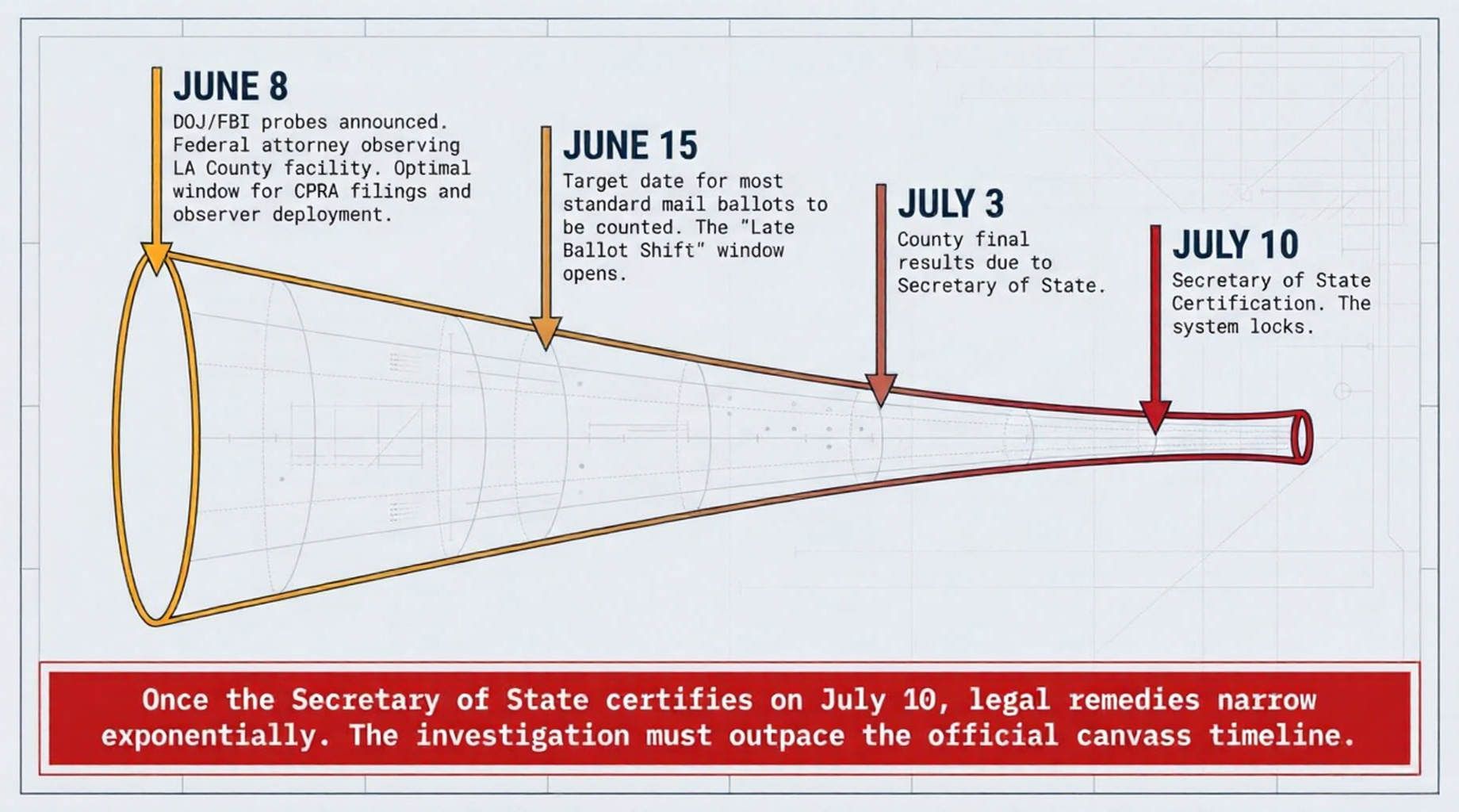
The June 2, 2026 California Statewide Primary resulted in competitive races for both Los Angeles Mayor and Governor, with results still being tallied through the seven-day post-Election Day window and into the 30-day official canvass period. This plan provides a structured investigative framework — grounded in California statutory law, federal election statutes, and procedural rights — for determining whether significant fraud has occurred, with particular focus on the structural vulnerabilities created by California’s permissive ballot harvesting (AB 1921) framework and its post-Election Day ballot acceptance window. As of June 8, 2026, the DOJ/FBI have already announced “multiple election fraud investigations” in California, and a federal attorney has been deployed to observe ballot processing at the LA County facility. The window to act is narrow: counties must finalize results by July 3, 2026, and the Secretary of State certifies on July 10, 2026.
Understanding the Statutory Environment
California’s Permissive Ballot Harvesting Framework
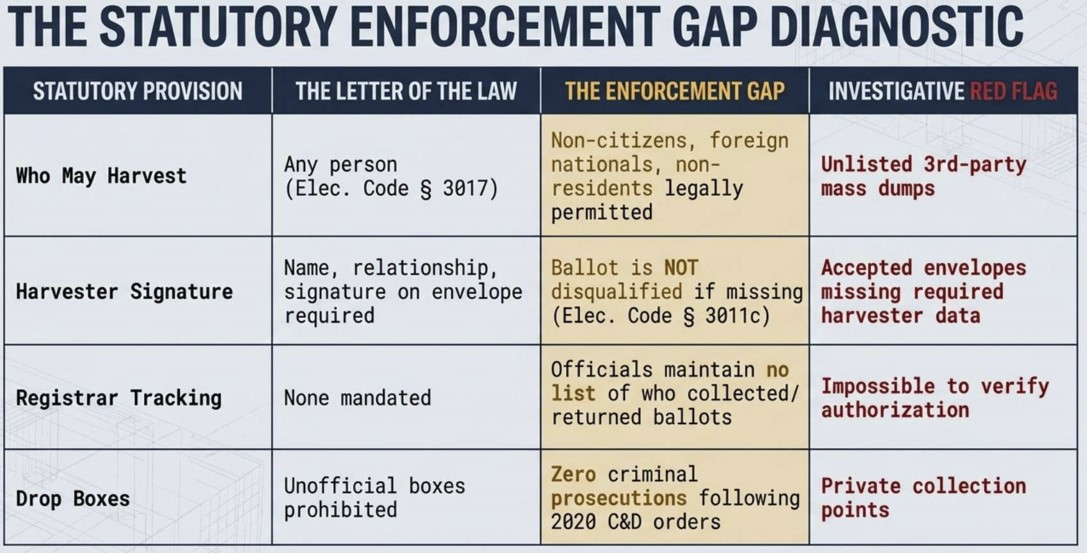
California’s third-party ballot return law, fundamentally shaped by Assembly Bill 1921 (2016), allows any person — regardless of citizenship, residency, or relationship to the voter — to collect and return an unlimited number of mail-in ballots. This is the broadest such law in the nation. Key statutory provisions and their enforcement gaps include:
|
Provision |
What the Law Says |
The Enforcement Gap |
|
Who may harvest |
Any person (Elections Code § 3017) |
Non-citizens, non-residents, foreign nationals are permitted |
|
Harvester signature |
Must provide name, relationship, signature on envelope |
A ballot is not disqualified solely because this information is missing (Elec. Code § 3011(c)) |
|
Compensation |
No per-ballot compensation allowed |
Flat-rate pay to harvesters is legal; campaigns and nonprofits may pay |
|
Chain of custody |
None required for third-party harvesters |
Harvesters are not required to document custody, provide a receipt, or identify their employer |
|
Registrar tracking |
None required |
Officials are NOT required to maintain any list of who collected and returned harvested ballots |
|
Unofficial drop boxes |
Prohibited |
Enforcement has been inconsistent; cease-and-desist orders were issued in 2020 but no criminal prosecution followed |
The Post-Election Day Acceptance Window
California law mandates that mail ballots postmarked by Election Day and received within seven days after must be counted. Under AB 840 (2017), ballots not counted in the “semifinal official canvass” (completed by the Thursday after Election Day) are exempt from the 1% manual tally audit, meaning late-arriving ballots receive less scrutiny. County officials have up to 30 days to finalize counts, with final results due to the Secretary of State by July 3, 2026, and certification scheduled for July 10, 2026.
The “Blue Shift” and Delayed Democratic Gains
Election experts and California officials have consistently documented a “red mirage” phenomenon: Republican candidates tend to lead on election night from in-person and early mail votes, while later-arriving mail ballots trend heavily Democratic. In the 2026 LA Mayoral race, Nithya Raman overtook Spencer Pratt in post-election-night counting following exactly this pattern. This is by design, not inherently fraudulent — but it creates a statistical environment ripe for abuse if bad actors exploit the lack of chain-of-custody requirements for harvested ballots. It should be noted that just because a pattern of voting has been exhibited over many races and years, does not make it legitimate. The “Blue Shift” could reasonably be explained by an established election fraud machine as opposed to benign voting practice differences between Republicans and Democrats.
Credible Vulnerability Vectors to Investigate
The following represent the specific vectors where fraud, if present, would most likely occur and be detectable:
Vector 1: Harvester Identity and Volume Anomalies
Because harvesters are not tracked, and their signatures are not required for ballot validity, the most direct fraud vector is organized mass harvesting — collecting ballots from non-voters, deceased voters, or voters who did not knowingly authorize the transfer.
Specific red flags:
- Unusually large numbers of ballots returned from a single drop by an unlisted third party
- Ballots returned without harvester signatures yet accepted
- Ballots returned from addresses that match non-residential locations (PO boxes, commercial addresses, vacant lots)
Vector 2: Voter Roll Integrity / Ineligible Voter Registrations
As of June 2026, the DOJ’s Central District is collaborating with Assistant AG Harmeet Dhillon to audit California’s voter rolls, with litigation pending before the Ninth Circuit. California has been accused of stonewalling federal requests to verify citizenship on its voter rolls.
Specific red flags:
- Registered voters at addresses with no residential history
- Duplicate registrations (same person registered multiple times)
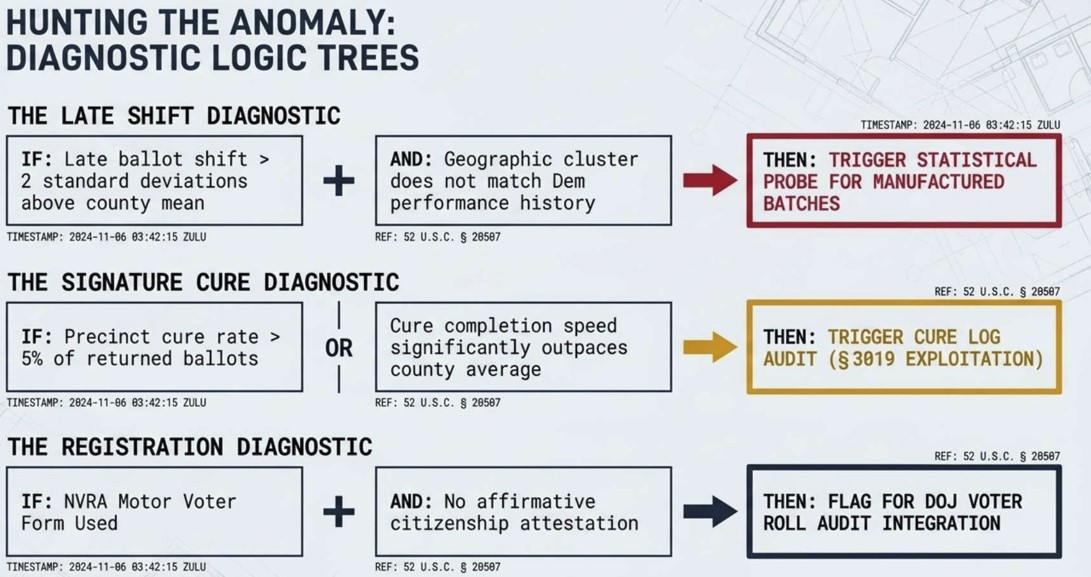
- Ballots cast by voters registered with NVRA motor voter forms who have not affirmatively attested citizenship
Vector 3: Signature Verification Integrity
Under California Elections Code § 3019, officials must compare the signature on the return envelope to the voter’s registration signature. However, an exact match is not required — officials are instructed to consider “explanations for discrepancies” including variation over time. The curing window extends 22 days post-election for signature issues.
Red flags:
- Ballots with no signature accepted through the curing process with minimal documentation
- Batches of ballots with signatures verified unusually quickly relative to volume
- Abnormal cure rates in specific precincts or zip codes
Vector 4: Post-Election Day Ballot Provenance
Ballots arriving days after Election Day cannot be independently verified as having been physically in the voter’s possession on Election Day. The 7-day window combined with no harvester chain of custody creates a window for backdating or manufacturing ballots.
Red flags:
- Ballots with postmarks that are smudged, faint, or unreadable
- USPS data showing no scan of a ballot envelope prior to its claimed postmark date
- Statistical anomalies in the ratio of late ballots to registered voters in specific geographic clusters
Vector 5: Unofficial Drop Box Activity
In 2020, the California Republican Party was issued cease-and-desist orders for placing unofficial drop boxes; the state backed down from prosecution after the party modified its practices. The potential for unofficial boxes — which have no chain of custody at all — to be used by any actor remains a structural vulnerability.
Red flags:
- Photographic or witness evidence of unlabeled or privately operated collection boxes
- Large ballot batches returned from non-official locations
Investigative Action Plan
Phase 1: Immediate Actions
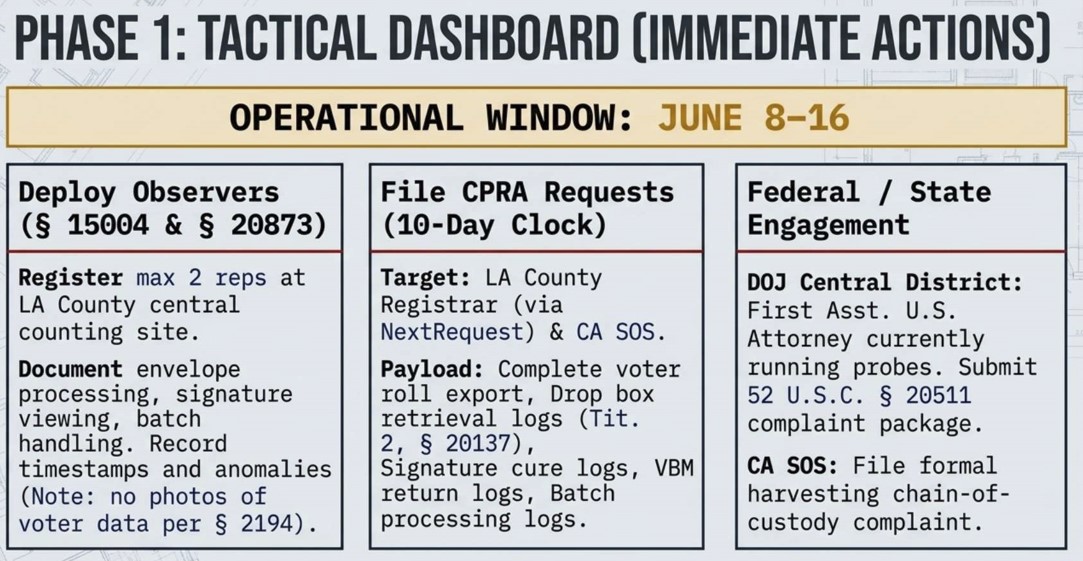
Deploy Credentialed Election Observers
Under California Elections Code § 15004 and Cal. Code Regs. Tit. 2, § 20873, any qualified political party, bona fide citizens’ association, or media organization may place up to two representatives at the central counting site.
Observers have the explicit right to:
- Observe processing of vote-by-mail identification envelopes
- View signatures on envelopes and watch the signature verification process
- Observe all phases of the election canvass
Action: Immediately contact the LA County Registrar-Recorder/County Clerk and the California Secretary of State’s office to register observers for all remaining counting sessions. Observers should document — by timestamp and notes (not photo of voter data per § 2194) — any anomalies in envelope processing, signature verification practices, or batch handling procedures.
File California Public Records Act (CPRA) Requests
Under the California Public Records Act (Gov. Code § 6250 et seq.), agencies must respond within 10 business days.
File targeted CPRA requests immediately with:
- LA County Registrar-Recorder/County Clerk (via NextRequest portal at ORG)
- California Secretary of State office
Request the following records:
- Complete voter roll export for Los Angeles County (name, address, registration date, registration method, party, ballot returned date)
- Drop box retrieval logs including two-harvester sworn oath forms, retrieval timestamps, and chain of custody forms (Cal. Code Regs. Tit. 2, § 20137)
- Vote-by-mail ballot return logs showing date/time of each returned ballot
- Signature cure logs (number of cured ballots, dates, by precinct)
- Any harvester name/signature data that was collected on identification envelopes
- Batch processing logs for all post-Election Day ballot drops
- Results update reports from election night through the current date
Engage Federal Investigative Resources
The DOJ’s Central District (First Asst. U.S. Attorney Bill Essayli) has already announced “multiple election fraud investigations” and is working with the FBI. The office is also partnering with AG Harmeet Dhillon on a voter roll audit.
Action steps:
- File a written complaint and evidence package with the U.S. Attorney’s office (Central District of California) at 312 N. Spring St., Los Angeles, CA 90012, referencing 52 U.S.C. § 20511 (criminal penalties for defrauding a fair election) and 18 U.S.C. § 594 (intimidation/coercion) as applicable statutes
- Request FBI field office contact for election crimes unit in Los Angeles
- Submit evidence to the DOJ Civil Rights Division’s Election Crimes Branch (Washington, DC)
Engage the California Secretary of State’s Complaint Process
The CA Secretary of State accepts election integrity complaints. File a formal complaint specifying the harvesting chain-of-custody gaps and requesting a supplemental audit of late-arriving ballots in LA County.
Phase 2: Data Analysis and Forensic Review
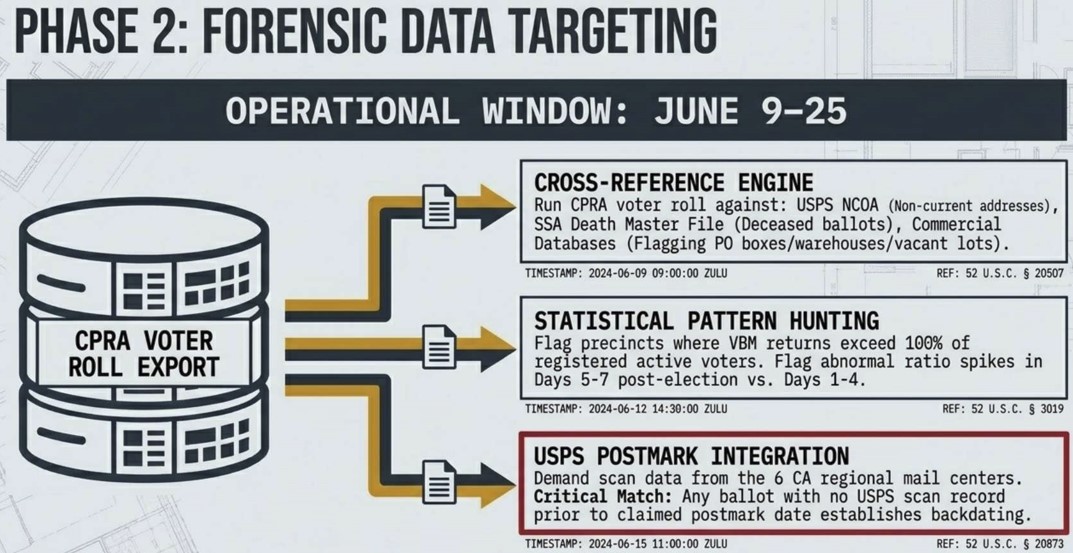
Once CPRA records begin arriving (10-business-day deadline), implement the following analytical protocols:
Voter Roll Cross-Reference Analysis
Using the voter roll export, cross-reference against:
- USPS National Change of Address (NCOA) database to identify voters registered at non-current addresses
- SSA Death Master File to identify ballots cast by deceased voters
- Commercial residential address databases to flag ballots returned from non-residential addresses (offices, warehouses, PO boxes)
- National Voter Registration Interstate Crosscheck (ERIC) data, if accessible, to identify potential duplicate registrations across state lines
This analysis can be performed with publicly available voter data and commercially available data append tools.
Statistical Pattern Analysis — The “Late Ballot Shift”
Normal post-election blue shift should follow a predictable pattern based on known Democratic vs. Republican mail-in voting behavior.
Flags warranting further investigation:
- Precincts where the post-Election Day ballot shift significantly exceeds the predictable blue shift rate (e.g., more than 2 standard deviations above the county mean shift)
- Geographic clustering of late ballot returns in specific zip codes that do not match known Democratic performance areas
- Unusually high ratios of VBM ballots received on days 5-7 after Election Day compared to days 1-4
- Precincts where the number of returned ballots exceeds 100% of registered active voters
Envelope Signature and Cure Rate Audit
From the cure logs, identify:
- Any precincts with abnormally high cure rates (e.g., >5% of returned ballots requiring cure)
- Any precincts with cure completion rates significantly faster than the county average
- Whether cured ballots skew disproportionately to one candidate
Postmark Integrity Analysis
Request from the U.S. Postal Service (USPS) via appropriate channels the scan/postmark data for ballot return envelopes processed through the six California regional mail processing centers. This is relevant because: USPS scan records establish a timestamped chain of custody independent of county registrar data. Ballots with no USPS scan record prior to their claimed postmark date are a significant red flag.
Harvester Envelope Signature Audit
From the identification envelope data (if obtained), determine:
- What percentage of returned ballots have no harvester name/signature
- Whether any harvester names appear with suspiciously high frequency (indicating organized mass harvesting)
- Whether any harvester names match known campaign or GOTV organization employees
Phase 3: Legal Challenges and Administrative Actions
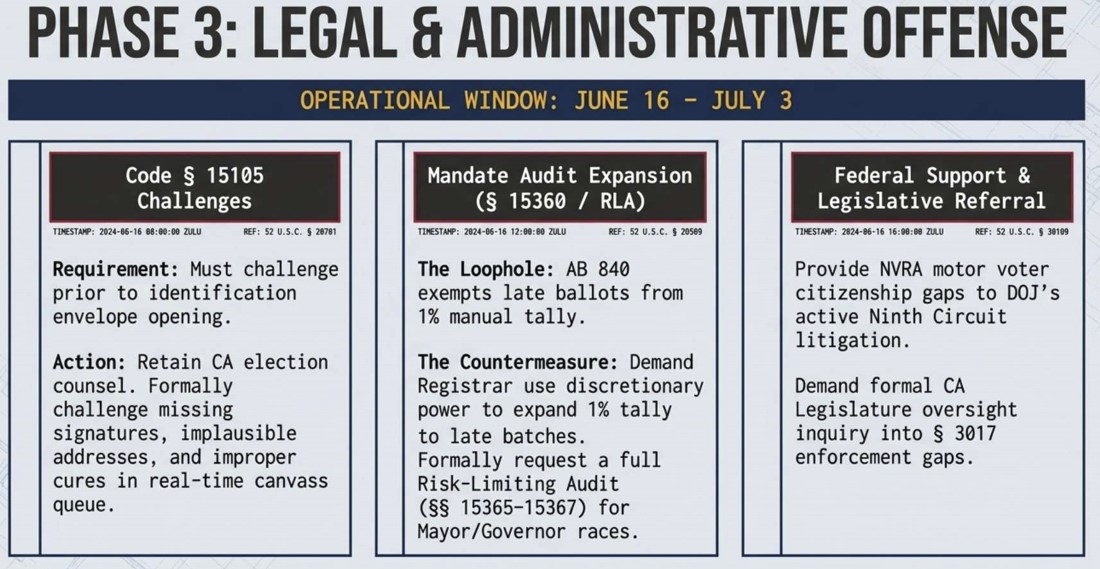
Challenge Specific Ballots via Elections Code § 15105
Under California Elections Code § 15105, challenges to vote-by-mail voters may be entered on grounds including failure to receive the ballot within the statutory time period. Challenges must be made prior to the opening of the identification envelope. For ballots still in queue, this window remains open during the canvass period. Retain qualified California election law counsel to:
- Review challenged ballot categories with the county Registrar
- File formal challenges for ballots with documented defects (missing signatures, implausible addresses, mismatched signatures that were improperly cured)
Demand Inclusion of Late Ballots in the 1% Manual Tally
California Elections Code § 15360 mandates a 1% manual tally, but AB 840 (2017) exempts ballots not in the semifinal canvass. However, elections officials may select additional precincts at their discretion. File a formal written demand — with supporting statistical analysis from Phase 2 — requesting that the LA County Registrar expand the manual tally to include a statistically significant sample of post-Election Day ballots.
Risk-Limiting Audit (RLA) Request
Under California Elections Code §§ 15365–15367, counties may conduct a risk-limiting audit as an alternative or supplement to the 1% manual tally. An RLA gives every ballot an equal chance of being audited, unlike the precinct-based 1% tally. Formally request that LA County conduct an RLA for the mayoral and gubernatorial races, particularly encompassing post-Election Day ballots.
Support the Federal Voter Roll Audit
The DOJ’s lawsuit in the Ninth Circuit seeks access to California’s voter registration data to verify citizenship. File amicus materials or declarations supporting the DOJ position. Specifically, obtain and submit: NVRA motor voter registration records for LA County that do not include affirmative citizenship attestation, cross-referenced against returned ballots.
State Legislative Referral
Contact members of the California State Assembly and Senate Elections Committees — particularly Republican minority members — requesting a formal legislative inquiry under the Legislature’s oversight authority into the structural enforcement gaps in Elections Code § 3017 (harvesting) and § 15360 (1% tally exemption for late ballots).
Phase 4: Public Documentation and Litigation Preservation
Preserve All Evidence
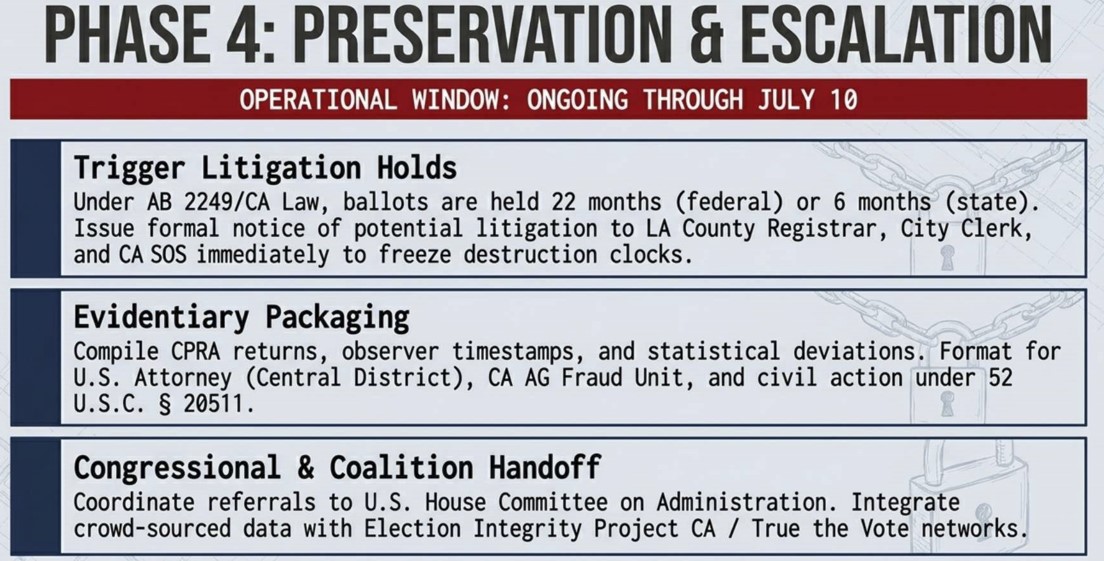
Under California law, voted ballots and VBM identification envelopes must be retained for 22 months for federal elections and 6 months for state elections. Formal written notice of potential litigation should be sent to the LA County Registrar, the California Secretary of State, and the City Clerk immediately to trigger litigation hold obligations and prevent premature destruction of materials.
Document the Full Chain of Findings
Compile all CPRA responses, observer notes, statistical analyses, and federal complaint submissions into a documented evidentiary package.
This package should be formatted for:
- Submission to the California Attorney General’s elections fraud unit
- Submission to the U.S. Attorney’s office (Central District)
- Potential use in a civil action under 52 U.S.C. § 20511 or California Elections Code provisions for ballot fraud
Monitor the Canvass and Certification in Real Time
The key dates remaining in the certification timeline are:
|
Milestone |
Deadline |
|
Most standard mail ballots counted |
~June 15, 2026 |
|
County final results to Secretary of State |
July 3, 2026 |
|
Secretary of State certification |
July 10, 2026 |
|
Ballot destruction window opens (state races) |
6 months post-certification |
|
Ballot destruction window opens (federal races) |
22 months post-certification |
Coordinate with Other Investigative Actors
- The DOJ/FBI Central District has an active observer and open investigations
- Congressional oversight: U.S. House Committee on Administration has jurisdiction over federal election integrity matters; a formal referral package from an organized investigation carries weight
- Election integrity organizations: Election Integrity Project California, True the Vote, and similar organizations have existing networks for crowd-sourced observer deployment and data analysis
Counter-Arguments to Anticipate
The “Red Mirage” Defense: State officials and independent election experts uniformly state that the late Democratic shift is a predictable, documented pattern caused by partisan differences in voting method, not fraud. Any statistical challenge must rigorously distinguish abnormal shift from the expected shift.
Debunked Viral Claims: The claim that Spencer Pratt received zero votes in a batch of 24,000 ballots has been authoritatively debunked by LA County Registrar Michael Sanchez, who confirmed Pratt received votes in every update. Building an investigation on debunked claims damages credibility. Focus only on structural and documentary gaps, not social media narratives.
Federal Jurisdictional Limits: Federal prosecutors have jurisdiction over federal races (gubernatorial races involve no federal office; the LA Mayoral race is a city race). Federal election fraud statutes apply where federal offices are on the same ballot — which they are in a California statewide primary. However, state-only or city-only races may require reliance on state-law remedies.
The Chain-of-Custody Gap Cuts Both Ways: While the absence of mandatory harvester documentation is a genuine structural vulnerability, its absence also means there is little documentary evidence of misconduct absent testimony or investigative subpoena. CPRA requests will not produce harvester logs that were never required to be kept.
Certification Finality: Once the Secretary of State certifies results on July 10, 2026, legal remedies narrow significantly. Speed of action is essential.
Summary
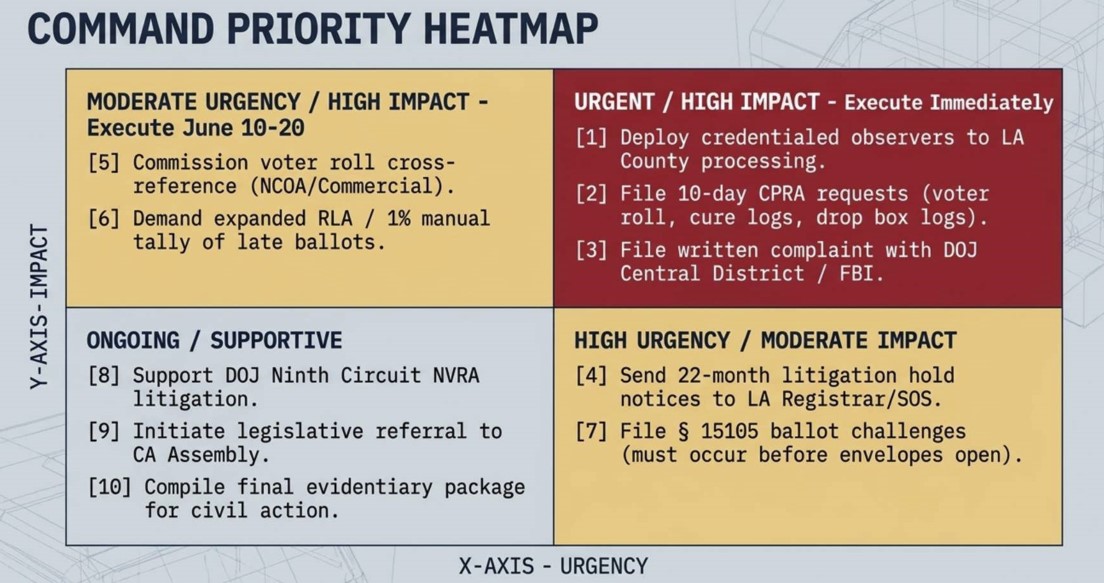
|
Priority |
Action |
Deadline |
|
1 — URGENT |
Deploy credentialed observers to LA County ballot processing |
Immediately |
|
2 — URGENT |
File CPRA requests: voter roll, drop box logs, cure logs, batch reports |
Immediately (10-day clock starts) |
|
3 — URGENT |
File written complaint with DOJ Central District / FBI |
June 9–10, 2026 |
|
4 — HIGH |
Send litigation hold/preservation notice to LA County Registrar and CA SOS |
June 10, 2026 |
|
5 — HIGH |
Commission voter roll cross-reference and statistical analysis |
June 10–20, 2026 |
|
6 — HIGH |
Demand expanded manual tally / RLA of late ballots |
June 15–20, 2026 |
|
7 — HIGH |
File ballot challenges under Elections Code § 15105 |
Before envelopes opened |
|
8 — MEDIUM |
Support DOJ Ninth Circuit voter roll litigation |
Ongoing |
|
9 — MEDIUM |
Legislative referral to CA Assembly/Senate Elections Committees |
June–July 2026 |
|
10 — ONGOING |
Compile evidentiary package for potential civil action |
Through July 10, 2026 |
Citations
- DOJ office says ‘multiple’ probes of California elections underway … – A federal prosecutor indicated the investigations are focused on the Los Angeles area following Pres…
- Essayli says ‘multiple election fraud investigations underway … – ABC7 – Jun 02, 2026, 7:54 PM. See live election results for California Primary 2026. Ballot are being count…
- Election fraud probes in California announced by US Attorney amid … – First Assistant U.S. Attorney Bill Essayli announced federal election fraud probes in California fol…
- Election results for CA governor, L.A. mayor could be slow. Don’t … – Voters should remember that it’s very likely that particular primaries, such as the gubernatorial an…
- DOJ prosecutor in California opens ‘multiple election fraud’ probes – Bill Essayli, the first assistant U.S. attorney for the Central District of California, announced Fr…
- US attorney opens investigations into California’s election – YouTube – The U.S. attorney’s office in Los Angeles said Friday it had opened “multiple election fraud investi…
- When will we know California election results? – CalMatters – Don’t expect results for the California governor’s race tonight. Mail-in voting contributes to the s…
- Here’s what you need to know about ballot harvesting in California … – Elections officials say it is illegal, but Republicans argue the drop boxes are a legal form of ball…
- What is ballot harvesting and what is allowed in California? – Yet California Republicans are refusing to remove the boxes, which Democratic officials say are ille…
- Calvert Exposes Serious Ballot Harvesting Liabilities – Congressman Ken Calvert (CA-42) has received a response to his March 4th letter to the Riverside Cou…
- California election: GOP buys into ‘ballot harvesting’ – CalMatters – The California GOP is going big on collecting ballots from voters and dropping them off at election …
- Vote By Mail – California Secretary of State – CA.gov – Any registered voter may vote using a vote-by-mail ballot instead of going to the polls on Election …
- How Does California Count votes? – TIME – California election officials say the state’s drawn-out tally is by design, not the result of fraud.
- Audit Law Database – California – Verified Voting – California’s audit law calls for every contest and ballot issue on the ballot to be audited by means…
- DOJ debunks social media claim of discrepancy in LA mayor vote … – A Los Angeles-based Justice Department official late Friday debunked a baseless claim of a discrepan…
- Musk Boosts Election Denialism As Raman Overtakes Pratt In LA … – Musk’s boosting of baseless claims about the primaries in California follows similar efforts by Pres…
- Trump, without proof, claims California vote fraud and orders inquiry – Trump made claims of cheating in the vote, as had been predicted by election experts and Democratic …
- Federal prosecutors are accusing California of blocking access to … – U.S. Attorney Bill Essayli said California is refusing to comply with a federal request for voter re…
- California Elections Code § 3019 (2025) – Justia Law – 3019. (a) (1) Upon receiving a vote by mail ballot, the elections official shall compare the signatu…
- Code Regs. Tit. 2, § 20873 – Rights of Election Observers – (a) As provided in Elections Code sections 15004(a) and (b), each political party qualified to parti…
- Election Observations Rights and Responsibilities – An election observer shall have the right to observe the processing of vote-by-mail identification e…
- Election Observer Guidelines – Vote Madera – The purpose of an Election Observer is to allow public observation and input into the election proce…
- How to make a California Public Records Act (CPRA) request – The CPRA ensures that the public has the right to access records maintained by state and local agenc…
- Make a Public Records Act Request – The County of Los Angeles DOES NOT maintain a centralized record keeping system. · Examples of reque…
- Code Regs. Tit. 2, § 20137 – Ballot Collection Procedures and … – The county elections official shall assign at least two designated ballot retrievers to retrieve vot…
- 52 USC 20511: Criminal penalties – OLRC Home – §20511. Criminal penalties. A person, including an election official, who in any election for Federa…
- Due to recent USPS changes, mail ballots from communities located … – 🗳️drop off your ballot in-person in the post office and ensure it is postmarked 🗳️drop off your ball…
- Section 15105. – 2025 California Code :: Elections Code – Justia Law – Cal. ELEC Code § 15105 – 15105. Challenges to a vote by mail voter may be made for the same reasons …
- Post-Election Audits – Shasta County Elections – We complete a post-election audit during the official canvass of each election where a voting system…
- Post Election Audits – Inyo County Elections – In Inyo County, all ballots are subject to a post-election audit in each election. These audits are …
- Risk-Limiting Audits – California Secretary of State – CA.gov – A risk-limiting audit is a method of ensuring that election results match voter selections reflected…
- Coalition Files Brief Urging Court to Block Justice Department’s … – PASADENA — Today the League of United Latin American Citizens filed an amicus brief in the U.S. Cour…
- AB 2249: Elections: retention of election records. | Digital Democracy – Under existing law, specified election materials, including voted ballots, vote by mail voter identi…
- How a simple mix-up fueled false claims about L.A. vote count – Since election night in California, a single theory of election fraud has taken root like no other a…