Every election ends the same way for most Americans. We cast our ballots, turn on the news, and watch numbers scroll across the screen. A few weeks later the results are certified, and we are told the matter is settled.
But what actually happened between the moment your ballot went into the tabulator and the moment those results were certified? For the overwhelming majority of citizens, the honest answer is: we don’t know. We are asked to trust.
The Election Crime Bureau built the Audit Management Tool (AuditTheBlackBox.com) to help change that, one public record at a time.
Oh…one more thing…Mike Lindell has made the tool FREE to use.
What is the Black Box?
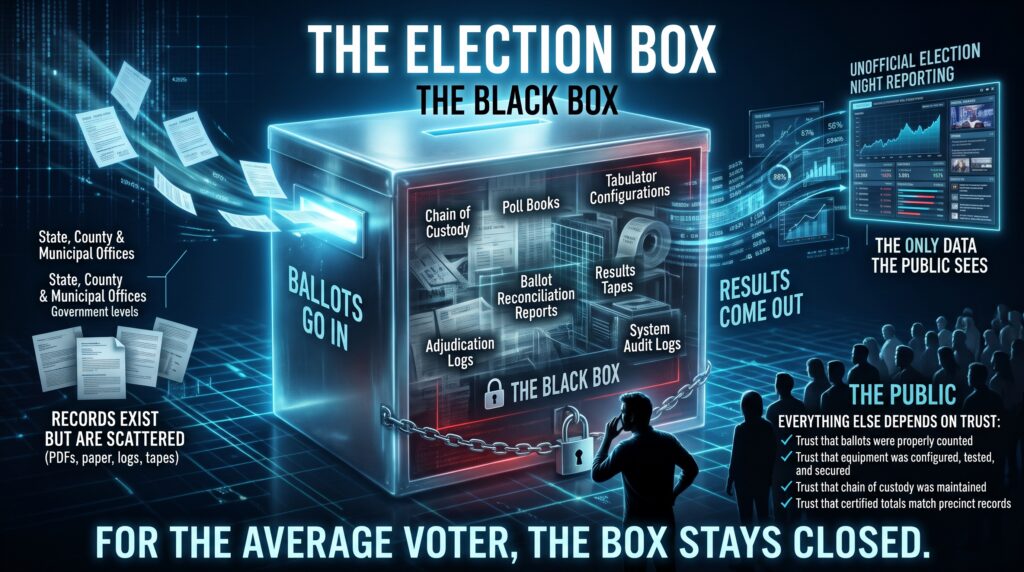
Think of an election as a box. Ballots go in one side. Results come out the other. Everything in between — the chain of custody, the poll books, the tabulator configurations, the results tapes, the ballot reconciliation reports, the adjudication logs, the system audit logs — sits inside the box, out of public view.
On election night, the only data the general public sees is unofficial election night reporting, typically relayed through media outlets and results websites. Those numbers are useful for headlines, but they are not the records of the election. They are summaries, and they offer no way to independently confirm how the totals were produced.
Everything else depends on trust:
- Trust that ballots were properly counted and reconciled against the number of voters who checked in.
- Trust that equipment was configured, tested, and secured as required.
- Trust that the chain of custody for ballots, memory devices, and records was maintained.
- Trust that the certified totals match the underlying records at the precinct level.
The records that would let a citizen verify those things generally exist. They are created by election officials as part of normal operations. But they are scattered across state, county, and municipal offices, held in inconsistent formats, and usually available only through formal public-records requests. For the average voter, the box stays closed.
Why Is An Audit Management Tool Necessary?
Because trust alone is no longer enough.
A large share of Americans now say they lack confidence in how elections are administered. That loss of confidence is not resolved by press releases or reassurances. It is resolved by verification: citizens being able to see the records, check the math, and draw their own conclusions.
The principle is simple. In any other high-stakes system, whether financial, aerospace, or medical, we don’t accept “trust us” as an answer. We audit. We document. We verify. Elections, which determine who governs us, deserve at least the same standard.
The problem is that citizen-led verification is hard to do at scale. One person can file a records request. Auditing a statewide election requires hundreds or thousands of requests, sent to the right custodians, tracked against statutory deadlines, followed up when overdue, paid for when fees apply, and organized when the responses arrive. Without a system to manage that work, efforts fragment, requests fall through the cracks, and the records that do come in are hard to use.
The Audit Management Tool exists to provide that system.
What Is the Audit Management Tool?
The Audit Management Tool is the Election Crime Bureau’s platform for coordinating statewide election audits. It brings volunteers, jurisdictions, elections, and public-records requests into one managed workspace.
Here’s how participation works:
- Volunteer registration. Citizens register online, select the states and elections they would like to help with, and agree to handle audit materials confidentially and in accordance with Election Crime Bureau policy.
- Administrator review. Every registration is reviewed by an audit administrator before access is granted. New registrants start with a Volunteer role.
- Scoped assignments. Administrators assign each volunteer a specific jurisdiction and election scope, so every request has an owner and work isn’t duplicated.
- Invited audits. Volunteers can also join through an invitation link tied to a particular audit, with the jurisdiction and election preset.
The result is an organized, accountable process for turning a closed box of election records into an open, reviewable body of evidence.
How the Tool Supports Election Audits
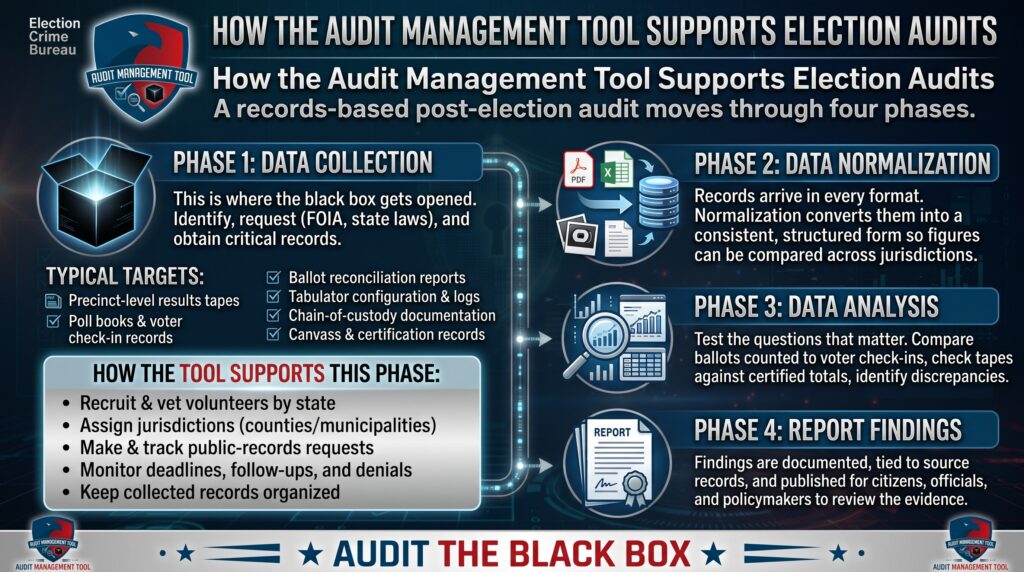
A records-based post-election audit moves through four phases.
Phase 1: Data Collection
This is where the black box gets opened. Data collection means identifying the records that matter, requesting them from the correct custodians, and actually obtaining them. Depending on the state, those requests go out under the Freedom of Information Act or the state’s public-records law (Minnesota, for example, uses its Data Practices Act). Typical targets include:
- Precinct-level results tapes and statements of votes cast
- Poll books and voter check-in records
- Daily ballot reconciliation reports for election day, early voting, and absentee counting
- Tabulator configuration, logic-and-accuracy testing, and audit logs
- Chain-of-custody documentation for ballots and memory devices
- Canvass and certification records
This is the phase the Audit Management Tool is built to support. It gives each audit a structured way to:
- Recruit and vet volunteers by state and election
- Assign jurisdictions so every county and municipality is covered
- Make and track public-records requests from submission to response
- Monitor deadlines, follow-ups, denials, and fee demands
- Keep collected records organized and tied to the request that produced them
Phase 2: Data Normalization
Records arrive in every format imaginable: scanned PDFs, spreadsheets, photographs of tapes, exported logs, and sometimes paper. Normalization converts them into a consistent, structured form so precinct totals, reconciliation figures, and equipment data can be compared across jurisdictions.
Phase 3: Data Analysis
With normalized data in hand, the audit can test the questions that matter. Do ballots counted match voters checked in? Do precinct results tapes match certified totals? Do equipment configurations and logs match what was certified and tested? Where are the discrepancies, and how large are they?
Phase 4: Report Findings
Finally, findings are documented, tied back to the source records, and published so citizens, officials, and policymakers can review the evidence for themselves. Good findings separate what the records prove from what still needs explaining.
Super Intelligence Changes the Math on Phases 2 Through 4
Historically, normalizing and analyzing thousands of election records took teams of analysts months of work, at a cost few citizen groups could afford. That is no longer the case.
Advances in artificial super intelligence (SI) now make Phases 2, 3, and 4 feasible in a timely and cost-effective manner. SI tools can extract data from scanned documents, structure inconsistent formats, cross-check figures across thousands of records, flag anomalies for human review, and help draft documented findings. Work that once took months can now be done in days, with humans verifying the results.
That shifts the bottleneck. Analysis is no longer the hardest part. Getting the records is.
How You Can Help
No amount of computing power can analyze records that were never requested. Data collection remains the hardest, slowest, and most labor-intensive phase of any election audit. It depends on two things that only people can provide.
Volunteers
Statewide audits require requests to state, county, and local election offices, often several requests per office. Each one has to be drafted, submitted, tracked, followed up on, and logged when it comes back. That takes many hands. Whether you can give an hour a week or an hour a day, the Audit Management Tool will help you put that time where it counts.
Financial Support
Public records are not always free. Audits incur real costs:
- FOIA and public-records fees charged by jurisdictions for search, review, and copying
- Super intelligence costs for the compute that powers normalization, analysis, and reporting
- Infrastructure costs for the secure platform, storage, and tools that hold the records and coordinate the work
Every dollar contributed goes toward keeping the box open: paying for records, analyzing them, and publishing what they show.
Support Our Effort
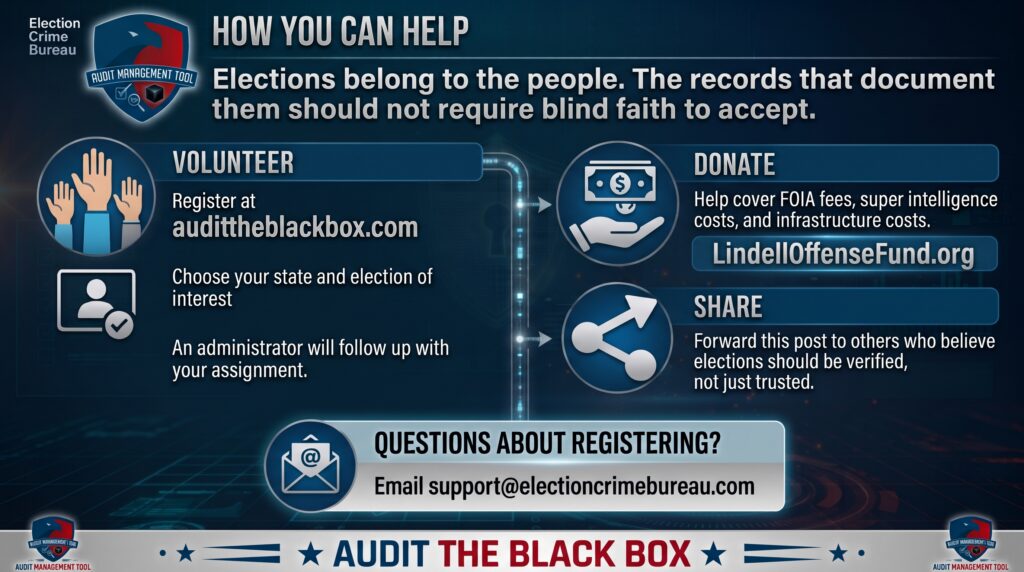
Elections belong to the people. The records that document them should not require blind faith to accept.
- Volunteer: Register at AuditTheBlackBox.com, choose your state and election of interest, and an administrator will follow up with your assignment.
- Donate: Help cover FOIA fees, super intelligence costs, and infrastructure costs. LindellOffenseFund.org
- Share: Forward this post to others who believe elections should be verified, not just trusted.
Questions about registering? Email [email protected].