Established Fact
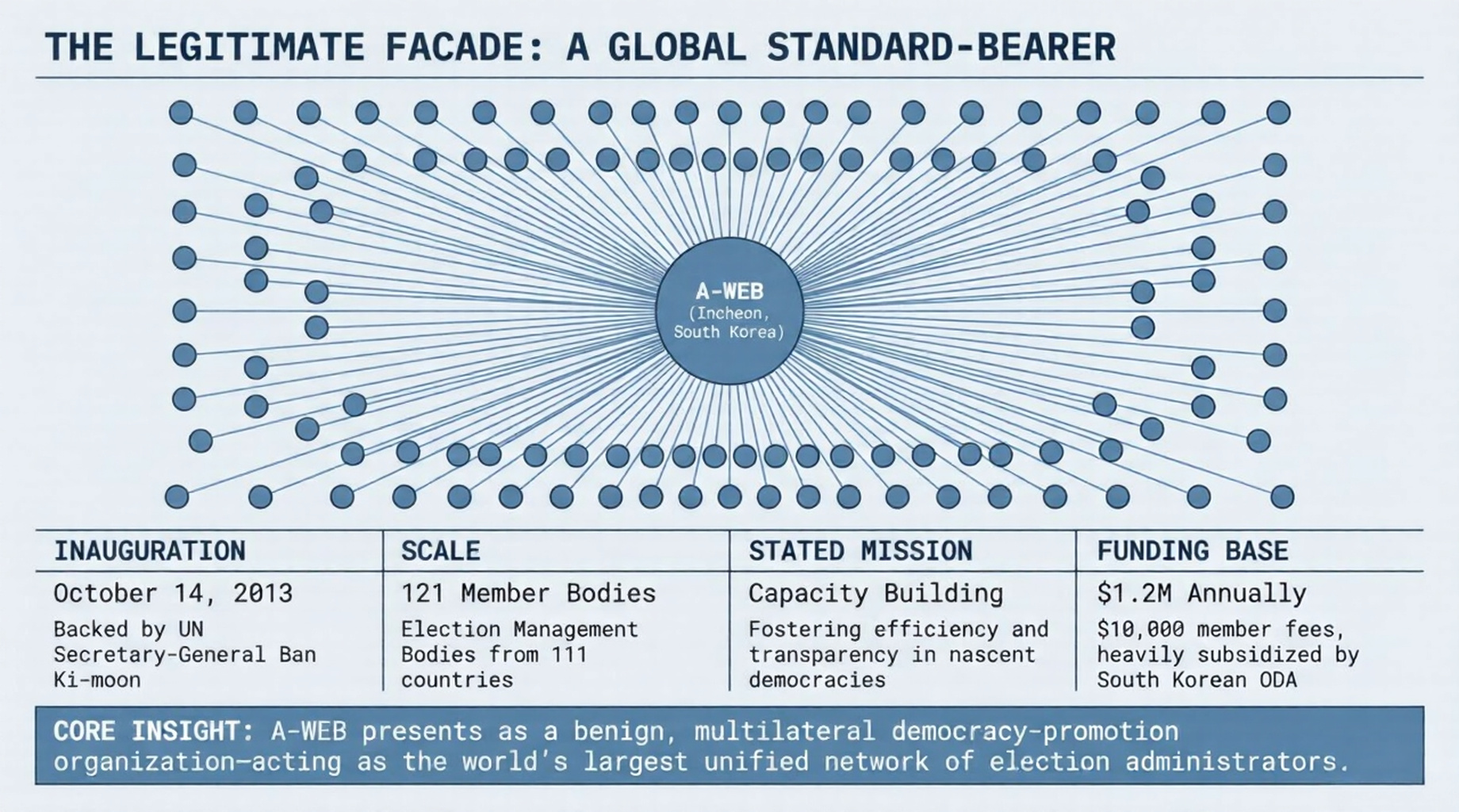
The Association of World Election Bodies (A-WEB) is the world’s largest international organization dedicated to election management, headquartered in Incheon (Songdo), South Korea, and comprising 121 election management bodies (EMBs) from 111 countries. Founded in October 2013 under the direct sponsorship of South Korea’s National Election Commission (NEC), A-WEB presents itself as a benign democracy-promotion organization. However, a convergence of documented cybersecurity failures in South Korea’s own NEC, the international deployment of controversial South Korean election technology through associated firm Miru Systems, and a growing body of allegations from U.S. and Korean election integrity researchers have raised substantive concerns about its true scope of influence — particularly regarding elections in developing nations where USAID funds the electoral process, and its indirect linkages to election integrity debates in the United States.
Origins and Founding
The South Korean NEC Proposal
A-WEB traces its origins to a 2010 proposal by South Korea’s National Election Commission (NEC), which presented the concept of a global election management body to the Association of Asian Election Authorities (AAEA). The NEC’s chairperson, Nung-Hwan Kim, personally visited UN Secretary-General Ban Ki-moon in August 2012 at UN headquarters to build support, with Ban endorsing the concept and pledging UN assistance. The UNDP’s Bureau for Development Policy also formally joined the working group established to draft A-WEB’s charter.
A series of working group meetings followed, with the first held in Seoul in 2012. Participants included regional associations (AAEA, ACEEEO, ACEO, UNIORE) and international organizations (IFES, EISA, International IDEA, and UNDP). The name “A-WEB” was adopted upon the suggestion of the Election Commission of India.
Formal Establishment
A-WEB was officially inaugurated on October 14, 2013, in Songdo, Incheon, South Korea, where the Secretariat was permanently established. Over 400 participants from 140 election management bodies, international organizations, and NGOs attended the founding ceremony, with 97 organizations immediately gaining membership. The charter articulates a vision “to foster efficiency and effectiveness in conducting free, fair, transparent and participative elections worldwide”.
The founding rationale was explicitly developmental: many newly democratic nations lacked the institutional capacity to conduct credible elections, and political instability was undermining the effectiveness of international economic development assistance. A-WEB was positioned as the structural solution — providing capacity building and knowledge transfer to nascent democracies.
Governance Structure
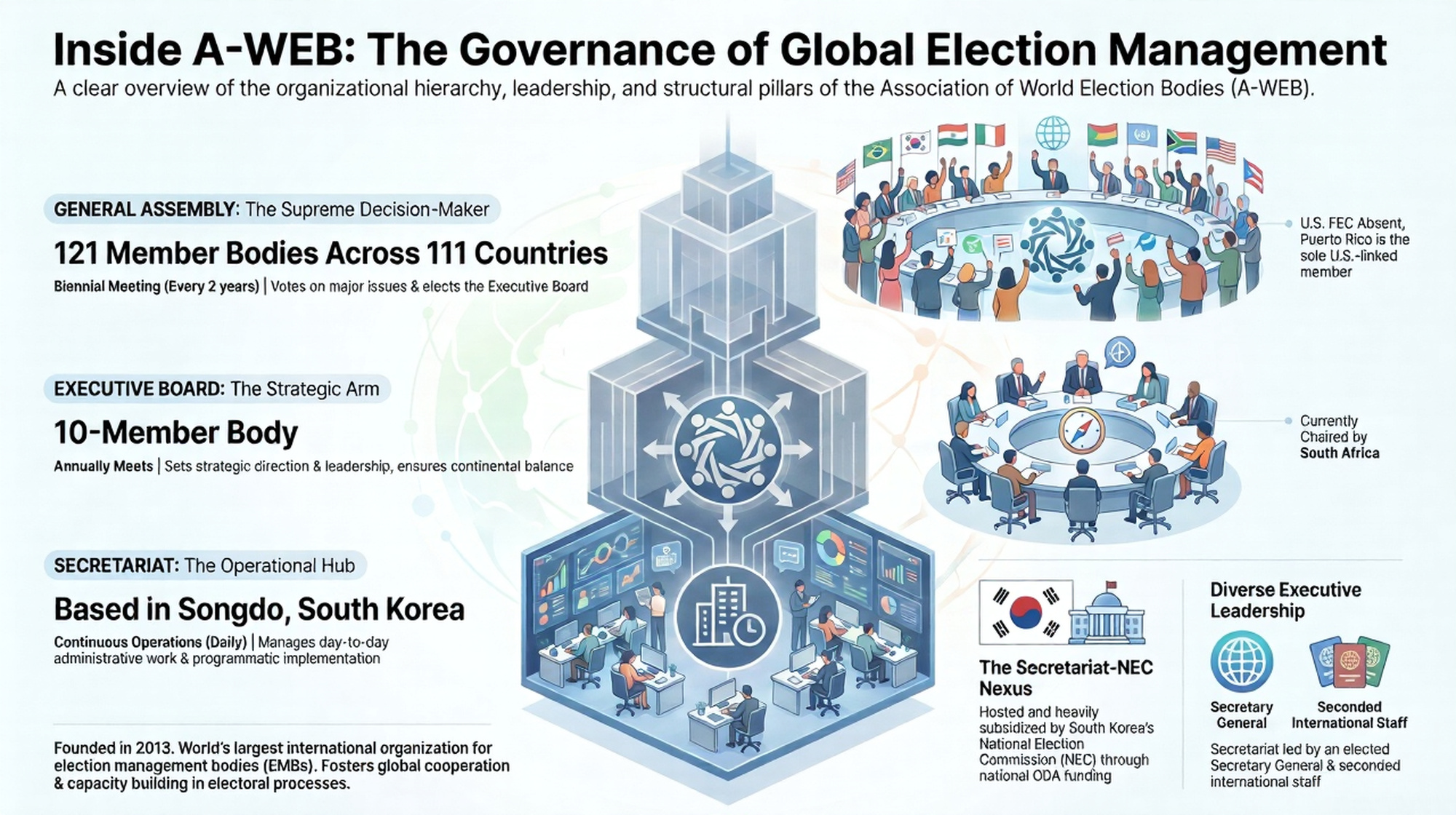
A-WEB operates through three primary bodies:
- Executive Board — The executive arm, meeting annually to set strategic direction. Consists of up to 10 member organizations, with a continental balance requirement. Headed by a Chairperson serving a two-year term.
- General Assembly — Convenes biennially. Votes on major issues, elects Executive Board members, and confirms new member organizations.
- Secretariat — Located in Songdo, South Korea, carries out day-to-day administrative and programmatic work. The Secretary General is elected by the Executive Board and hosted in South Korea; seconded staff from member countries operate alongside Korean nationals.
The current chairman is Mosotho Moepya of South Africa. The Election Commission of India served as Vice-Chair (2017–19) and Chair (2019–22), reflecting the organization’s significant outreach beyond Korea. As of 2026, A-WEB comprises 121 EMBs from 111 countries.
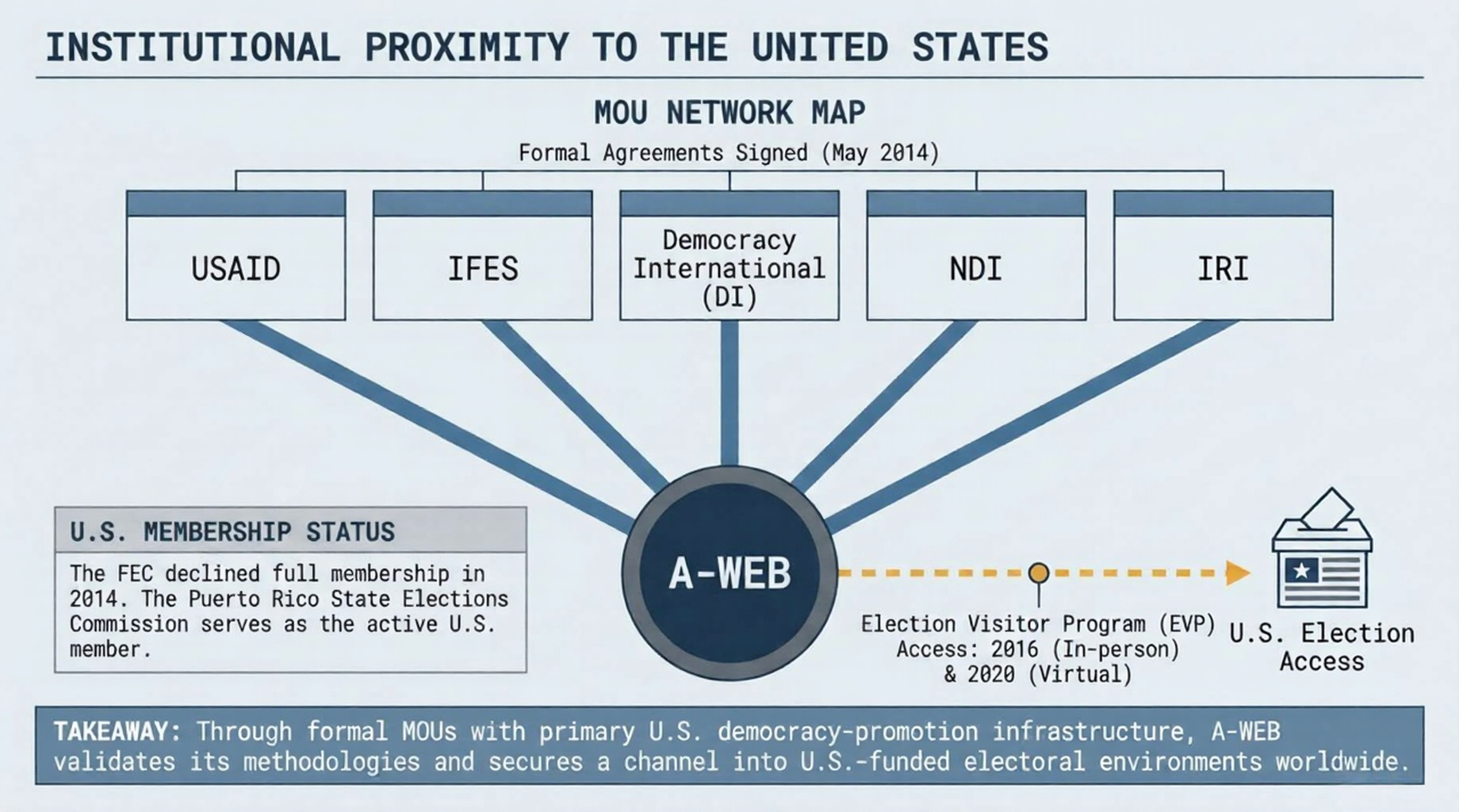
Notably, the U.S. Federal Election Commission (FEC) is not a member — A-WEB’s U.S.-linked member body is the Puerto Rico State Elections Commission. A-WEB encouraged the FEC to join as a full member during Washington meetings in 2014 but the FEC declined.
Funding and Financial Structure
Membership Fees
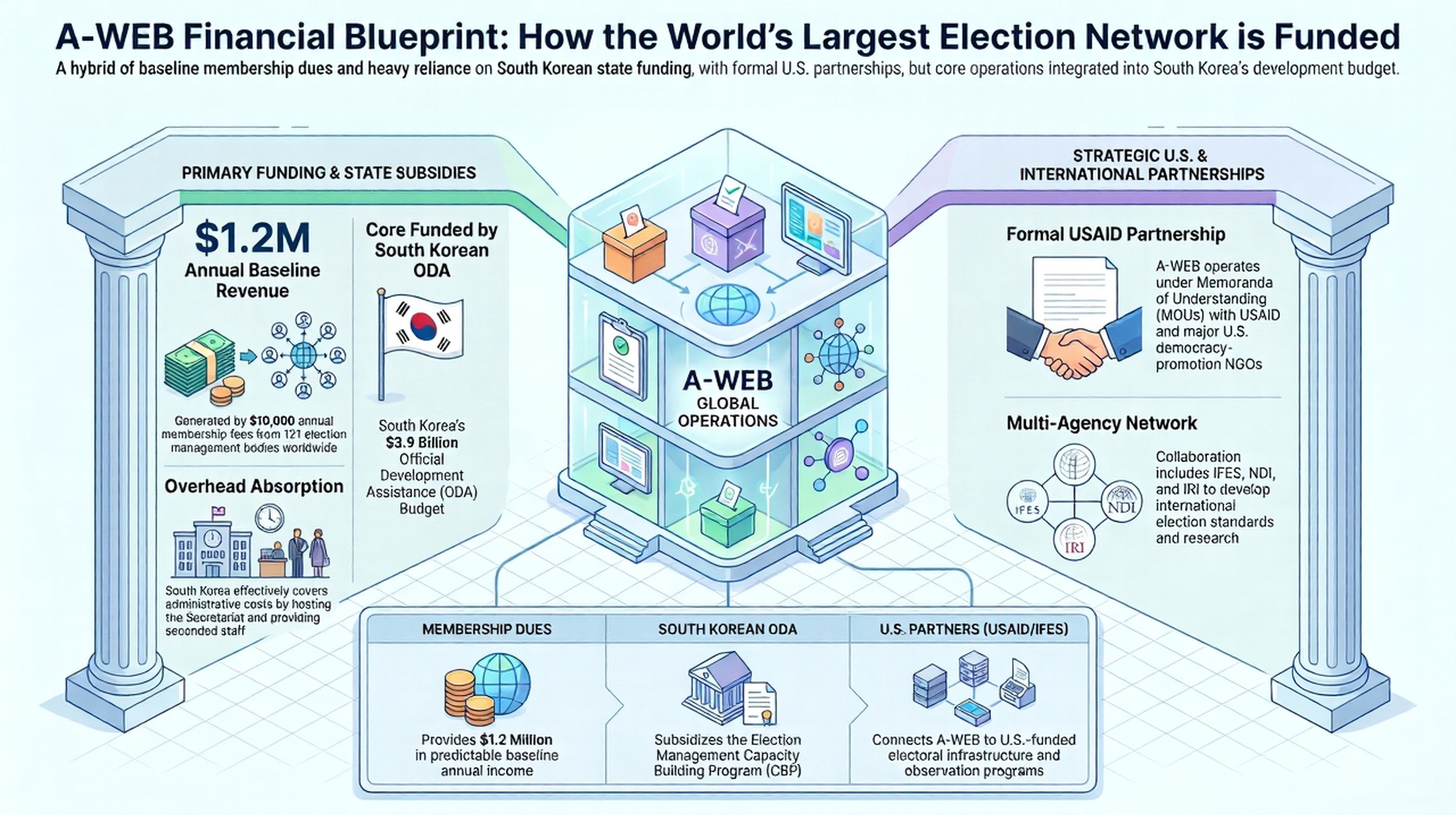
Each A-WEB member pays an annual membership fee of USD $10,000, individually managed per member account. With 121 members, this generates approximately $1.2 million annually in baseline membership income. However, this figure alone significantly understates A-WEB’s total budget and operational resources.
South Korean Government (ODA) Funding
The most significant funding channel is South Korea’s Official Development Assistance (ODA) budget. A-WEB’s Election Management Capacity Building Program (CBP) is explicitly described on its own website as “part of the International Development Program of the Government of the Republic of Korea“. Academic research confirms that A-WEB’s international cooperation programs are “funded from South Korea’s ODA budget”. South Korea’s total ODA reached USD $3.9 billion in 2024, with election governance and democracy promotion as explicit strategic priorities.
This arrangement means that the South Korean government — through its NEC — not only created and hosts A-WEB but continues to subsidize its core programming through taxpayer-funded ODA grants. The degree to which A-WEB operates as an independent multilateral body versus as an instrument of South Korean foreign policy and soft power is therefore a meaningful structural question.
USAID and U.S. Partner Organizations
In May 2014, A-WEB signed formal Memoranda of Understanding (MOUs) with the following U.S.-based organizations in Washington, D.C.:
- USAID (U.S. Agency for International Development)
- IFES (International Foundation for Electoral Systems)
- Democracy International (DI)
- National Democratic Institute (NDI)
- International Republican Institute (IRI)
The scope of cooperation under these MOUs includes: capacity building for EMBs, developing international election standards, exchanging research on election management and women’s participation, and joint election observation programs. A-WEB also visited the Asia Foundation and the National Endowment for Democracy during the same Washington trip. This web of partnerships connects A-WEB directly to the principal U.S. democracy-promotion funding infrastructure — creating a channel by which Korean election methodologies and associated technologies gain credibility and exposure in U.S.-funded electoral environments worldwide.
Additional Funding Sources
Per Article 23 of the A-WEB Charter, additional funding sources include contributions from EMBs, regional associations, international organizations (in financial or staff form), and donations from individuals, groups, companies, and international foundations related to democracy and elections. The Secretariat’s operational costs are supplemented by seconded staff from member countries — meaning South Korea effectively absorbs a disproportionate share of administrative overhead.
Programs and Methods
Election Management Capacity Building Program (CBP)
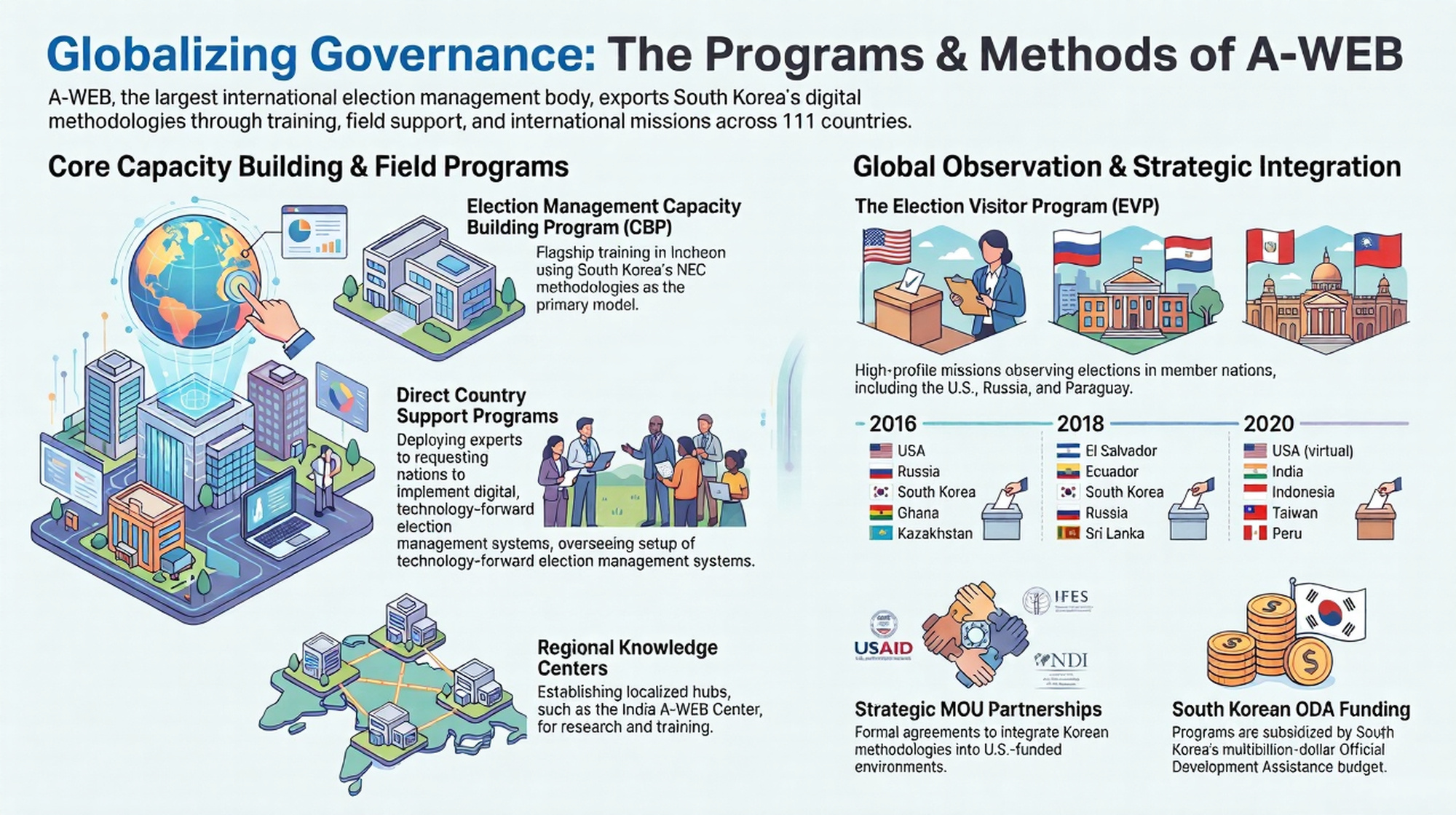
A-WEB’s flagship offering trains election officials from member nations to “strengthen election management capacity and manage elections more effectively”. Hosted in Incheon, the program addresses topics including electoral systems, political participation of marginalized groups, gender equality, and media in election management. Sessions bring together election officials from across the world for collaborative knowledge exchange — with South Korea’s NEC methodologies as the underlying model.
Country Programs
Country Programs deploy A-WEB expertise directly to the election cycle in requesting nations, aiming to “strengthen the accuracy in election processes by improving systems related to election management and support the establishment of ‘good governance'”. These programs have been deployed in developing nations across Africa, Asia, Latin America, and Eastern Europe, with South Korea’s digital, technology-forward approach to election management promoted as the template.
Election Visitor Program (EVP)
The EVP allows A-WEB delegates to observe elections in member countries, theoretically spreading best practices. The scope of countries visited is extensive and includes:
Year | Key Countries Visited |
2016 | USA, South Korea, Russia, Ghana, Kazakhstan, Moldova, Romania, Dominican Republic |
2017 | Ecuador, South Korea, Russia, Indonesia, Bolivia, Kyrgyzstan, Croatia |
2018 | El Salvador, Ecuador, South Korea, Russia, Sri Lanka |
2019 | Indonesia, South Korea |
2020 | Dominican Republic, India, Indonesia, Taiwan, Peru, United States (virtual) |
2021 | Paraguay, India (virtual) |
2022 | Colombia (parliamentary and presidential primaries) |
The 2020 virtual observation of the United States election is significant from an election integrity perspective, as it placed A-WEB in a formal observer role during a highly contested U.S. election cycle, even if that role was virtual and limited in scope.
A-WEB Regional Centers
A-WEB has established regional knowledge centers, the most notable being the India A-WEB Center in New Delhi, established in 2019 following an Extraordinary Executive Board decision. The center focuses on documentation, research, training, and capacity building for A-WEB members — effectively extending South Korea’s organizational model through India’s vast election administration apparatus.
A-WEB's Relationship with South Korea's NEC
Structural Dependency
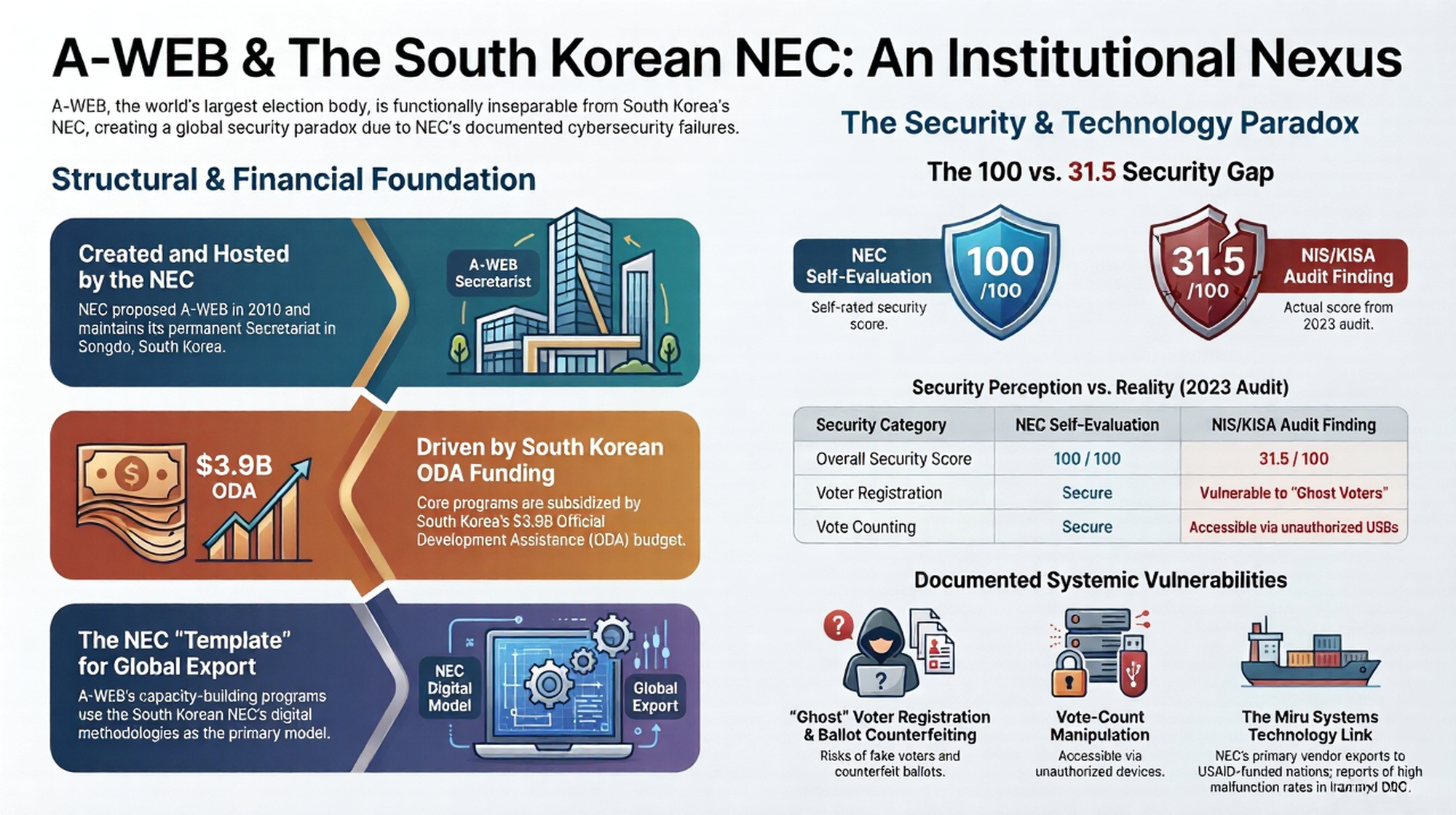
A-WEB is inseparable from South Korea’s NEC in structural terms. The NEC proposed, championed, and founded A-WEB; hosts the permanent Secretariat in South Korea; funds core programs through ODA; and has promoted its own election technology and methodologies as the global standard. The NEC is simultaneously the parent organization of A-WEB and, through Miru Systems (see below), the commercial beneficiary of the global adoption of Korean election technology.
NEC Cybersecurity Vulnerabilities (2023 NIS Audit)
In a development with profound implications for A-WEB’s credibility as a democracy-promotion body, a joint security inspection conducted from July 17 to September 22, 2023 by the NEC, South Korea’s National Intelligence Service (NIS), and the Korea Internet & Security Agency (KISA) — with observers from both ruling and opposition parties — found sweeping cybersecurity vulnerabilities in South Korea’s own election systems.
The findings, released October 10, 2023, included:
- Voter Registration System: Hackers could infiltrate the NEC’s internal network via the internet; could mark early voters as non-voters or register “ghost voters”
- Ballot Printing: The official stamp files used on early voting ballots could be stolen; unauthorized parties could print counterfeit ballots with matching QR codes
- Vote Counting System: Hackers could change vote-counting results due to insufficient password and access management; unauthorized USB devices could install hacking programs on ballot sorting machines capable of altering sort results; ballot sorting machines could accept wireless internet-capable devices
- System Management: Poor network separation allowed internet-to-intranet intrusion; simple, easily guessable passwords were in use; key data including candidate lists and overseas voter rolls were stored in plain text
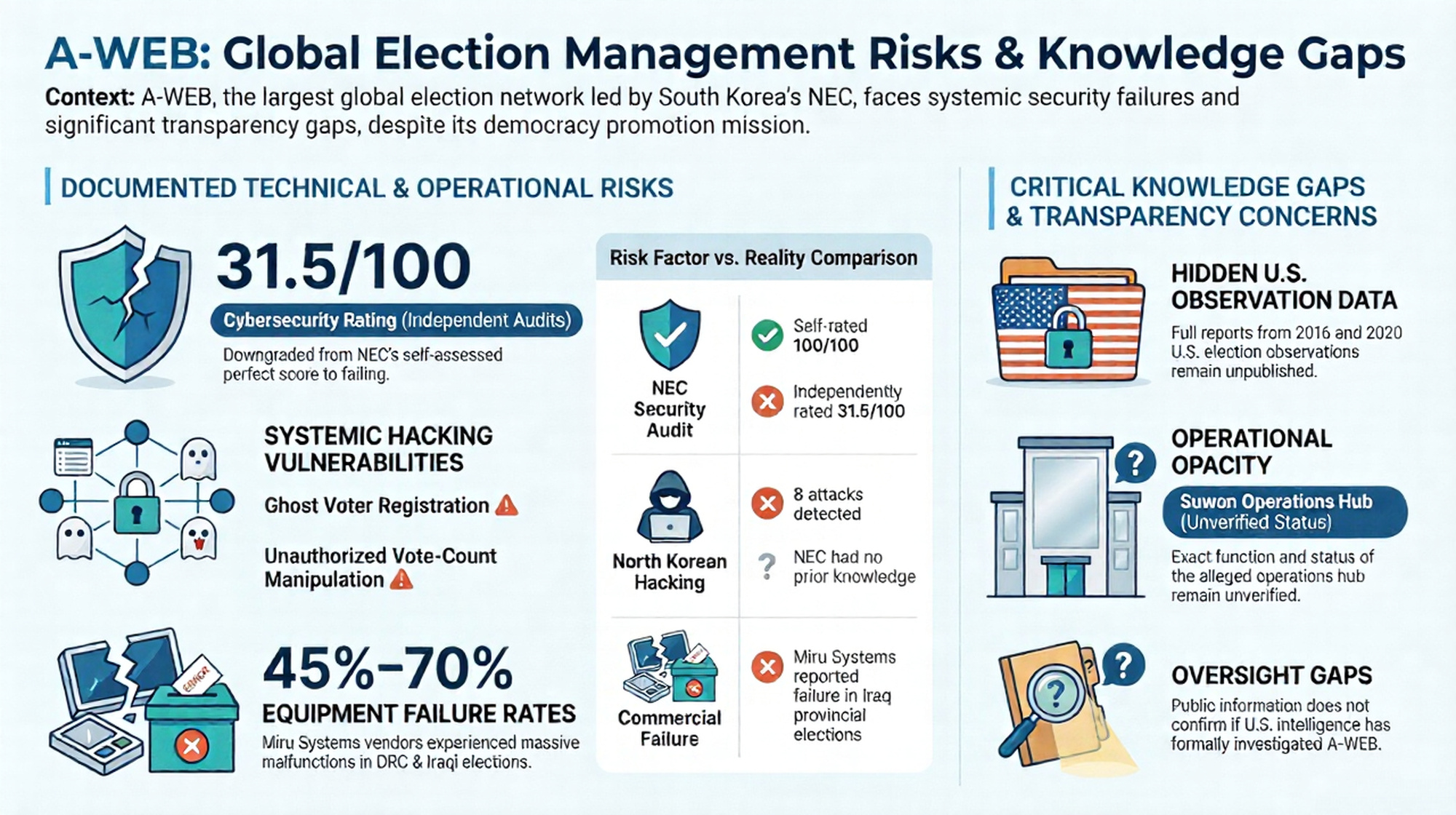
The NIS/KISA team reported that the NEC had no prior knowledge of North Korean hacking incidents reported by the NIS over the prior two years. The NEC’s own self-evaluation had rated its security at 100 out of 100 — the joint inspection team’s re-evaluation found the actual score was 31.5 out of 100. The audit confirmed the NEC had used unqualified vendors for vulnerability assessments in violation of South Korean law.
Separately, the South Korean NEC had been cyber-attacked 8 times over the preceding two years, with 7 attacks attributed to North Korea’s Lazarus Group — the same organization behind the $81M Bangladesh Central Bank hack and the WannaCry ransomware attack. In April 2021, the NEC’s internet PCs were infected with malware from North Korea’s “Kimsuky” organization, leaking confidential documents.
The strategic implication: An organization that exports election management best practices globally — through A-WEB’s programs, country visits, and technology advocacy — while operating election infrastructure with critical documented vulnerabilities raises serious questions about what exactly is being exported.
The 2024 Martial Law Crisis and Election Fraud Claims
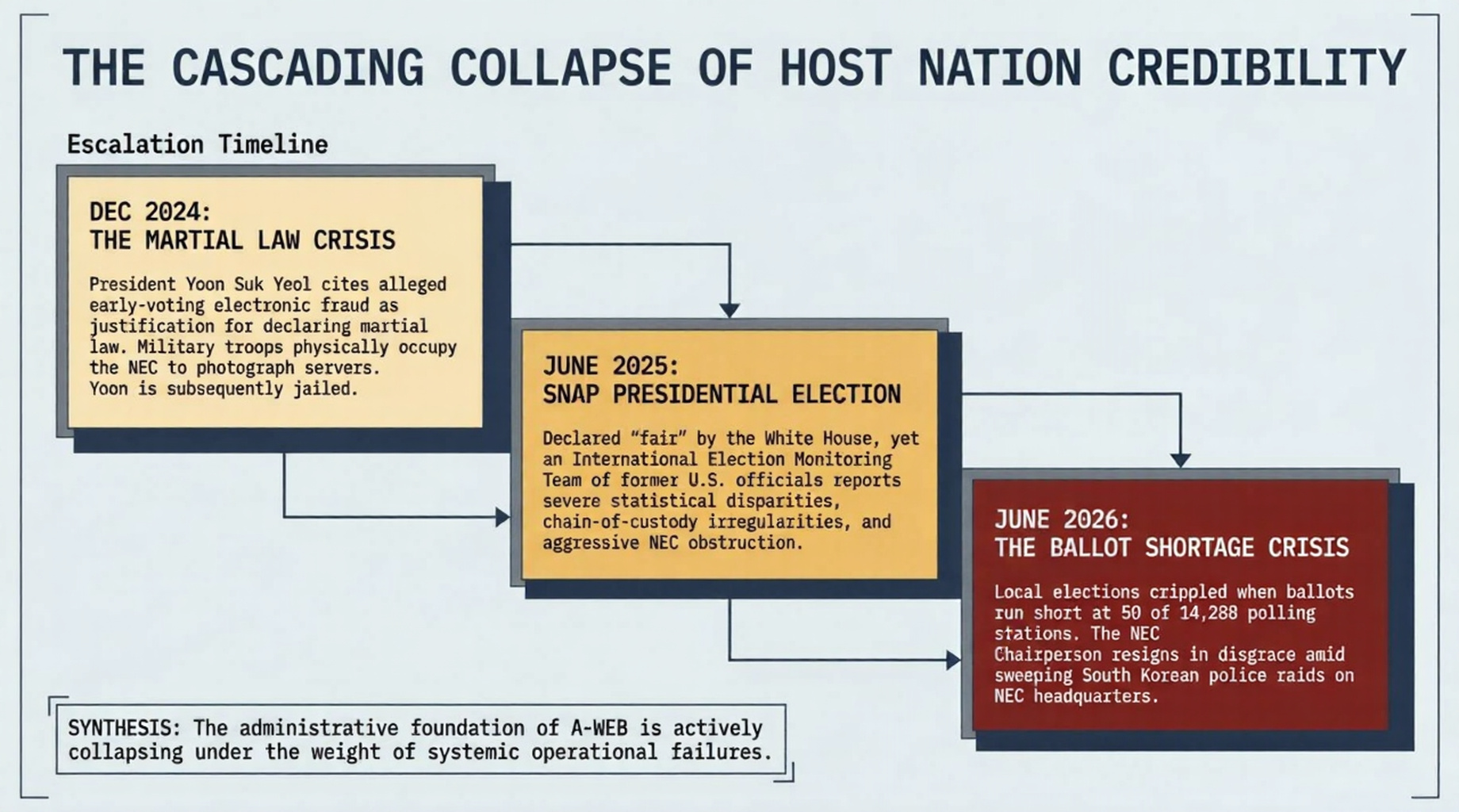
The NEC’s integrity became a flashpoint in South Korea’s political crisis of December 2024. Impeached President Yoon Suk Yeol cited alleged election fraud as his justification for declaring martial law — specifically targeting the NEC with his military units. Yoon’s defenders alleged that the opposition’s April 2024 legislative election victory resulted from digitally manipulated early voting results. Military troops that briefly occupied the NEC photographed equipment and servers during the short-lived martial law.
Yoon was subsequently jailed, receiving a life sentence for insurrection in February 2026. The NEC firmly rejected all fraud allegations, stating that its internal election network “can only be accessed from a limited number of pre-authorized computers within the NEC that are not connected to the internet”. South Korean courts had repeatedly ruled such claims unsubstantiated.
However, election integrity researchers — including Dr. Gong Byeong-ho — published detailed analyses of alleged voting pattern anomalies, describing what they characterized as a statistically consistent manipulation value applied across districts during early voting. These analyses remain disputed, with mainstream South Korean political scientists and international bodies characterizing them as methodological misinterpretations.
Miru Systems: The Technology Export Nexus
Company Background
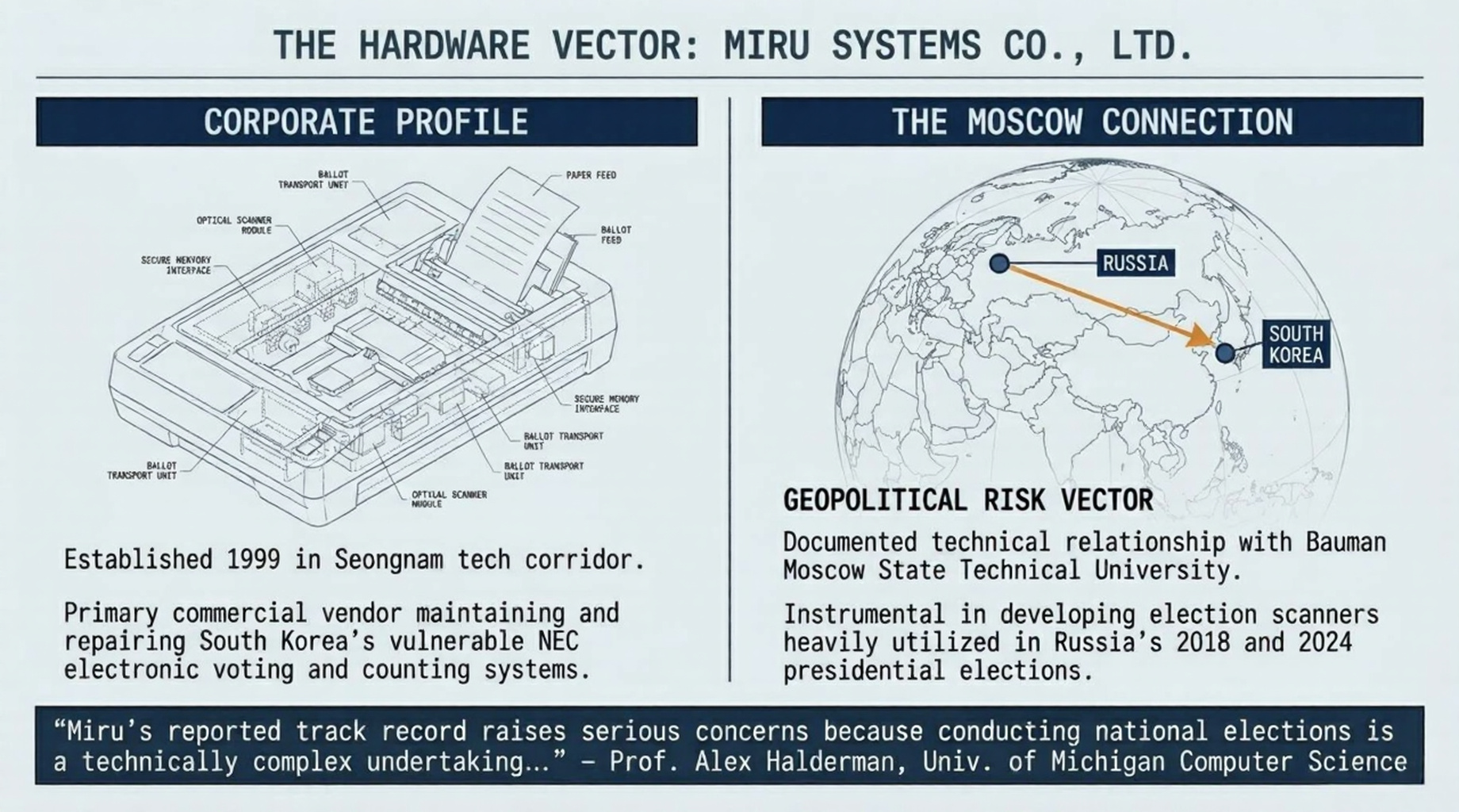
Miru Systems Co., Ltd., headquartered in Seongnam, Gyeonggi Province (near the Pangyo tech corridor), was established in 1999 and has been the primary commercial vendor maintaining and repairing South Korea’s NEC electronic voting and counting systems. It describes itself as providing “proven end-to-end election solutions”.
International Deployments and Controversy
Miru Systems has deployed election technology internationally in a pattern that overlaps significantly with A-WEB country programs and USAID-funded elections:
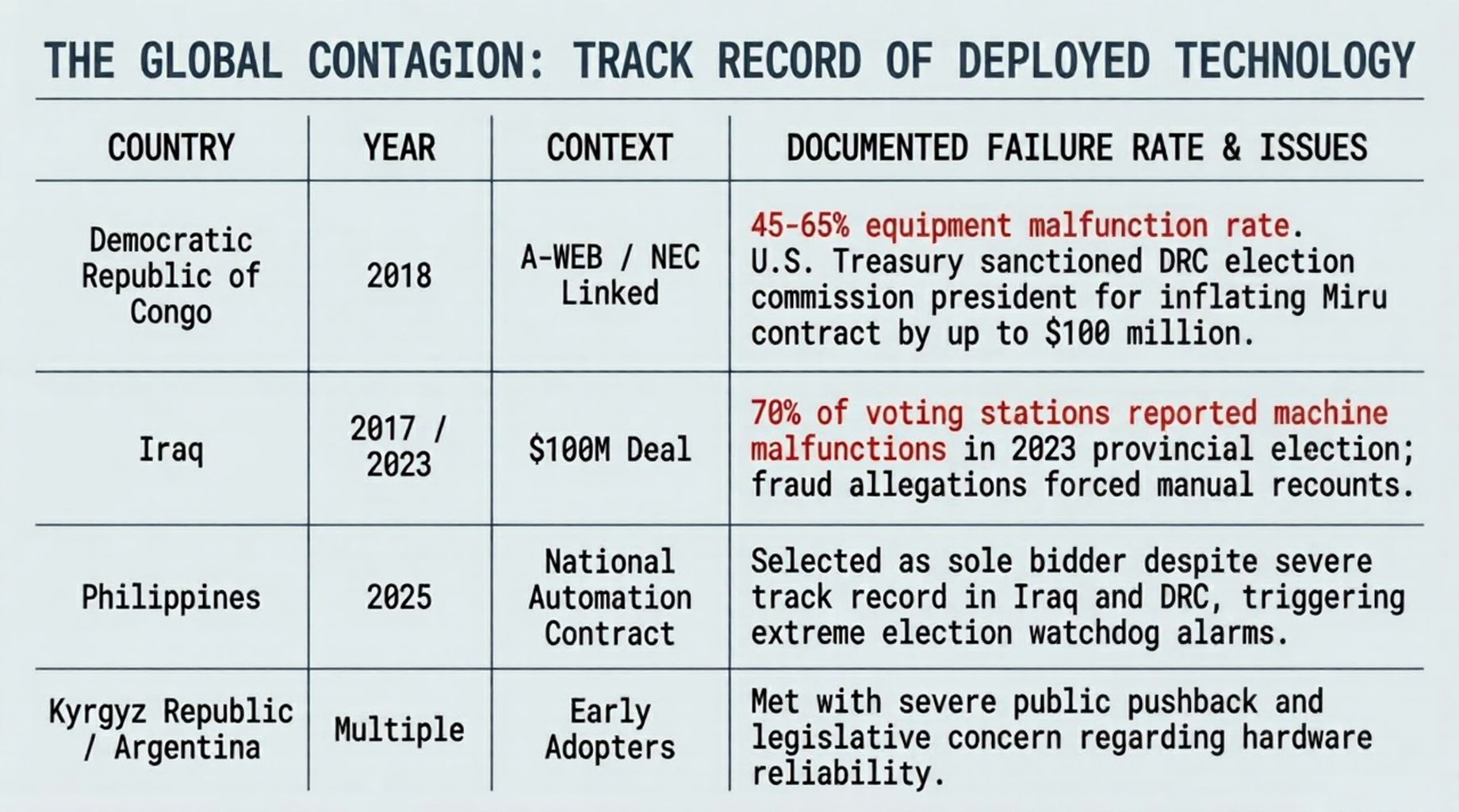
A particularly alarming dimension: Miru Systems reportedly has a relationship with Bauman Moscow State Technical University, a connection that was instrumental in developing election scanners used in Russia’s 2018 presidential election — and subsequently in Iraq. Miru’s involvement with Russian elections reportedly began around 2009 and extended through Russia’s 2024 presidential election.
Politico’s 2024 investigation noted that experts from democracy NGOs funded by the U.S. government called Miru’s track record “long, troubling and well-documented,” and called for rigorous review of how commercial election technology is procured. University of Michigan computer science professor Alex Halderman stated that “Miru’s reported track record raises serious concerns because conducting national elections is a technically complex undertaking, and upholding voters’ trust requires utmost care in the design, testing, and operations of the equipment”.
Impact on South Korean Elections
Structural Control
A-WEB does not directly administer South Korean elections — that is the constitutional mandate of the NEC. However, the NEC’s documented vulnerabilities, combined with persistent statistical anomaly research by Korean academics and the profound political disruption of the 2024 martial law crisis, have placed the NEC itself under sustained scrutiny.
The Early Voting Controversy
The most persistent domestic election integrity concern in South Korea involves statistical disparities between early voting and same-day voting results — a pattern that conservative researchers allege is too consistent to be organic. The NEC has consistently rejected these claims, and mainstream analysts attribute the disparities to demographic and behavioral differences between early and same-day voters. However, the 2023 NIS audit established that the early voting system was the most technically vulnerable component of Korea’s election infrastructure — specifically the systems for managing voter lists, ballot printing, and QR code authentication.
June 3, 2025 Presidential Election
South Korea held a snap presidential election on June 3, 2025, following Yoon’s impeachment, resulting in a decisive victory for liberal candidate Lee Jae-myung with 49.4% of the vote. The White House declared the election “fair”, though it expressed concern about potential Chinese interference. An International Election Monitoring Team (IEMT) composed of former senior U.S. government officials — including Ambassador Morse H. Tan (former U.S. Ambassador-at-Large for Global Criminal Justice), Col. John R. Mills (Ret.), Dr. Bradley A. Thayer, and Col. Grant Newsham (Ret.) — conducted field observations and held a press conference at the National Press Club in Washington, D.C. on June 26, 2025, presenting findings of:
- Significant statistical disparities between early and same-day voting
- Concerns about security and transparency of electronic counting systems
- Irregularities in ballot handling and chain of custody
- Obstruction of citizen-led election monitoring efforts
- Lack of NEC cooperation with international observers
The NEC rejected all fraud allegations. Ambassador Tan subsequently faced a defamation investigation by Korean police.
June 3, 2026 Local Elections: Ballot Shortage Crisis
South Korea’s June 2026 local elections produced a fresh NEC credibility crisis when ballots ran short at 50 of 14,288 polling stations, with voting stunted at 22 of them. The NEC chairperson Rho Tae-ak resigned alongside the secretary-general, citing an “unacceptable incident” that “infringed upon the people’s precious right to vote”. South Korean police raided NEC headquarters as the scandal widened. President Lee described the situation as “shocking” and damaging to South Korea’s reputation as a democratic model.Impact on American Elections
Formal Observer Access
A-WEB’s Election Visitor Program documented observation missions to U.S. elections in 2016 and 2020. The 2016 mission was an in-person visit; the 2020 mission was a virtual program during the COVID-19 pandemic. The nature, scope, and reporting products of these missions are not prominently published on the A-WEB website, and no publicly available detailed reports from these U.S. observation missions have been located.
The USAID Connection: Election Infrastructure in USAID-Funded Countries
The more significant U.S. impact operates through the USAID nexus. Both the DRC and Iraq — the primary countries where Miru Systems machines faced the most documented problems — received substantial U.S. USAID funding for their elections. Politico’s investigation noted that given USAID’s financial support for these elections, “some experts argue that the U.S. should be taking a more active role in steering these countries away from companies like Miru”. In effect, U.S. taxpayer dollars funded election environments where A-WEB-connected Korean technology and methodology were deployed — creating accountability gaps that U.S. oversight bodies were not positioned to address.
U.S. Legal and Political Figures Demand Investigation
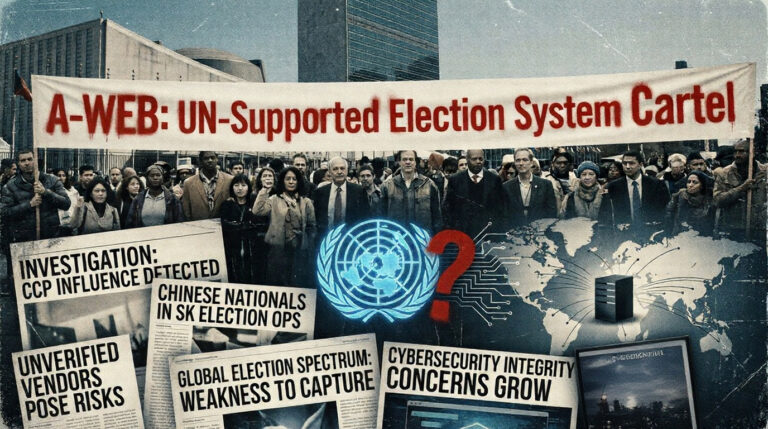
Beginning in late 2025 and into early 2026, A-WEB became a direct subject of U.S. political and legal concern. A January 2026 report from Korea Portal detailed calls by U.S. legal figures — including references to Sidney Powell calling on the U.S. Department of Justice to investigate A-WEB’s activities abroad. The report alleged that A-WEB’s partnership with USAID “sits at the heart of an international network of electoral problems” and described an alleged operations hub in Suwon, South Korea. President Trump reportedly shared content suggesting South Korea’s role in what critics called a global election “cartel”.
The allegations specifically centered on Miru Systems — noting countries that adopted its systems (Iraq, DRC, Philippines, Kyrgyzstan, El Salvador, Ecuador, Bulgaria) had “all faced serious fraud allegations and public protests afterward”. Former U.S. Ambassador Nikki Haley had previously warned about these systems, according to the same reporting.
Structural Concern: The Technology Export Model
The most substantive and documentable concern for American election integrity researchers is the model A-WEB represents rather than specific proven interventions in U.S. ballots:
- South Korea exports its election technology model — including automated vote counting systems, electronic voter list management, and QR-coded early voting ballots — through A-WEB’s capacity building programs
- The NEC’s own systems have documented, critical vulnerabilities confirmed by Korea’s own intelligence services — raising questions about whether best practices being exported are actually best
- Miru Systems, the commercial arm maintaining NEC systems, has a documented relationship with Russian technical institutions and a track record of machine failures and fraud allegations across multiple nations
- USAID and U.S. partner organizations (IFES, NDI, IRI) have formal MOU relationships with A-WEB, creating institutional channels that legitimize and amplify the reach of Korean election technology in developing democracies
- A-WEB formally observed the 2016 and 2020 U.S. elections, creating precedent for access that could be expanded
The Transnational Conspiracy Theory Connection
A broader political-cultural dimension exists: South Korean conservative narratives about NEC election fraud have closely paralleled American right-wing election integrity narratives, with researchers noting the convergence is not coincidental. South Korean Yoon supporters flew American flags at protests, and fringe Korean media structures closely mirror American alternatives. This transnational parallel — whether organic or coordinated — creates a feedback loop where narratives about Korean NEC fraud inform American election integrity activists, and vice versa.Critical Assessment: Legitimate Organizations or Risk Vector?
The Legitimate Case for A-WEB
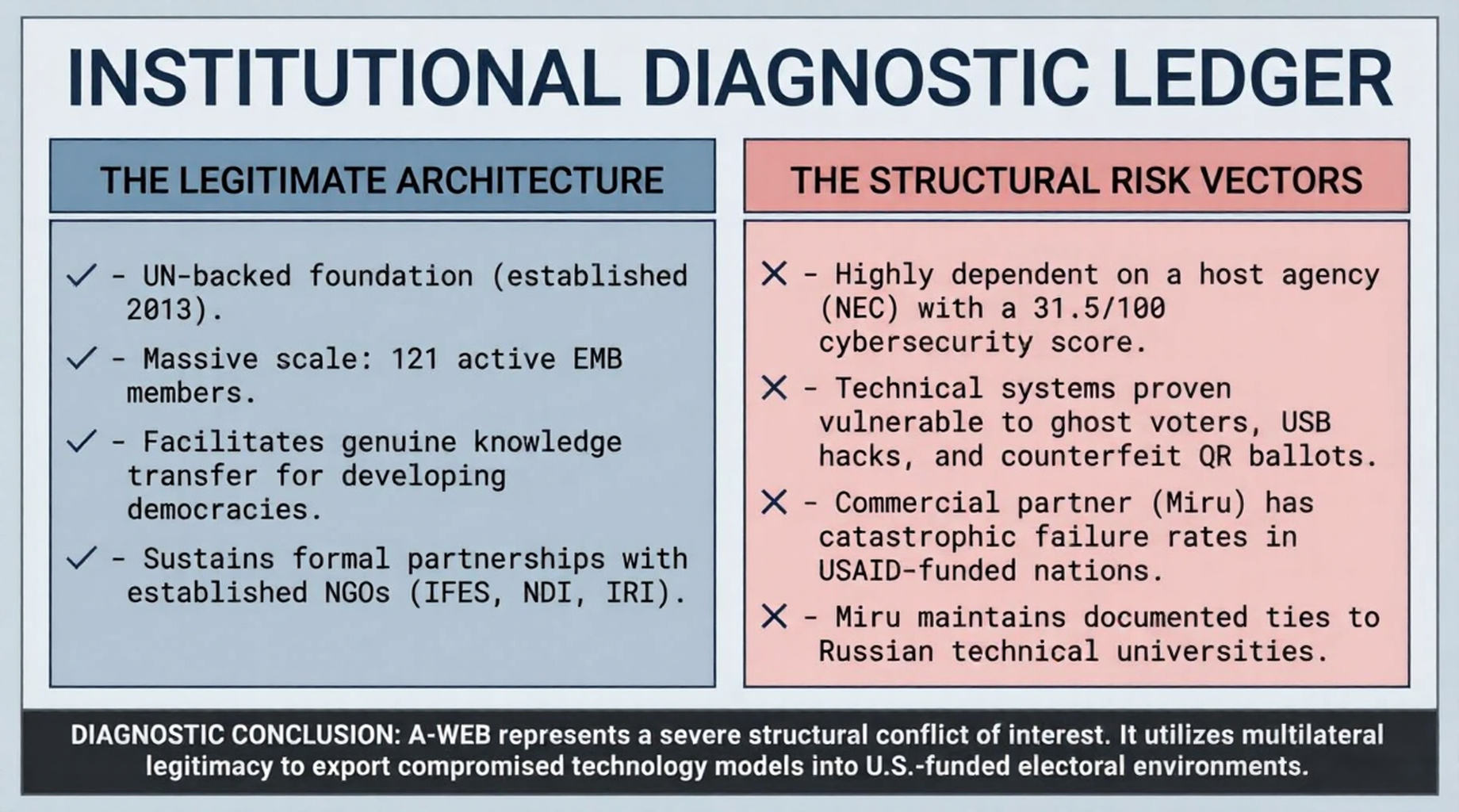
A-WEB’s formal structure, UN support at founding, partnerships with USAID and established democracy NGOs, and the genuine challenge of helping developing democracies manage complex elections all represent legitimate institutional purposes. The organization has trained thousands of election officials, produced publications on electoral best practices, and facilitated genuine knowledge-sharing. The Election Commission of India — one of the world’s most trusted and experienced electoral bodies — has been a founding member and former Chair, lending significant credibility.
The Risk Factors
However, a rigorous election integrity assessment must weigh the following documented concerns:
Risk Factor | Status |
NEC cybersecurity self-rated 100/100; independently rated 31.5/100 | Confirmed (NIS/KISA audit) |
NEC systems vulnerable to ghost voter registration, vote count manipulation, counterfeit ballot printing | Confirmed |
NEC lacked awareness of 8 North Korean hacking incidents | Confirmed |
Miru Systems deployed in USAID-funded elections with documented machine failures | Confirmed (Iraq 70%, DRC 45% malfunction rates) |
Miru Systems’ Russian technical university affiliation and Russia election involvement | Confirmed |
A-WEB programs funded by South Korean government ODA (not independent) | Confirmed |
U.S. legal figures calling for DOJ investigation of A-WEB | Reported (January 2026) |
A-WEB formally observed 2016 and 2020 U.S. elections | Confirmed |
South Korea’s 2025 and 2026 elections faced credibility crises | Confirmed |
Key Knowledge Gaps
Several critical questions remain unanswered by publicly available information:
- The full content and any classified findings of A-WEB’s 2016 and 2020 U.S. election observation reports
- The detailed scope of Miru Systems’ technical integration with Korean NEC systems that are the model for A-WEB exports
- Whether DOJ or any U.S. intelligence agency has formally investigated A-WEB’s activities
- The exact nature and current status of the alleged Suwon operations hub
- The degree to which A-WEB’s capacity building programs explicitly promote Miru Systems’ products versus general methodologies
Conclusion
A-WEB occupies a uniquely sensitive position in the global election architecture. As the world’s largest election management body network — controlled administratively and financially by South Korea’s NEC, which itself has documented systemic cybersecurity vulnerabilities — it operates as the primary global channel for South Korean election methodology and technology export. The confluence of USAID partnerships, MOU relationships with U.S. democracy NGOs, formal observation access to U.S. elections, and the commercial track record of affiliated Miru Systems creates a risk profile that warrants serious scrutiny from American election security researchers and policymakers.
The organization is not monolithic: A-WEB has real members, conducts real training, and serves real democratic needs in developing countries. But the gap between its stated mission and the documented technical failings of its host nation’s own election systems — combined with the commercial interests tied to the global export of Korean election technology — represents a structural conflict of interest that the organization has not transparently addressed. For researchers focused on election integrity, A-WEB represents a vector worth monitoring closely: not as a proven direct threat to U.S. election infrastructure, but as an institutional architecture with documented vulnerabilities, disputed international deployments, and opacity around its exact operational footprint.
Citations
- Who We Are – A-WEB – The Association of World Election Bodies (A-WEB) is the world’s largest international organization i…
- Association of World Election Bodies – Wikipedia – The Association of World Election Bodies, commonly referred to as ‘A-WEB’, was established on Octobe…
- News & Notice | News | NATIONAL ELECTION COMMISSION – The Chairperson of the National Election Commission of the Republic of Korea, Mr. Nung-Hwan Kim who …
- News & Notice | News | NATIONAL ELECTION COMMISSION – The NEC has well recognized the importance of independent election bodies’ role in realizing free an…
- Explainer – Association of World Election Bodies (A-WEB) – … • Chief Election Commissioner Rajiv Kumar participated in the 11th meeting of the Executive Boar…
- CEC Rajiv Kumar participates in the 11th meeting of the Executive … – Chief Election Commissioner Shri Rajiv Kumar led a three-member Election Commission of India (ECI) d…
- News·Publications – A-WEB – A-WEB Signs MOUs with International Development Agencies, including USAID: Reaching an agreement on …
- Membership fees & Donations – A-WEB – The annual membership fee;. Contributions made by election management bodies, regional election asso…
- Election Management Capacity Building Program – A-WEB – For example, a genderbased finance clause was included in the revised Political Parties Financing La…
- The Promotion of Democracy and Japan’s and South Korea’s Official … – However, the A-WEB has implemented international cooperation programs funded from South Korea’s ODA …
- Development Co‑operation Profiles: Korea – OECD – Korea’s total ODA increased in 2024 to USD 3.9 billion (preliminary data), representing 0.21% of gro…
- A-WEB – 주메뉴 바로가기 본문내용 바로가기 …
- Election Visitor Program<What We Do< A-WEB – 2025, Referendum & Public Consultation in Ecuador ; 2025 · Parliamentary Elections in Moldova ; 2025…
- International Cooperation – Election Commission of India – India, as the largest practicing democracy in the world and with over 75 years’ record of holding ef…
- (2nd LD) Election watchdog’s cybersecurity system vulnerable to … – The voting and ballot counting systems at the state-run election watchdog remain vulnerable to poten…
- A Lesson to Learn from Cybersecurity Vulnerabilities in South … – This investigation, a collaborative effort between the National Election Commission (NEC), NIS, and …
- [Full Text] South Korean Voting System Vulnerable to Hacking, NIS … – 2023-10-10, NIS/KISA Press Release [TRANSLATION] [Posted on 2024-12-17] National Intelligence Servic…
- North Korea Hacks South Korea’s National Election Commission – 2023-5-11, Tara O South Korea’s National Election Commission (중앙선거관리위원회) has been cyber attacked 8 t…
- Alleged election rigging led to martial law in South Korea – YouTube – South Korean President Yoon Suk Yeol’s short-lived bid to impose martial law was an attempt to inspe…
- 2024 South Korean martial law crisis – Wikipedia – South Korea · Opposition to budget proposals; Attempted impeachment of prosecutors involved in scand…
- Why did martial law troops go to National Election Commission? – Conspiracy theory that opposition party’s April election win resulted from election rigging appears …
- YouTube election fraud conspiracy theories fuel impeached South … – … election fraud, a claim that remains unsubstantiated in South Korea. … Even if hackers somehow…
- Yoon Suk Yeol: Who is the South Korean president jailed for … – BBC – … Yoon’s party was a victim of election fraud. They also believe his declaration of martial law wa…
- Conspiracy theories targeting S.Korean election integrity resurface … – As South Koreans cast early ballots for new governors, mayors and other representatives in key regio…
- Flawed research into election fraud can undermine democracy and … – An academic’s claims of irregularities at the ballot box created a media buzz in South Korea. The re…
- Was South Korea’s Election Rigged? Dr Gong Byeong-ho Speaks Out – Pointing to statistically improbable voting patterns, Dr Gong explains how South Korea’s election fr…
- Korean firm bags deal to export vote-counting machines to Iraq – SEOUL, April 2 (Yonhap) — A South Korean election equipment maker has signed a US$100 mil…
- MIRU SYSTEMS – Proven end-to-end election solutions.
- Press Release – Privilege Speech of Senator Risa Hontiveros on … – … Argentina, where similar machines faced pushback. Ang tawag nga sa Congo ng mga election machine…
- The red flags over South Korean voting tech – POLITICO – A South Korean company’s voting machines were at the center of major technical issues in recent elec…
- Smudged ID cards, missing names blemish Congo’s $1 billion election – Congolese law student Stephanie Mbafumoja was exhilarated to sit for the photo for a voter identity …
- Iraq election commission ignored warnings over voting machines – Iraq’s election commission ignored an anti-corruption body’s warnings about the credibility of elect…
- After Miru Systems won as the country’s election provider in 2025 … – Worse, Miru Systems is notorious for widespread fraud and failed elections in Iraq, Congo and Argent…
- MIRU’s TRACK RECORD: A CONCERN FOR THE US – Daily Tribune – An investigative piece by the US-based journal Politico has cast a spotlight on Miru Systems, questi…
- Report on Election Fraud in the June 3 South Korean Presidential … – Report on Election Fraud in the June 3 South Korean Presidential Election – International Election M…
- Presidential Election, 3 June 2025 – International IDEA – On 3 June 2025, South Korea held a snap presidential election following the … voting fraud. The go…
- INTERNATIONAL ELECTION MONITORING TEAM TO PRESENT … – The delegation conducted field observation in Seoul and surrounding areas during the early voting pe…
- White House calls South Korea election ‘fair,’ expresses concern … – The White House said on Tuesday that South Korea’s election, which saw liberal party candidate Lee J…
- Press Releases | News | NATIONAL ELECTION COMMISSION – … voting and counting process. Given the involvement of such a vast number of people, systemic ele…
- Morse Tan, election conspiracy peddler, arrives in Korea ahead of … – Tan faces an investigation by Korean police over alleged defamatory statements about President Lee J…
- The Democratic Dilemma in South Korea’s Local Election Ballot … – President Lee sold Korean democracy abroad as a system that fixes itself. Now his party and the admi…
- South Korea election chief quits after ballot shortage sparks blockade – he head of South Korea’s election commission resigned Friday, hours after riot police cleared protes…
- South Korea to overhaul election process after ballot shortage … – … election fraud.” The Reuters Inside Track newsletter is your … Lee has said the issue exposed…
- watchdog-offices-as-ballot-shortage-scandal-widens … – Facebook – Police raided the National Election Commission’s headquarters and local election offices Thursday as…
- S. Legal Figures Demand Investigation into South Korea’s A-WEB … – U.S. Legal Figures Demand Investigation into South Korea’s A-WEB Over Global Election Fraud Allegati…
- Before Trump, South Korean Conservatives Also Claimed a ‘Stolen … – Today’s right-wing politics has a transnational element, resulting in eerily similar conspiracy theo…