Across the Seditious Conspiracy pre‑election, Election Day, and post‑election phases, the findings depict a single, multi‑stage operational network that deliberately positioned itself to control both the administration of the 2020 election and the constitutional processes for contesting and certifying its outcome, using a blend of pre‑planned mobilization, insider access, and information dominance that rises to the investigative threshold for 18 U.S.C. 2384.
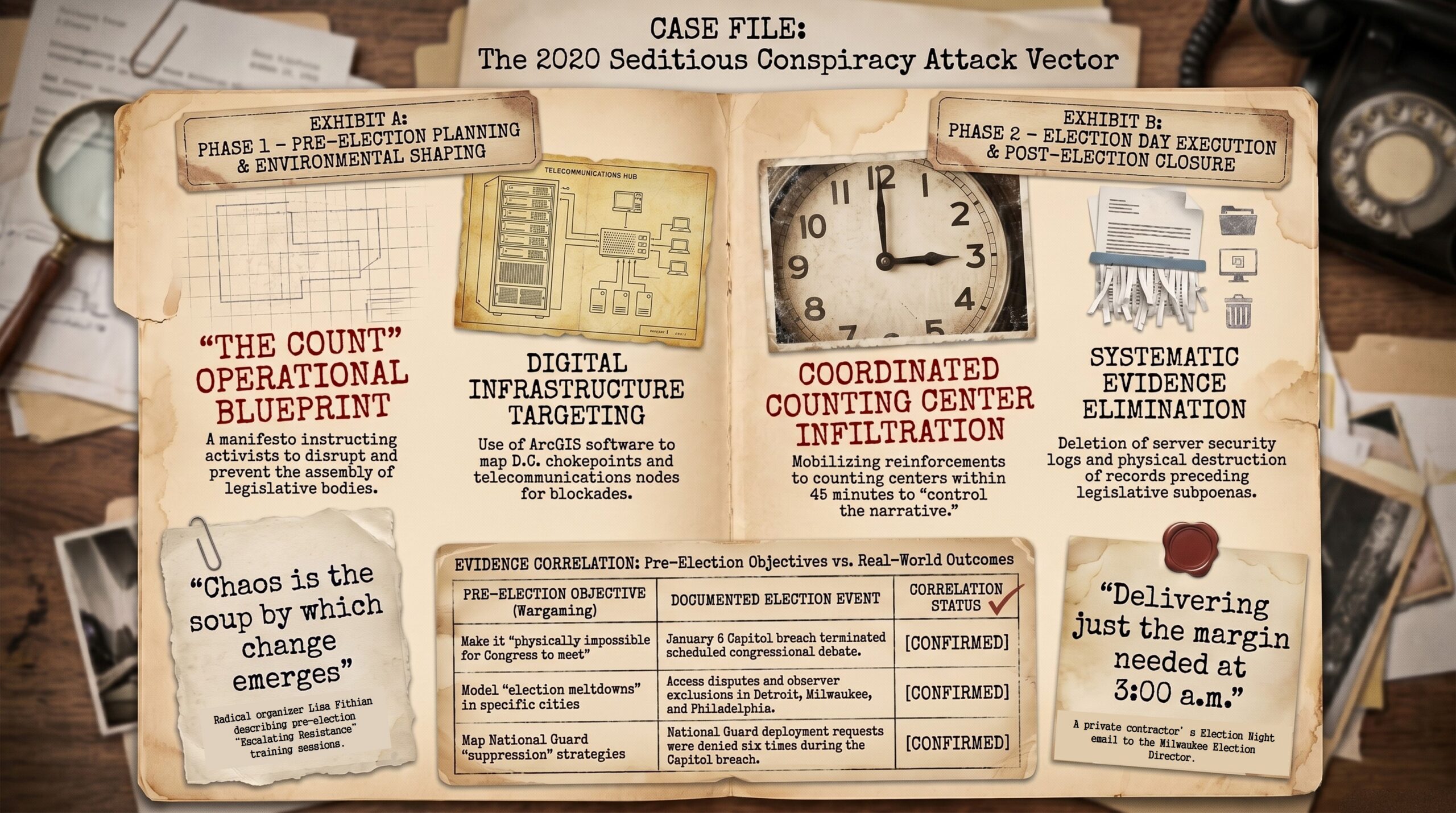
From a national security perspective, the collective impact is that a domestic “inside–outside” architecture—federal employees and contractors on the inside, NGOs/union/activist coalitions on the outside, and private vendors embedded in the infrastructure—demonstrably worked to prevent, hinder, or delay execution of federal election laws and the Electoral Count Act through intimidation, obstruction, and pre‑planned physical disruption, while simultaneously degrading every institutional mechanism (forensic records, courts, public information, and intelligence reporting) that should have detected or corrected misconduct. This creates a durable vulnerability: adversarial foreign services no longer need to design a coup architecture themselves; they can exploit and amplify an existing domestic network that has already shown it can shape outcomes and narratives around the transfer of power faster than the U.S. security and justice systems can respond.
MOST SIGNIFICANT FINDINGS
1 | “The Count” Pre-Election Manifesto Explicitly Planned to Make It Physically Impossible for Congress to Meet A document titled “The Count,” authored by Real Justice PAC operatives and circulated to the 148-partner Protect the Results coalition before Election Day, instructed activists to “stage protests inside the Capitol” and make it “physically impossible for Congress to meet” in the event the incumbent contested the outcome. The Protect the Results coalition — including Indivisible, MoveOn.org, Stand Up America, and the SEIU — launched June 12, 2020 and was committed in writing to trigger street-level mass mobilization if the result was challenged. AFL-CIO senior adviser Mike Podhorzer, described by Time magazine as the “architect” of the shadow campaign, ran the Fight Back Table and Democracy Defense Coalition from a single Washington, D.C. address, drafted internal memos predicting specific battleground-state outcomes before the votes were counted, and mobilized union members for deployment to counting centers. The constitutional target of the pre-election planning network — preventing congressional certification — was achieved on January 6, 2021. |
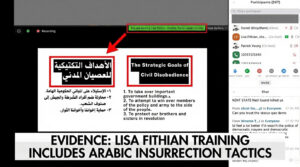
2 | ShutDown DC GIS Infrastructure Mapping — Pre-Election Targeting of Capitol Chokepoints and National Guard Suppression Strategy ShutDown DC used ArcGIS geographic information software to map bridges, government buildings, transportation chokepoints, and telecommunications nodes in Washington, D.C. before the election — a level of pre-operational infrastructure targeting inconsistent with spontaneous protest. Organizer Lisa Fithian conducted “Escalating Resistance” trainings addressing “Hong Kong-style” riot tactics and blockade techniques; separate training sessions explicitly addressed protocols designed to prevent deployment of the National Guard against protesters, citing prior occupation of the Wisconsin State Capitol as an operational blueprint. Federal employees from multiple agencies attended these sessions and self-identified their employing agencies during the trainings — creating documented Hatch Act exposure. Pre-election simulation exercises specifically modeled post-election unrest in Philadelphia (“Liberty City Antifa”) and Wisconsin (“Wisconsin United”), the exact jurisdictions that became Election Night operational flashpoints. |
3 | Six National Guard Requests Denied — Security Withheld During the Decisive Constitutional Window United States Capitol Police Chief Steven Sund submitted six formal requests for National Guard assistance — both in advance of and during January 6, 2021 — all of which were denied by the House and Senate Sergeants at Arms, with the stated justification of political “optics.” Department of Defense deployment was delayed more than seventy minutes after the Capitol breach began. The net constitutional effect of the breach was the permanent termination of scheduled congressional proceedings that would have allowed formal debate over electoral certification from multiple battleground states — precisely the outcome the pre-election planning documents had identified as the strategic objective. The alignment between the documented pre-election National Guard suppression planning by Fithian and affiliated organizations, and the actual denial of National Guard deployment on January 6, constitutes circumstantial evidence of coordinated intent under 18 U.S.C. § 2384. |
4 | Election Night Observer Exclusion in Pre-War-Gamed Cities — TCF Center, State Farm Arena, Philadelphia For seven months before the election, Podhorzer’s network ran weekly scenario-planning sessions explicitly modeled on Detroit, Milwaukee, and Philadelphia — the exact counting centers that became Election Night flashpoints. At Detroit’s TCF Center, Republican challengers were denied re-entry under a capacity rationale while windows were covered with cardboard and pizza boxes; a Podhorzer-network contact mobilized reinforcements to the site within 45 minutes of a Republican challenger surge. A written document titled “Tactics to Distract GOP Challengers” was observed by sworn witnesses on the TCF floor. At Atlanta’s State Farm Arena, a Fulton election worker announced counting was done for the night, most observers left, then sealed ballot containers were retrieved for continued scanning — a sequence the Secretary of State’s own field monitor recorded contemporaneously. At Philadelphia, credentialed observers were held 15–18 feet from counting tables during active counting. |
5 | Post-Election Record Destruction and Congressional Letter Containing 42 Alleged False Statements In Antrim County, Michigan, every server security log prior to 11:03 p.m. on November 4, 2020, and every 2020 adjudication log were systematically deleted. In Maricopa County, EMS database logs were overwritten or cleared after the Arizona Senate’s subpoena issued. In Delaware County, Pennsylvania, a named witness testified under oath that 2020 election materials were torn and subsequently burned in a pit. Fulton County, Georgia defied a DOJ subpoena for post-election records. On January 6, 2021, Georgia’s Secretary of State transmitted a letter to Congress asserting no fraud or irregularities had occurred; VoterGA researchers identified 42 alleged false statements, and the letter omitted the Georgia Senate Ligon Report and more than 250 open fraud investigations. The House Select Committee on January 6 then failed to archive critical witness transcripts — including Secret Service testimony — while sharing unarchived materials with a state district attorney prosecuting the former President. |
WHY SUBSTANTIVE RESOLUTION IS ESSENTIAL
Election systems were designated critical infrastructure by DHS in January 2017 on the premise that both the machinery of the vote and the constitutional processes for certifying it must be protected from interference. The Seditious Conspiracy findings document a multi-stage operational architecture — pre-election planning, Election Day execution, and post-election record destruction — that targeted every layer of that protection in the decisive jurisdictions. Observer access was controlled at counting centers that had been war-gamed for seven months. The records that would have allowed the count to be tested were subsequently destroyed. The constitutional proceeding was terminated by a breach whose net effect was precisely the outcome the pre-election planning network had modeled.
NATIONAL SECURITY IMPLICATION: An adversarial foreign intelligence service does not need to design a coup architecture from scratch if a domestic network has already demonstrated it can shape electoral outcomes, control the information environment, and foreclose the constitutional challenge process faster than U.S. security institutions can respond. The Seditious Conspiracy record documents that such a network existed, operated, and achieved its modeled objectives in 2020. The documented architecture — insider federal employees, NGO coalitions, private contractors, and a pre-mapped physical security plan — remains intact, unindicted, and available for exploitation or reactivation. |
Supporting Evidence