
Across all six Election Results Certification subtopics—canvassing boards, recounts, audits, unofficial reporting, state certification, and national certification—the report concludes that every major checkpoint that should have independently validated or halted defective results instead functioned to ratify them, converting the certification architecture itself into a strategic vulnerability in the transfer of national power.
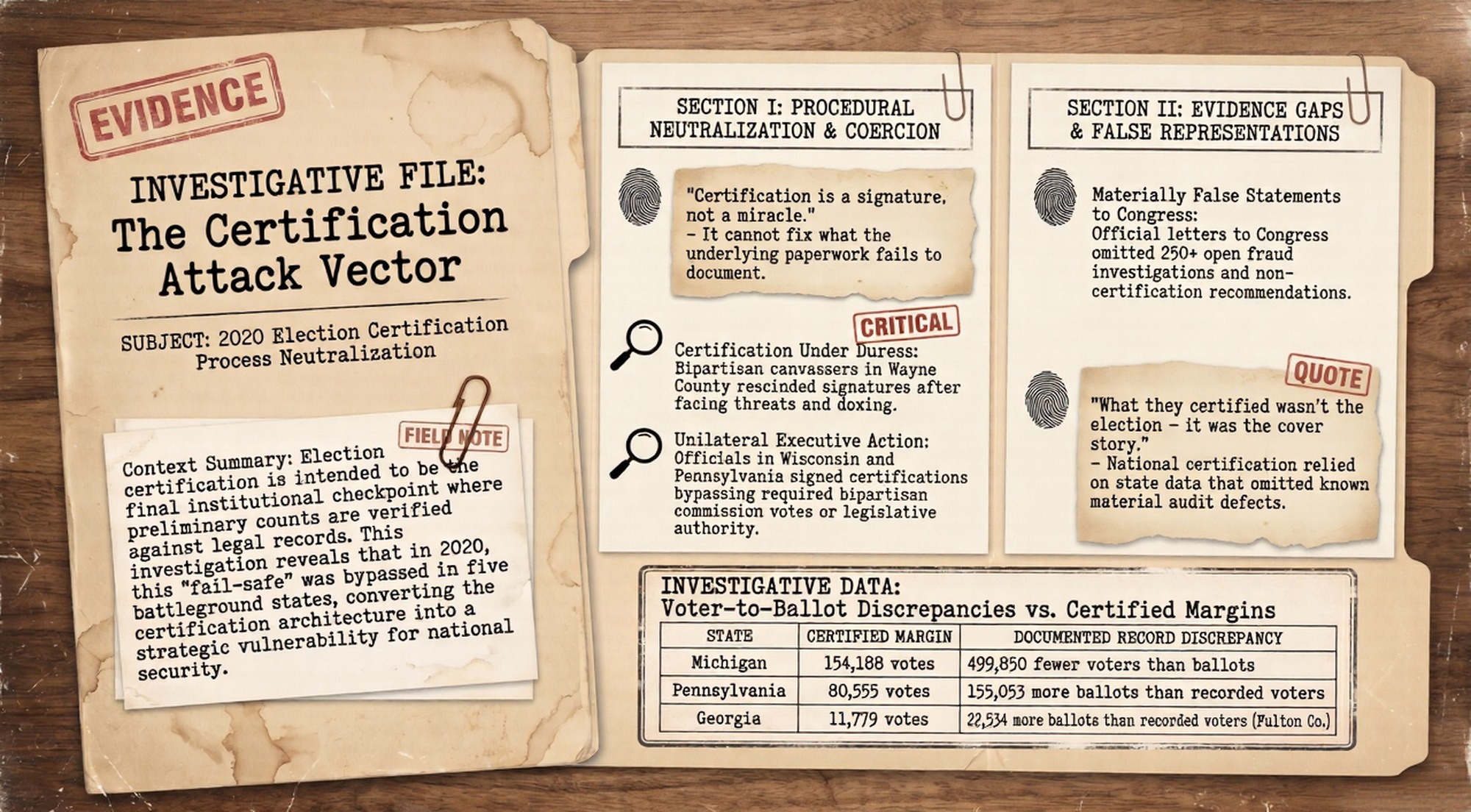
Collectively, these findings describe a certification system that moved in one direction only—toward finality—regardless of the condition of the underlying evidence. From a national security perspective, that means the United States converted a stack of unresolved record‑integrity and system‑security failures into the legally recognized basis for presidential succession, depriving federal authorities of clean, auditable ground truth and signaling to foreign and domestic adversaries that, once a narrative and certification momentum are established, even serious evidentiary defects are unlikely to alter national outcomes.
MOST SIGNIFICANT FINDINGS
1 | Canvassers Certified Under Duress — Then Rescinded Under Oath. Wayne County (MI) canvassers voted against certification citing 71% of Detroit absentee counting boards out-of-balance; were publicly identified, doxxed, and received death threats including photographs targeting a canvasser’s daughter (18 U.S.C. § 875, § 1512). They conditionally reversed in reliance on an audit promise publicly repudiated within hours. Neither Republican canvasser signed the statutorily required certification paperwork. The certification was transmitted and treated as valid. |
2 | Certifications Transmitted Without Required Signatures or Documentation. At least one state’s presidential certification bore fewer signatures than statute required and was accepted without challenge. In Delaware County, PA, 244 of 428 precincts lacked valid return sheets and 233 of 428 zero-report tapes were missing at the moment of certification. In Fulton County, GA, 148 advance-voting tabulator returns covering ~316,000 ballots — 25× the statewide margin — were never certified. |
3 | Mathematical Impossibility Certified Without Investigation. Pennsylvania certified 6,915,283 votes while SURE recorded only 6,760,230 voters — a 155,053-vote deficit. Separately, 440,781 mail ballots had no matching application on file. One state certified its presidential election while its own voter registration system documented more ballots than voters. No recount can close a chain-of-custody gap the state’s own records document. |
4 | False Statements Transmitted to Congress — Omitting 250+ Open Fraud Investigations. Georgia’s Secretary of State transmitted a letter to Congress on January 6, 2021, containing identified false statements, omitting more than 250 open fraud investigations, and citing a Pro V&V audit that documentary records confirm had not yet occurred at the time of transmission (18 U.S.C. § 1001). |
5 | Every Post-Certification Verification Layer Failed Simultaneously in Decisive Jurisdictions. Forensic audits, risk-limiting audits, legislative subpoenas, and FOIA requests were each defeated — by database purges (AZ), fabricated RLA batch sheets (GA), selective log deletion (MI), retaliatory machine decertification (PA), and coordinated subpoena defiance by election commissions and vendors (WI). A verification architecture defeatable by deleting a database or refusing a subpoena is not a safeguard — it is a target surface. |
WHY SUBSTANTIVE RESOLUTION IS ESSENTIAL
Certification is the constitutional hinge point at which all prior links in the election chain of custody are legally ratified and electoral votes are committed. Because election systems are designated U.S. critical infrastructure, any compromise at the certification layer converts every upstream defect — uncertified software, destroyed records, ineligible ballots — into binding legal fact. The findings documented here reveal that certification functioned not as a checkpoint capable of halting a defective process, but as a one-way ratchet toward finality regardless of what the underlying evidence showed. Officials were coerced, statutory signature requirements were ignored, mathematical impossibilities were certified without inquiry, and false representations were transmitted to Congress. Foreign and domestic adversaries now have a documented model: establish narrative momentum, neutralize the canvassers, and the certification architecture will complete the work. Failure to address these findings substantively leaves that model intact for every future election cycle conducted on the same critical infrastructure.
NATIONAL SECURITY IMPLICATION Certification of a U.S. presidential election under duress, over mathematical impossibilities, and on the basis of materially false representations to Congress represents a structural failure of the constitutional transfer-of-power mechanism. If coercion was coordinated — as the cross-state pattern suggests — it constitutes a national security event regardless of the electoral outcome. |
Supporting Evidence