Election Crime Bureau

14 Machine-Based Methods to Steal Elections

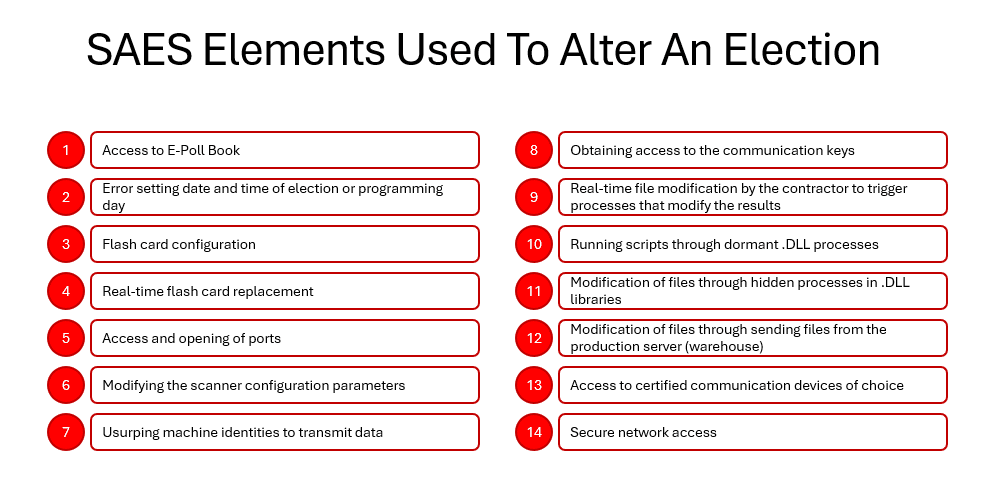
The investigation by Gary Berntsen and Martin Rodil resulted in the recruitment of over a dozen whistleblowers with direct knowledge of how the Smartmatic Automated Electoral Solution (SAES) was used to alter election results.  These whistleblowers identified 14 core mechanisms inherent in the SAES Architecture that were used in varying combinations to subvert the integrity of our elections. 

SOURCE: Stolen Elections by Ralph Pezzullo

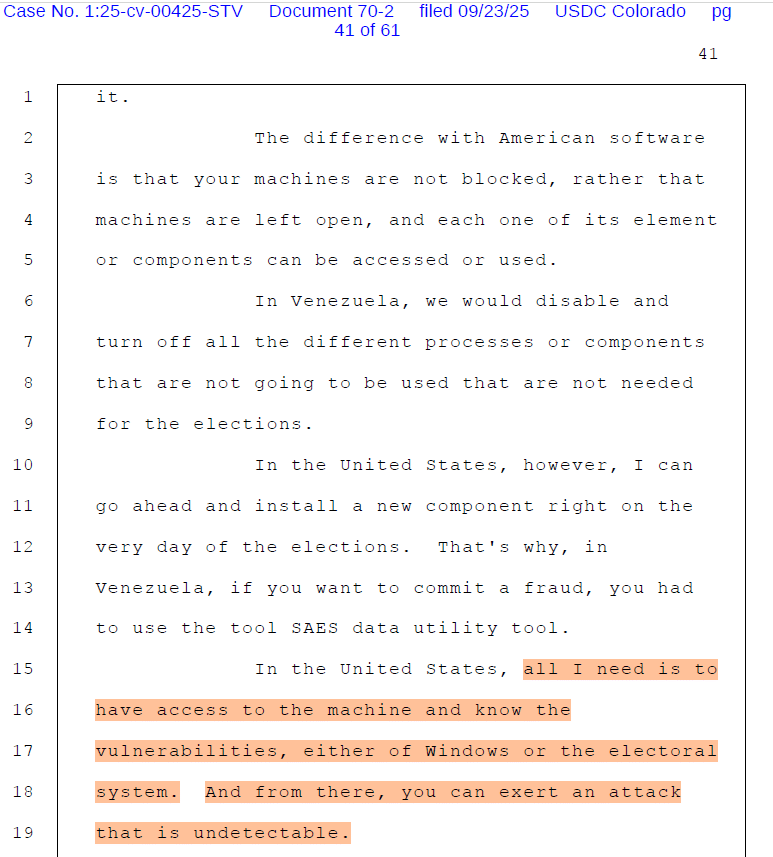
As disclosed by whistleblowers, these mechanisms were designed to ensure that any attack upon our electoral system would be “undetectable”.

In 2006, the U.S. Committee on Foreign Investment in the United States (CFIUS) opened an investigation into Smartmatic.  Smartmatic was eventually forced to sell its Sequoia assets in the United States.

"U.S. national security is potentially at risk because software used to count votes in 20% of the country during U.S. elections is owned and controlled by a Venezuelan-run company with ties to the Venezuelan government of Hugo Chávez,1 which has been described as “the foremost meddler in foreign elections in the Western hemisphere.”2 Foreign-owned and foreign-run Smartmatic’s control over votecounting software used in the voting machines of Sequoia Voting Systems, Inc. (“Sequoia” or “SVS”) presents a potential national security risk now just as it did in 2006 when the U.S. Committee on Foreign Investment in the United States (“CFIUS”) opened an investigation of Smartmatic’s ownership of Sequoia.3 CFIUS is a U.S. government inter-agency committee led by the U.S. Department of Treasury that addresses national security risks posed by foreign ownership of or influence over U.S. business, including companies providing the means by which voters in the U.S. elect their President and Congressional Representatives."

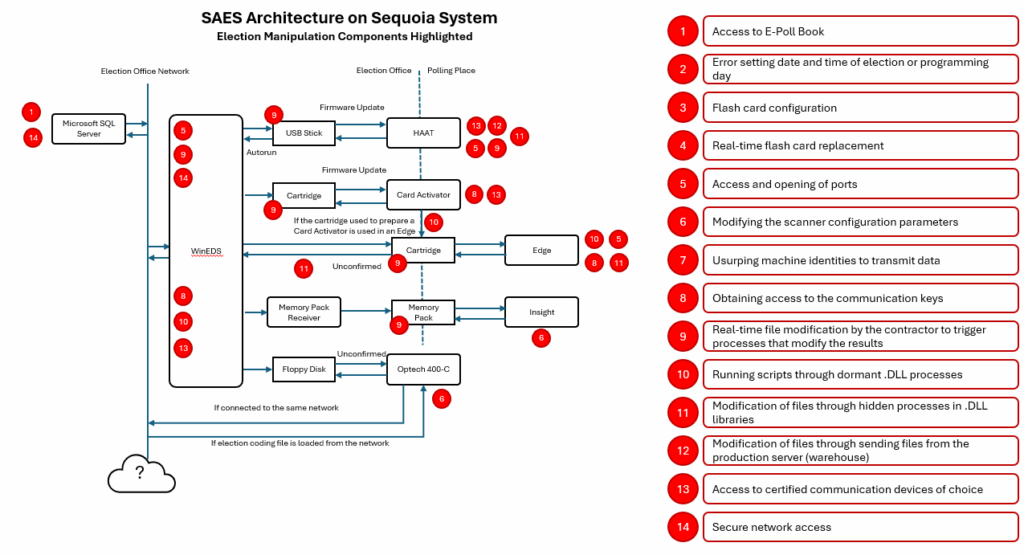
The same election theft mechanisms found in the core SAES Architecture can also be found in the Sequoia System Architecture.  Smartmatic acquired Sequoia in 2005.  

SAES Theft Mechanisms Found in Sequoia System

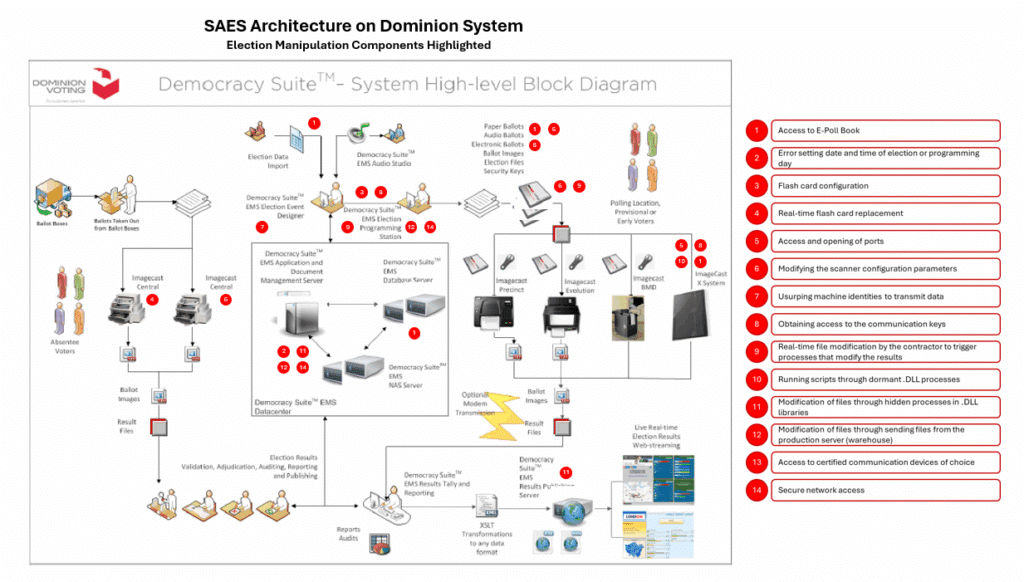
The same election theft mechanisms found in the core SAES Architecture can also be found in the Dominion System Architecture.  Dominion acquired Sequoia in 2010.  Dominion has since been purchased in 2025 by KnowInk and re-branded as Liberty Vote.

SAES Theft Mechanisms Found in Dominion System

ES&S acquired electronic voting assets from American Information Systems (AIS), part of the OpTech lineage previously licensed from Smartmatic and Sequoia. This transfer included core software modules and patents tied to Smartmatic design, with continued use through hardware layer and UI adaptations. ​

Hart InterCivic licenses Intellectual Property found in Sequoia’s machines per Smartmatic v SVS court documents.  In 2025, Hart InterCivic hired Smartmatic developer Heider Garcia as their Vice President of Customer Success.  Heider Garcia was kicked out of the Philippines under allegations of tampering with Philippine elections.

The SAES Architecture developed to alter the results of elections in Venezuela has been found in all of the major electronic voting systems in the United States.  The only sure way to secure our elections from election theft by any of the theft mechanisms built into the SAES Architecture is to ban the use of electronic voting systems in the tabulation of our votes and return to hand counts of paper ballots.

Related Posts