
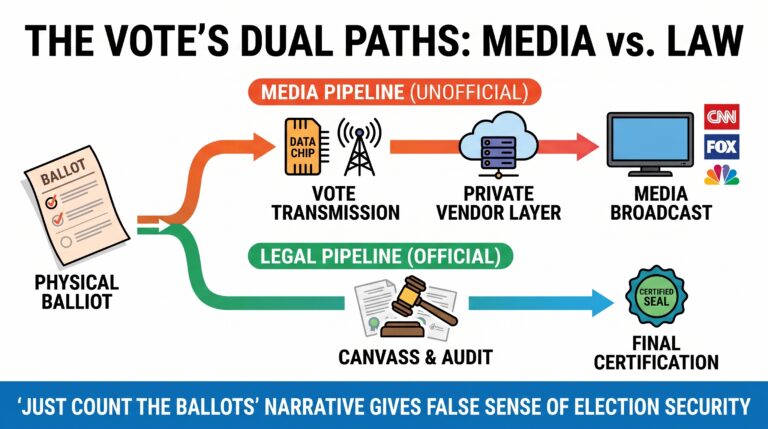
NOTE: Paper ballots DO NOT provide “ground truth” as to the integrity of an election, merely the integrity of the vote tally. The integrity of the physical paper ballot is critical. The integrity of a paper ballot is entirely dependent on the integrity of the ballot storage containers as well as the integrity of the voter registration roll and the front-end verification processes that occur before a ballot is ever scanned.
- Unofficial vs. Official Results: Media “calls” and election night tallies are statistical projections and unofficial data. Legal certification occurs days or weeks later following a formal canvass and audit process.
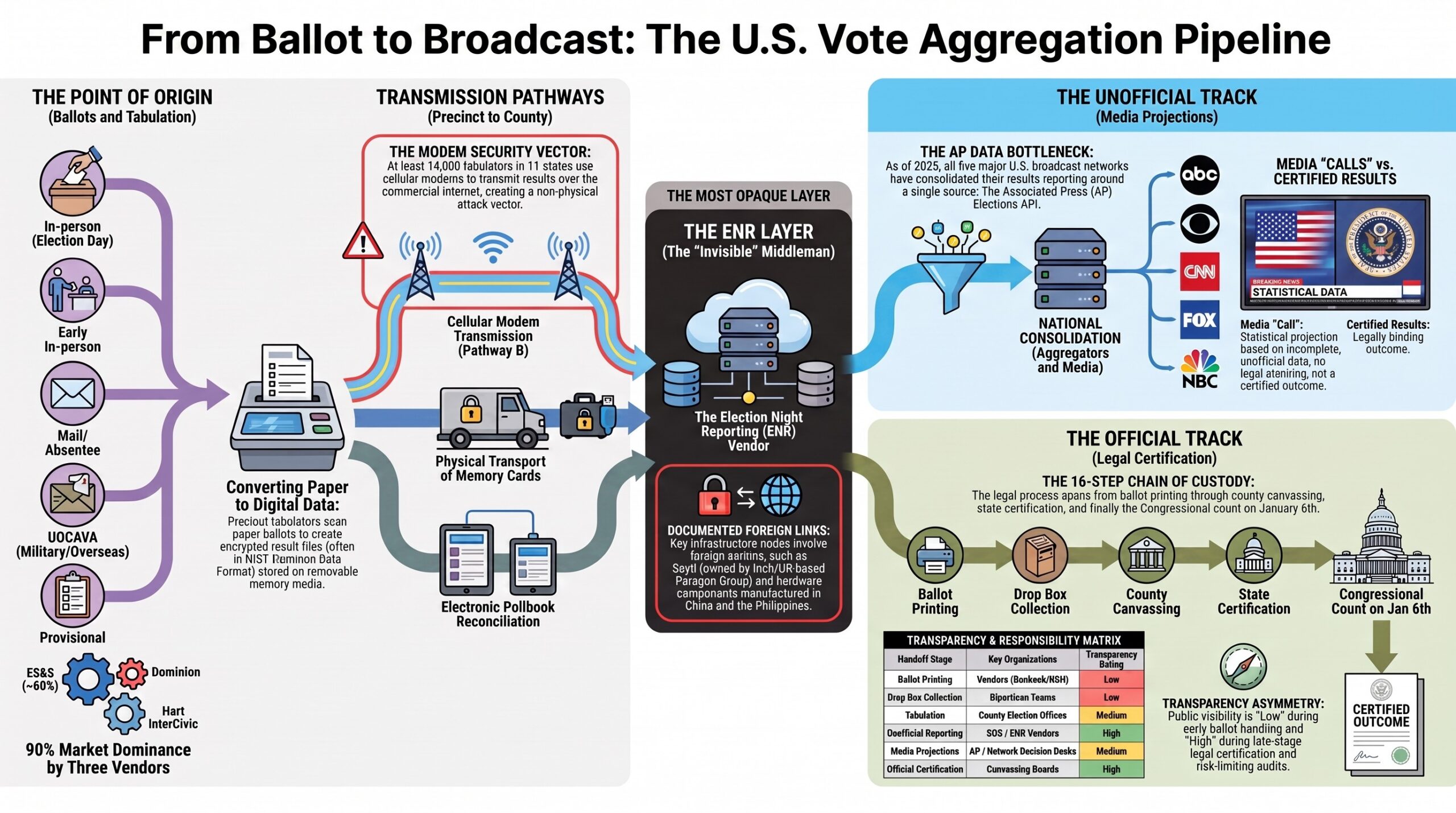
- Infrastructure Consolidation: Three companies (ES&S, Dominion, Hart InterCivic) provide 90% of voting equipment. The Associated Press has consolidated its role as the primary data source for all five major news networks for the 2026/2028 cycles.
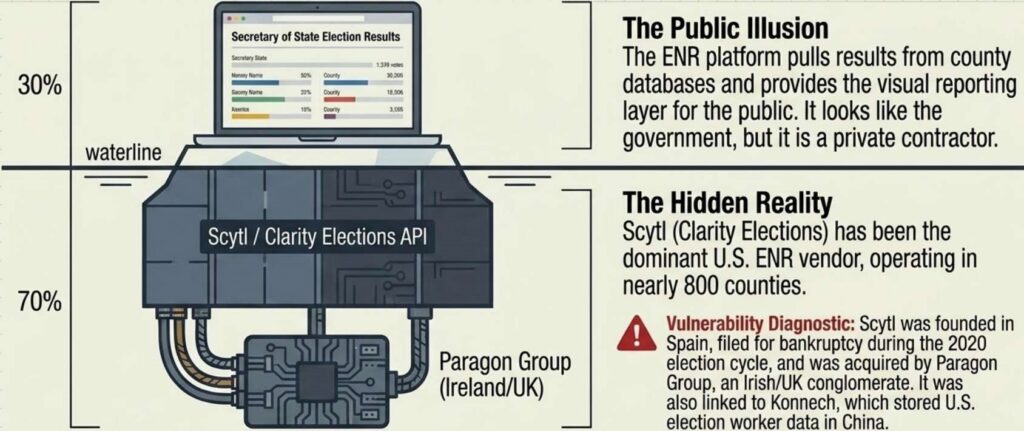
- The ENR Vendor Layer: Private companies like Scytl (owned by the Irish/UK-based Paragon Group) manage the public-facing reporting websites for many states, acting as a critical but often opaque intermediary between county data and the public.
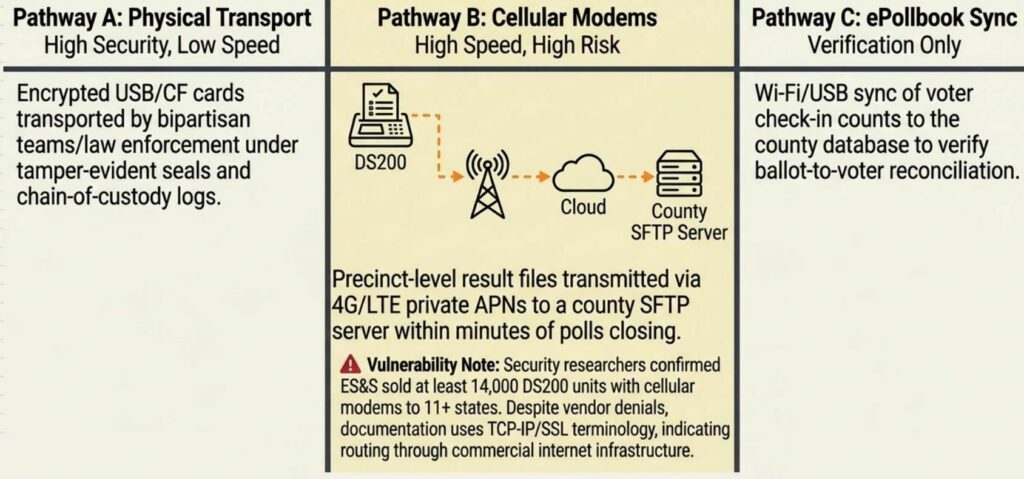
- Security and Foreign Links: Documented vulnerabilities include the use of cellular modems in 14,000+ tabulators, foreign-manufactured hardware components, and foreign ownership of key reporting infrastructure.
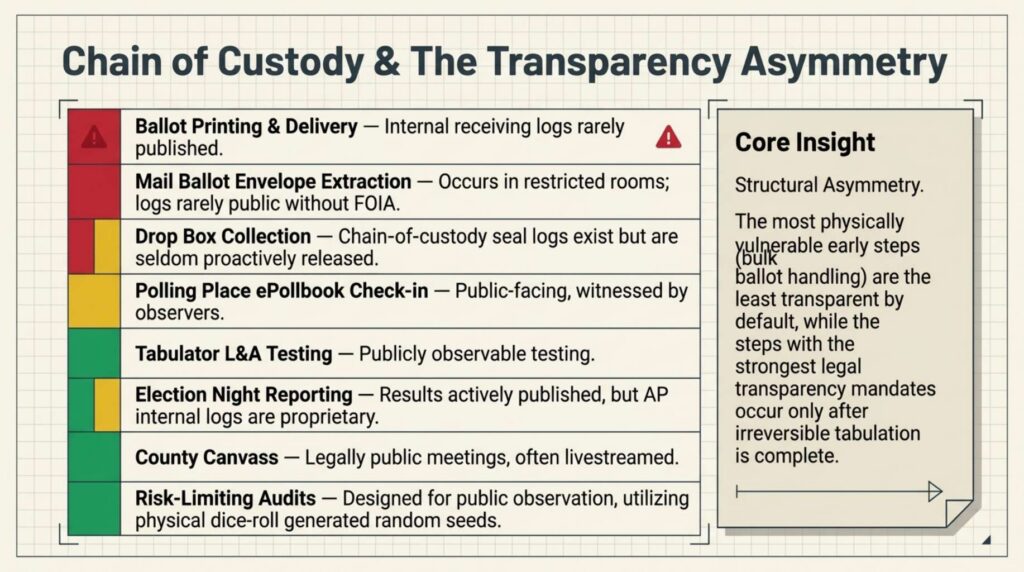
- Chain of Custody Asymmetry: Transparency is highest during the final legal stages (certification, Electoral College) and lowest during early, granular stages such as ballot printing, transport, and envelope processing.
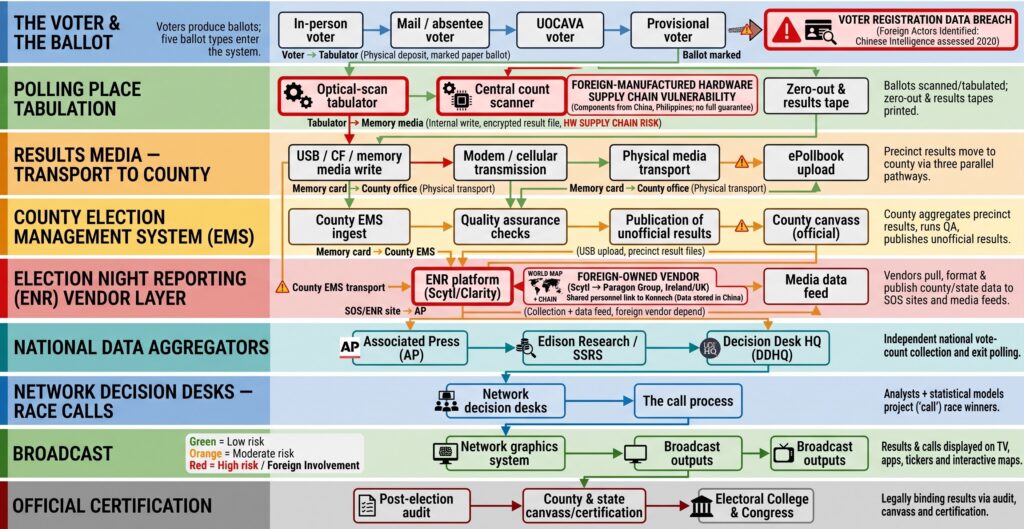
The U.S. Vote Aggregation Chain of Custody
Stage | Process | Key Details |
|---|---|---|
1. The Voter & Ballot | Casting the vote | Includes in-person, early, mail/absentee, UOCAVA, and provisional ballots. |
2. Tabulation | Scanning the ballot | Dominated by ES&S (~60% market share), Dominion, and Hart InterCivic. |
3. Result Transport | Moving data to County | Three pathways: Physical media (USB/CF cards), Modem/Cellular transmission, or ePollbook reconciliation. |
4. County EMS | Centralized aggregation | The Election Management System (EMS) aggregates precinct data and runs quality checks. |
5. ENR Vendor Layer | Reporting infrastructure | Private vendors (e.g., Scytl/Clarity) host state/county results websites and provide data feeds. |
6. National Aggregators | National data collection | The AP reportedly uses 4,000 stringers and automated tools to provide a unified data feed. |
7. Decision Desks | Race projections | Networks (CNN, Fox, ABC, NBC, CBS) use AP data and statistical models to “call” races. |
8. Broadcast | Public display | Results flow from AP API to network graphics systems every few minutes. |
9. Official Certification | Legal finalization | Parallel legal track involving audits, canvassing, and gubernatorial certification. |
Technical Infrastructure and Vulnerabilities
The Tabulation Layer
- Election Systems & Software (ES&S): Owned by McCarthy Group (Private Equity).
- Dominion Voting Systems: Owned by Staple Street Capital.
- Hart InterCivic: Privately held in Austin, TX
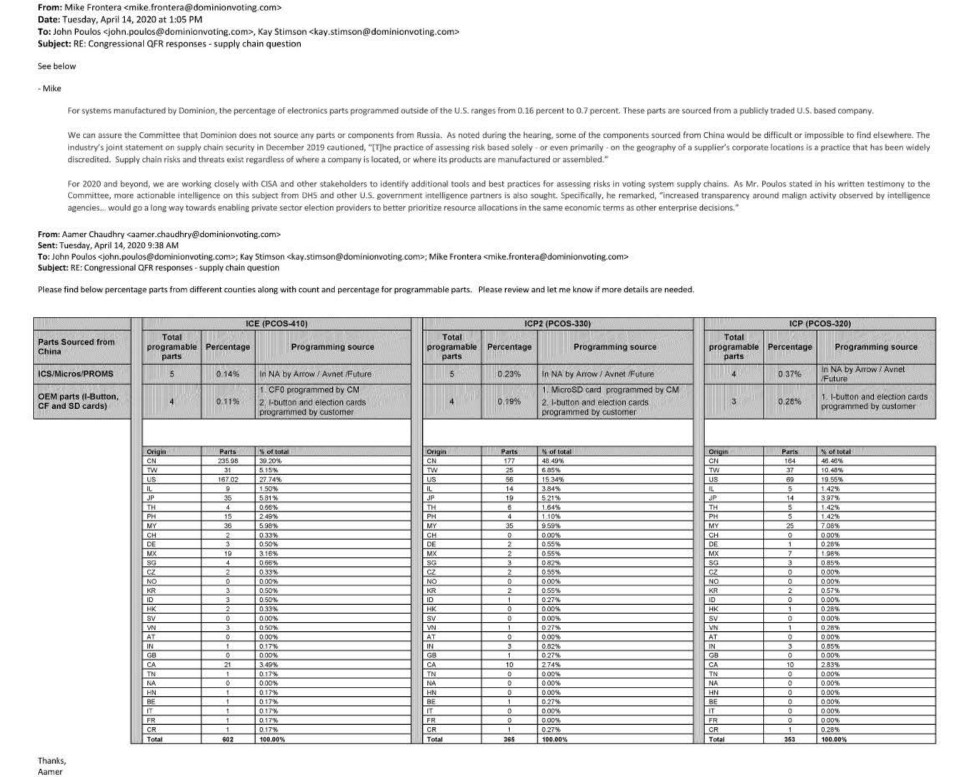
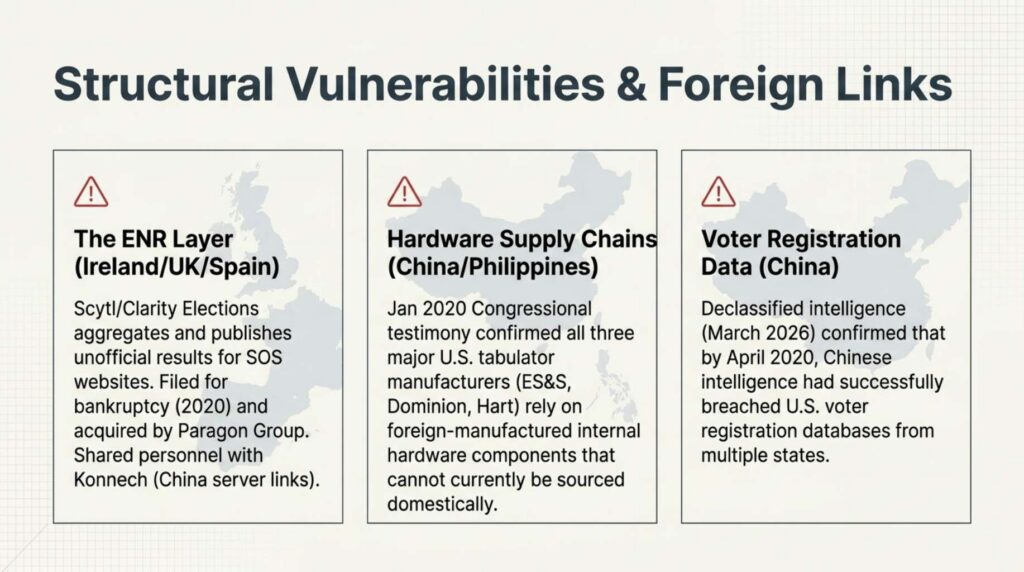
Supply Chain Concerns: In 2020, CEOs of these firms acknowledged that machines contain foreign-made components, including from China, which cannot currently be manufactured in the U.S. ES&S also disclosed manufacturing operations in the Philippines.
The Modem Pathway
The Election Night Reporting (ENR) Layer
- Ownership: Scytl, originally Spanish, was acquired by the Paragon Group (Ireland/UK) following a 2020 bankruptcy.
- Foreign Linkages: Documentation notes a connection between Scytl and Konnech (a firm that stored U.S. worker data in China) through a shared technical director, Luis Nabergoi-Puente.
National Data Aggregation and Media Projections
- Data Inputs: Decision desks combine AP vote counts with voter behavior data from Edison Research/SSRS (The Voter Poll).
- Methodology: Models calculate “race spread” and “expected turnout.” Projections are made only when confidence thresholds are met.
- Status: All results remain “unofficial” until state certification, even when displays show “100% precincts reporting.”
Chain of Custody and Transparency Analysis
Transaction Transparency Ratings
Transaction | Primary Records | Transparency Rating |
|---|---|---|
Ballot Printing & Delivery | Manifests, quantity logs | Low (Internal logs) |
Voter Casting/Ballot Return | Pollbooks, signature verification | Medium (Witnessed by watchers) |
Extraction from Envelopes | Bipartisan team sign-offs | Low (Restricted access) |
Tabulation (Scanning) | L&A test certificates, audit logs | Low (System configuration management and public L&A testing often lack critical infrastructure rigor) |
Unofficial Reporting | Website/Portal timestamps | Medium (Real-time public access but source data/transaction logs often not made public) |
Media Collection | Internal AP verification logs | Low (Proprietary logs) |
County/State Canvass | Minutes, RLA reports | High (Legally public meetings) |
Electoral College Vote | Certificates of Vote | High (Publicly inspectable) |
Congressional Count | Tellers’ tallies | High (Televised/Mandated) |
Security Findings and Documented Concerns
Foreign Actor Involvement:
- Scytl/Paragon: The reporting layer is managed by an Irish/UK-linked conglomerate.
- Chinese Intelligence: Declassified memos from March 2026 indicate that Chinese intelligence breached U.S. voter registration data in multiple states as early as February 2020.
Infrastructure Vulnerability: The ENR layer is the most opaque node. While it does not count votes, a “discrepancy attack” at this level could alter the public’s perception of the outcome by changing the data displayed on SOS websites and media feeds.
Paper as Ground Truth: Despite electronic vulnerabilities, 90%+ of jurisdictions utilize paper ballots. Legal certification is derived from the paper audit trail through:
- Post-Election Audits: Manual tallies or Risk-Limiting Audits (RLAs) that use statistical sampling to verify tabulator accuracy.
- The Canvass: A formal review of all ballots (mail, provisional, and cured) to reconcile any discrepancies documented on election night.
Conclusion
Citations
- EAC Election Results, Canvass, and Certification — https://www.eac.gov/election-officials/election-results-canvass-and-certification
- EAC Guide to the Canvass — https://www.eac.gov/sites/default/files/electionofficials/postelection/Guide_to_the_Canvass_EAC.pdf
- NIST SP 1500-100r2 Election Results CDF — https://nvlpubs.nist.gov/nistpubs/SpecialPublications/NIST.SP.1500-100r2.pdf
- NBC News: How votes get counted on election night — https://www.nbcnews.com/politics/2024-election/votes-get-counted-reported-election-night-nbc-news-gathers-checks-data-rcna174579
- PBS NewsHour: How AP counts the votes — https://www.pbs.org/newshour/politics/how-the-ap-counts-the-votes-on-election-night
- Bipartisan Policy Center: How Media Outlets Call Races — https://bipartisanpolicy.org/explainer/how-media-outlets-call-races-from-unofficial-election-results/
- Center for Election Innovation & Research — https://electioninnovation.org/research/how-election-results-coverage-really-works/
- Axios: AP election data agreement 2025 — https://www.axios.com/2025/10/15/ap-election-data-cbs-fox-cnn-nbc-abc
- NASS State Canvassing Timeframes — https://www.nass.org/node/2455
- ES&S Modem Transmission FAQs — https://www.essvote.com/faqs/transmission-of-unofficial-election-results-faqs/
- Vice Media: ES&S systems exposed online — https://www.vice.com/en/article/exclusive-critical-us-election-systems-have-been-left-exposed-online-despite-official-denials/
- NBC News: Voting systems connected to internet — https://www.nbcnews.com/politics/elections/online-vulnerable-experts-find-nearly-three-dozen-u-s-voting-n1112436
- Politico: Wireless modems midterms risk — https://www.politico.com/news/2022/10/14/wireless-modems-could-endanger-midterms-00061769
- Congressional hearing Jan 2020 – voting machine vendors — https://finance.yahoo.com/news/voting-machine-vendors-scrutiny-congressional-224318201.html
- Poynter: How news organizations call election results — https://www.poynter.org/commentary/2024/how-news-organizations-call-election-results/
- Edison/SSRS Voter Poll announcement — https://www.edisonresearch.com/introducing-the-voter-poll-by-ssrs/
- AP Developer Elections API — https://developer.ap.org/ap-elections-api/docs/Elections_Response_Data_Elements.htm
- FVAP UOCAVA qualitative research — https://www.fvap.gov/uploads/FVAP/Reports/FVAP_QualitativeResearch_20150731_final.pdf
- Elections Group Observer Guide — https://electionsgroup.com/wp-content/uploads/2024/03/ObserverGuide-ElectionResults-Template.pptx