Reasonable Inference
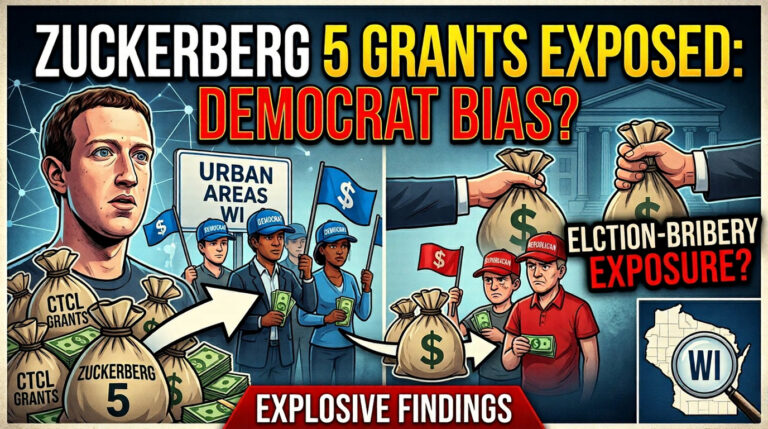
CTCL provided approximately 8.8 million dollars to Milwaukee, Madison, Green Bay, Racine, and Kenosha—about 86% of all CTCL funds in Wisconsin—with contracts (Wisconsin Safe Voting Plan) containing claw‑back provisions and detailed operational requirements for drop boxes, “voter navigators,” and outreach programs in “communities of color.” The OSC Gableman report concluded this scheme “facially violates” Wisconsin’s election‑bribery statute by offering “anything of value” to induce officials to perform election duties in a prescribed way.
Citations
Wisconsin Assembly Office of Special Counsel, Second Interim Investigative Report on the Apparatus & Procedures of the Wisconsin Elections System (March 1, 2022), Chapter 1, p. 1 et seq. (https://bloximages.chicago2.vip.townnews.com/madison.com/content/tncms/assets/v3/editorial/6/49/64989810-acbc-5ce7-bdc1-f56d37e7c923/621e4cdc386e7.pdf ). (Confirms CTCL provided $8.8 million to the “Zuckerberg 5 Cities” — Milwaukee, Madison, Green Bay, Racine, and Kenosha — under the Wisconsin Safe Voting Plan; these five cities received nearly 86% of all CTCL funds distributed in Wisconsin [total statewide >$9–10 million to 200+ jurisdictions].)
Id. at Chapter 1 (citing the Wisconsin Safe Voting Plan and grant agreements). (Details the contracts’ claw-back provisions: “Any amount reduced or not provided in contravention of this paragraph shall be repaid to CTCL up to the total amount of this grant”; cities were required to submit detailed spending reports to CTCL by January 31, 2021, with funds subject to repayment/recapture for non-compliance.)
Center for Tech and Civic Life, Wisconsin Safe Voting Plan 2020 (July 2020), pp. 4–14 & Table 3 (https://www.techandciviclife.org/wp-content/uploads/2020/07/Approved-Wisconsin-Safe-Voting-Plan-2020.pdf ). (The operative contract/plan explicitly required use of funds for drop-box deployment [$216,500 total across the five cities], hiring/training of voter navigators/bilingual LTE staff to assist with absentee processes and ID compliance, and “Dramatically Expand Strategic Voter Education & Outreach Efforts, Particularly to Historically Disenfranchised Residents” — with targeted campaigns via mail, radio, billboards, digital ads, and partnerships in communities of color, LatinX, African American, Hmong, Somali, and other specified demographic groups.)
Id. at Recommendations I–IV (detailed per-city budgets). (The plan imposed detailed operational mandates on the cities — including specific drop-box locations and staffing, voter-navigator roles, expanded early/absentee access, and outreach programs — as conditions of receiving the private CTCL funds.)
Wisconsin Institute for Law & Liberty (WILL), Finger on the Scale (June 2021), pp. 19–20 (https://will-law.org/wp-content/uploads/2021/06/WillLawFINGER-ON-THE-SCALE.6.pdf ). (Confirms the five cities received nearly 86% of all CTCL grant funds in Wisconsin [~$8.8 million out of ~$10.3 million statewide] and documents how the Safe Voting Plan contracts steered the money into drop boxes, navigators, and demographic-targeted outreach.)
Wisconsin Assembly Office of Special Counsel, Second Interim Investigative Report, supra note 1, Chapter 1. (Concludes the entire scheme “facially violates” Wisconsin’s election-bribery statute: “The CTCL agreement facially violates the election bribery prohibition of Wis. Stat. § 12.11 because the participating cities and public officials received private money to facilitate in-person or absentee voting within such a city”; the report explains this as offering “anything of value” (defined to include any amount of money) to induce officials to perform election duties in the precise manner prescribed by the grant/plan.)