Established Fact
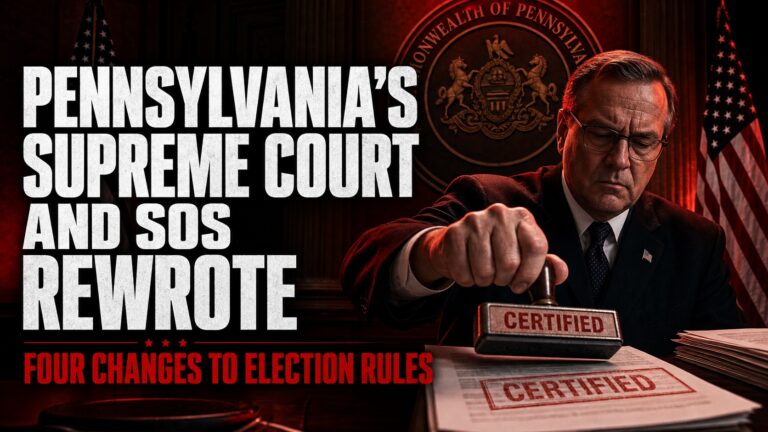
In the weeks preceding the November 2020 general election, the Pennsylvania Supreme Court and Secretary of the Commonwealth Kathy Boockvar altered four core provisions of Pennsylvania’s mail ballot law — Act 77 of 2019 — without action by the General Assembly.
First, Act 77 unambiguously required all mailed ballots to be received by 8:00 p.m. on Election Day. The Pennsylvania Supreme Court, by a 4-3 vote, extended that deadline by three days, accepting ballots received as late as 5:00 p.m. on November 6, 2020, acknowledging that the statutory deadline was “constitutional on its face” and that its ruling was not an interpretation of the statute but an exercise of remedial authority it claimed under the state constitution’s Free and Equal Elections Clause. Three Justices of the U.S. Supreme Court stated that this “squarely alters an important statutory provision enacted by the Pennsylvania Legislature pursuant to its authority under the Constitution of the United States,” expressing “a strong likelihood that the [Pennsylvania] Supreme Court decision violates the Federal Constitution.”
Second, the court authorized the use of unmanned ballot drop boxes across the Commonwealth, a mechanism not authorized by statute, on the basis that Act 77’s language permitting personal delivery to “the county board of election” encompassed locations other than the board’s office.
Third, Secretary Boockvar issued guidance on September 11, 2020 directing all county boards of elections to accept mail-in ballots without conducting signature verification — a practice that had previously been employed in at least some counties — effectively eliminating a verification mechanism without legislative sanction; the Pennsylvania Supreme Court subsequently ratified this guidance in a unanimous October 23, 2020 ruling.
Fourth, on the eve of Election Day, Secretary Boockvar issued guidance authorizing counties to share information with political parties about mail ballots with deficiencies so that voters could be contacted and allowed to cure their ballots by casting provisional ballots in person — a “ballot curing” process not authorized by the Election Code and challenged as executive overreach in federal court.
Citations
Act 77, § 11 provides that if any provision of the Act is found unconstitutional, the remaining provisions — including the entire mail-in voting authorization — are likewise void. The Commonwealth Court’s January 28, 2022 holding that Act 77 is “void ab initio” means, under the Act’s own nonseverability clause, that the entire mail-in voting authorization was void from enactment — which would encompass the 2020 election.
Pennsylvania Democratic Party v. Boockvar Receipt Deadline Extension: https://www.supremecourt.gov/DocketPDF/20/20-542/162072/20201130142834068_20-542%2020-574%20LuzerneCountyBoardOfElectionsInOpposition.pdf | US Supreme Court Brief
Justice Alito Statement, Republican Party of Pennsylvania v. Boockvar, No. 20-542 (U.S. Oct. 28, 2020) (joined by Thomas and Gorsuch, JJ.) — https://www.supremecourt.gov/opinions/20pdf/20-542_i3dj.pdf
Trump v. Boockvar, No. 2:20-cv-00966-NR, Doc. 574 (W.D. Pa. Oct. 10, 2020) (discussing Boockvar guidance on ballot curing as challenged executive overreach) — https://latino.ucla.edu/wp-content/uploads/2021/08/Trump-v.-Boockvar-1.pdf; Spotlight PA, Nov. 6, 2020 — https://www.spotlightpa.org/news/2020/11/pennsylvania-election-2020-provisional-cured-ballots-court-ruling/
Federalist Society State Court Docket Watch analysis — https://fedsoc.org/scdw/PADemvBoockvar2020