
Reasonable Inference
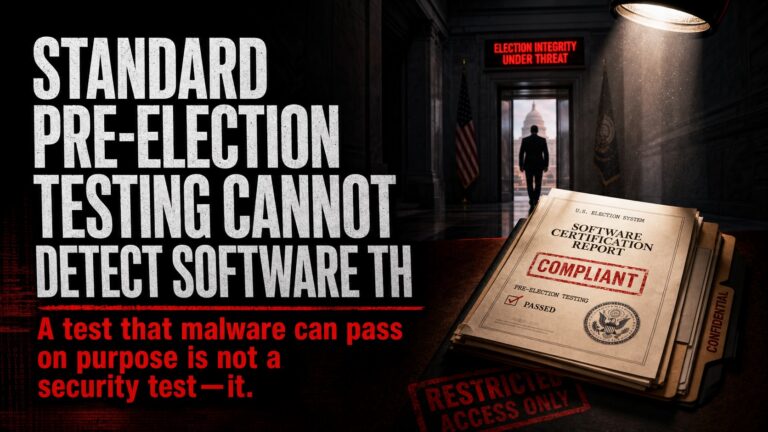
Technical cybersecurity evaluations of Pennsylvania voting system deployments – most concretely illustrated by the Northampton County ESS ExpressPoll failure in 2019, which produced zero votes for one candidate in a contested race despite those votes having been cast – demonstrated a documented pattern: systems passing L&A testing subsequently suffered massive tabulation failures in production conditions. Cybersecurity researchers, including Prof. Halderman in his expert report in Curling v. Raffensperger, documented that standard L&A test decks are wholly ineffective against test-aware malware that can detect the testing environment (limited ballot count, sequential testing pattern, absence of network traffic) and remain dormant during the test window while activating only during live polling hours. L&A testing, as designed and implemented, cannot detect malicious code that knows when it is being tested.
Citations
A year ago, voting machines malfunctioned in a pivotal Pa. county. Have the problems been fixed?: https://www.spotlightpa.org/news/2020/10/pa-northampton-county-voting-machines-glitches-presidential-election/ | Spotlight PA
Northampton County kept sloppy voting machine records: https://www.spotlightpa.org/news/2024/04/northampton-county-voting-machine-error-testing-records-2023-election/ | Spotlight PA
They may look and look, yet not see: BMDs cannot be tested adequately: https://arxiv.org/abs/1908.08144 | Philip B. Stark arXiv paper