
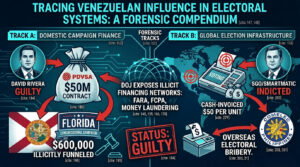
Attack Vector 6: Financial Influence
The 2020 election was administered against a backdrop of unprecedented, and often opaque, financial and operational intervention by private, nonprofit, and illicit actors into what are traditionally governmental election functions. Nationally, entities such as CTCL and CEIR injected hundreds of millions of dollars—primarily into heavily Democratic urban jurisdictions in battleground states—under the banner of “election assistance,” frequently with contractual conditions that shaped how and where voter outreach, drop boxes, and operational support were deployed. At the same time, campaign‑finance vehicles and pass‑through structures (for example, small‑dollar aggregation platforms and dark‑money networks) enabled unusually dense flows of ideologically aligned funding into federal races, in forms that, if coordinated with campaigns or targeted GOTV programs, may implicate federal contribution limits, straw‑donor prohibitions, and foreign‑source bans. Parallel NGO pipelines—including U.S. and foreign government‑funded programs, quasi‑diplomatic democracy‑promotion initiatives, and information‑operations centers—channeled grants, technical assistance, and narrative‑shaping support into domestic actors that engaged directly in election‑related messaging and voter‑mobilization activities.
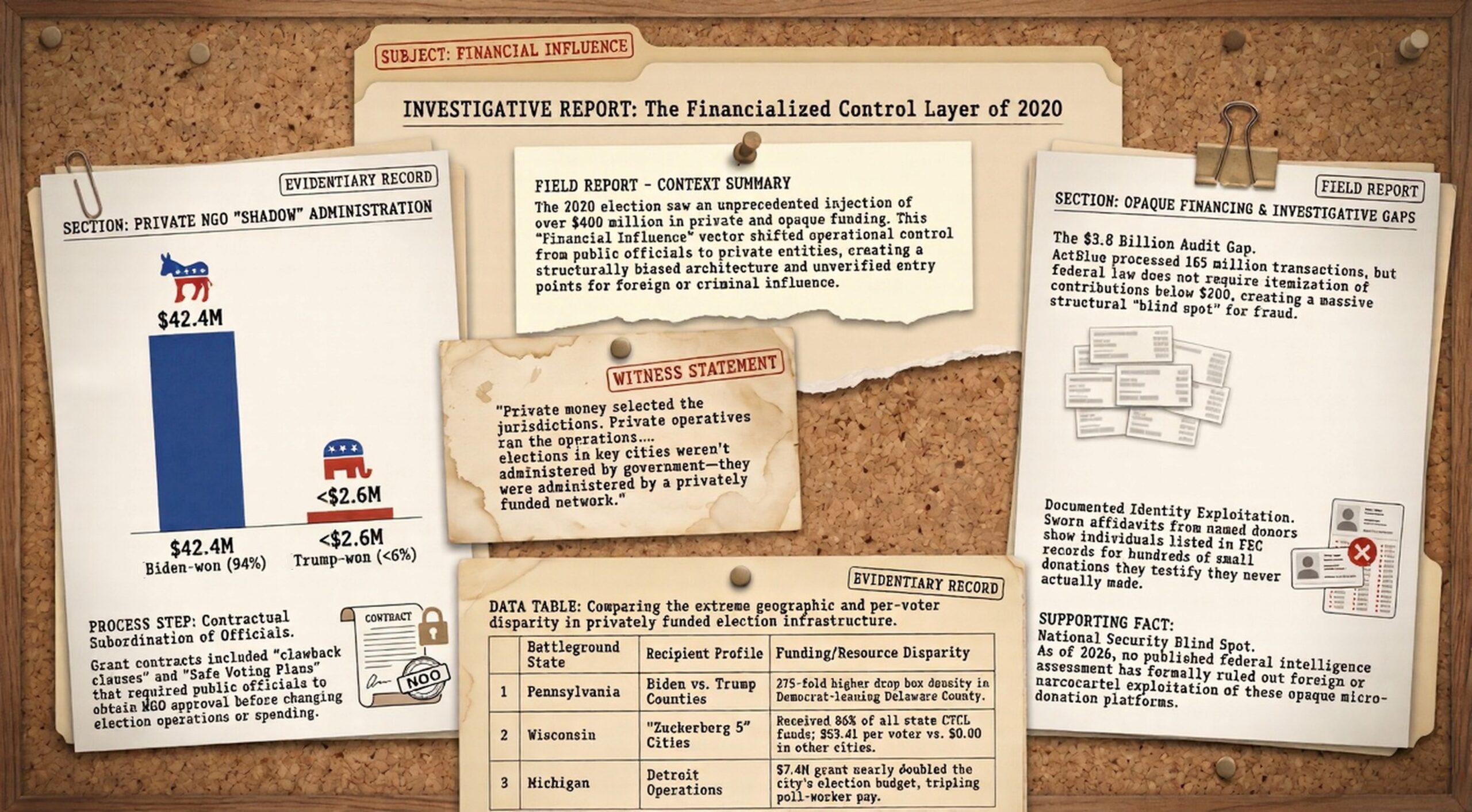
Overlaying this formal ecosystem, investigative reporting and law‑enforcement intelligence have raised concerns that transnational criminal organizations and corrupt foreign networks may have laundered proceeds or influence into the same political and nonprofit channels, potentially aligning cartel or foreign‑state interests with particular candidates, ballot measures, or policy outcomes. The net result was an election‑operations environment in which the deployment of drop boxes, the staffing and training of poll workers, and the design and focus of GOTV efforts were all materially shaped by concentrated, ideologically asymmetric funding streams, rather than by neutral public budgeting processes. When election‑administration resources and voter‑contact operations are financed, conditioned, and targeted in ways that systematically favor one party’s strongholds, the resulting system is not neutral facilitation of voting but a structurally biased architecture that may implicate election‑bribery statutes, campaign‑finance rules, foreign‑contribution bans, money‑laundering laws, and 501(c)(3) prohibitions on partisan activity.
Financial Influence Findings