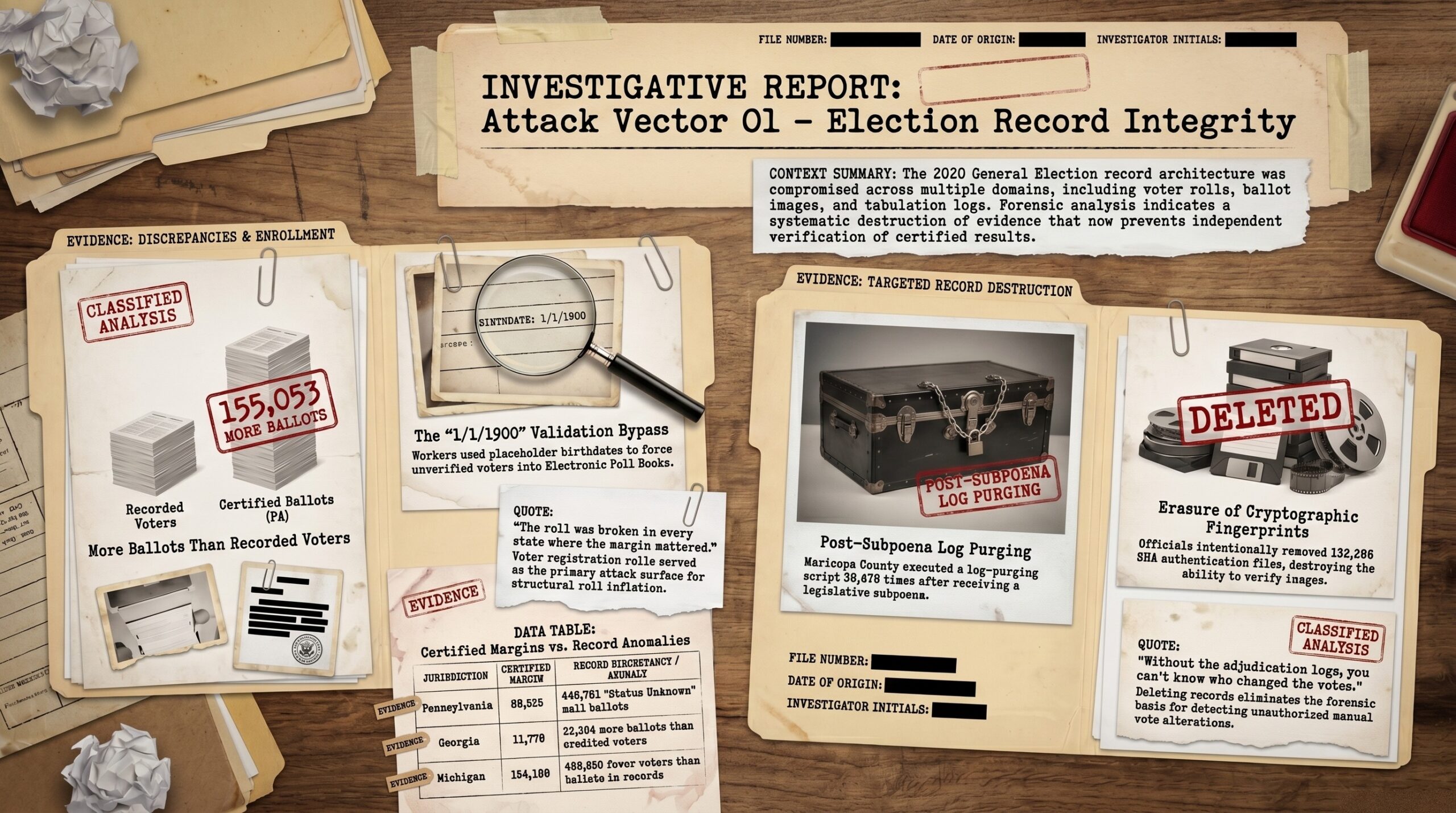
The integrity of any election ultimately rests on whether its records form an unbroken, auditable chain of custody from registration through tabulation and final certification. Voter rolls, poll books, ballots, tabulator reports, and associated logs are not mere administrative byproducts; together they are the evidentiary backbone that allows investigators, courts, and the public to verify that every eligible vote was counted once, only once, and in the correct contest. When any link in this record chain is missing, altered, or unverifiable, it becomes impossible to reconstruct what actually happened at critical stages of the process, and confidence in the election’s legitimacy is necessarily compromised.
This section presents key findings across four interlocking record domains: voter roll integrity, voter history and poll‑book integrity, ballot integrity (digital and physical), and vote‑tally integrity. Each domain corresponds to a distinct “link” in the end‑to‑end audit trail—from the initial creation of voter eligibility records, through issuance and casting of ballots, to the aggregation of those ballots into reported results and the preservation (or loss) of the underlying evidence. In addition to these record-specific findings, we will examine the overt destruction of records by election officials as a separate set of findings due to their concerning prevalence in the 2020 election. Evaluated together, these findings show that in multiple jurisdictions the record architecture necessary for a meaningful audit was fractured at several points, raising legal and factual questions that cannot be resolved by reference to aggregate vote totals alone.
These findings can be reviewed by clicking on the Attack Vector subtopic of interest below.