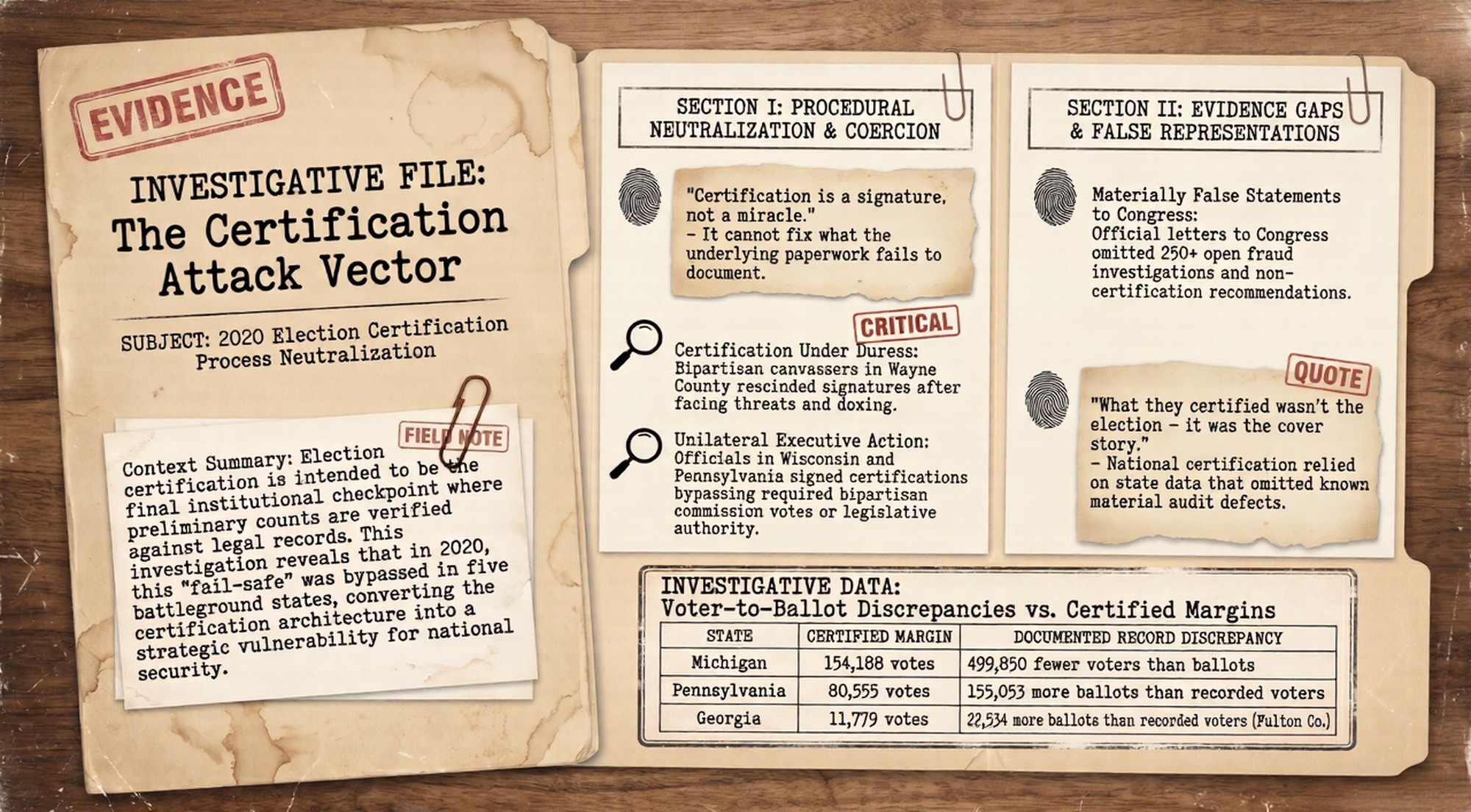
Certification is the legal moment when preliminary vote counts are transformed into binding results, and when all prior links in the election chain of custody—voter registration, poll‑book records, ballot handling, and tabulation—are presumed sufficient for constitutional purposes. At each level of government, from local canvassing boards to state officials and finally Congress’s acceptance of Electoral College votes, certification decisions both reflect and constrain the factual record on which subsequent investigations and litigation can proceed. If certification occurs despite unresolved statutory violations, missing records, or materially misleading public narratives, the resulting “finality” can rest more on institutional momentum and media consensus than on demonstrable compliance with law.
This section presents key findings across six certification‑related domains: canvassing boards, recounts, audits, media reports, state certifications, and the national certification process through Electoral College vote acceptance. Together, these findings show how pressure on local canvassers, limited or tightly constrained recounts and audits, premature or selective media narratives, and state and federal certification decisions made on incomplete or contested information combined to foreclose full resolution of serious election‑integrity questions in 2020.