Election Record Integrity

“1/1/1900” Placeholder Birthdate – Systematic Bypass of QVF Validation at TCF Center (MI)

Established Fact Multiple poll challengers present at the TCF Center Absentee Voter Counting Boards in Detroit on November 3-4, 2020, provided sworn testimony that election workers were manually entering thousands of unverified ballots into electronic poll books for voters who were not listed in the QVF. In each instance, workers entered a placeholder birthdate of

“1/1/1900” Placeholder Birthdate – Systematic Bypass of QVF Validation at TCF Center (MI) Read More »

GBI Strategies – Organized Voter Registration Fraud; 8,000-10,000 Fraudulent Forms in Muskegon (MI)

Established Fact In October 2020, an operative employed by GBI Strategies, LLC, a nationally operating voter registration organization, delivered between 8,000 and 10,000 voter registration forms to the Muskegon, Michigan city clerk’s office. The forms exhibited hallmarks of organized fraud: identical handwriting across multiple applications, non-existent addresses, and fictitious phone numbers. Identical, coordinated spikes in

GBI Strategies – Organized Voter Registration Fraud; 8,000-10,000 Fraudulent Forms in Muskegon (MI) Read More »

211,958 Georgia Votes Attributed to Ineligible Addresses – Warehouses, Vacant Lots, UPS Stores (GA)

Disputed Fact Fractal quantum data analysis identified 211,958 Georgia voters in 2020 who were recorded as casting ballots from addresses that are legally ineligible as residences – including commercial warehouses, vacant lots, and UPS Store mailbox addresses. Georgia law, O.C.G.A. § 21-2-216, requires that a voter be registered at their actual residence. The ERIC system,

211,958 Georgia Votes Attributed to Ineligible Addresses – Warehouses, Vacant Lots, UPS Stores (GA) Read More »

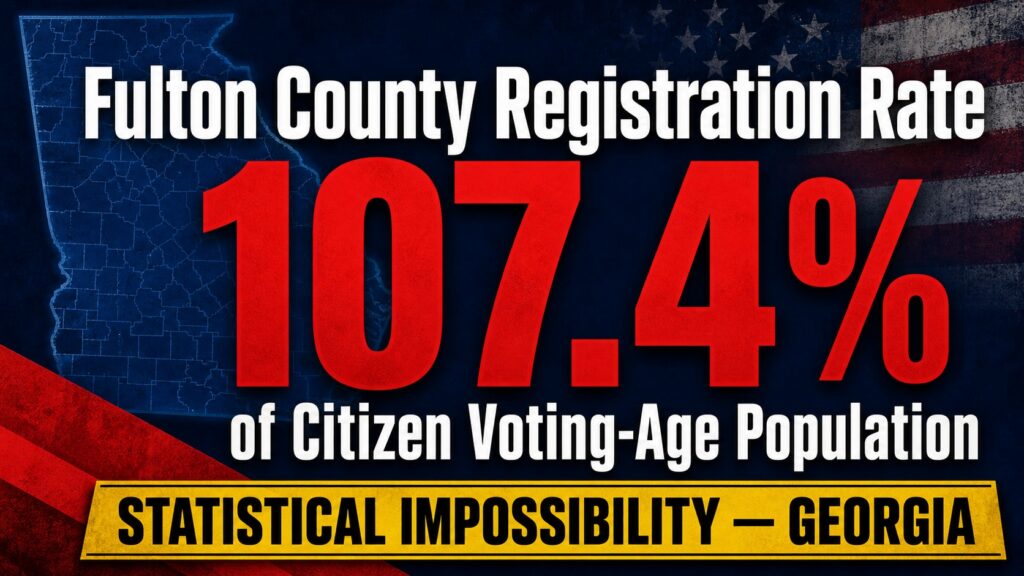
Fulton County Registration Rate of 107.4% of Citizen Voting-Age Population – Statistical Impossibility (GA)

Disputed Fact Fulton County, Georgia’s voter registration rate reached 107.4% relative to its citizen voting-age population (CVAP) – a mathematical impossibility that cannot be explained by any legitimate registration or demographic dynamic. A registration rate exceeding 100% of the eligible population provides per se evidence that the voter rolls contain registrations for individuals who either

Fulton County Registration Rate of 107.4% of Citizen Voting-Age Population – Statistical Impossibility (GA) Read More »

“Ghost Voting” – 96,389 Mail Ballots Attributed to Unknown or Relocated Persons; 173,000 Claimed Votes Unrecorded (AZ)

Reasonable Inference Canvassing analysis conducted post-election estimated that 96,389 mail-in votes were cast as “ghost votes” – attributed to individuals who were unknown to current residents at the listed address or who had moved prior to October 2020. In parallel, approximately 173,000 registered Maricopa County voters stated they had voted in the 2020 election, but

“Ghost Voting” – 96,389 Mail Ballots Attributed to Unknown or Relocated Persons; 173,000 Claimed Votes Unrecorded (AZ) Read More »

20-Year MVD Citizenship Verification System Failure – ~98,000 Unverified Registrants (AZ)

Established Fact A system defect in the Arizona Motor Vehicle Division’s automated voter registration interface allowed approximately 98,000 voter registrations to be processed and validated without requiring documentary proof of citizenship – the constitutional and statutory precondition for voter registration in Arizona. This defect persisted undetected for approximately 20 years. Arizona officials were aware of

20-Year MVD Citizenship Verification System Failure – ~98,000 Unverified Registrants (AZ) Read More »

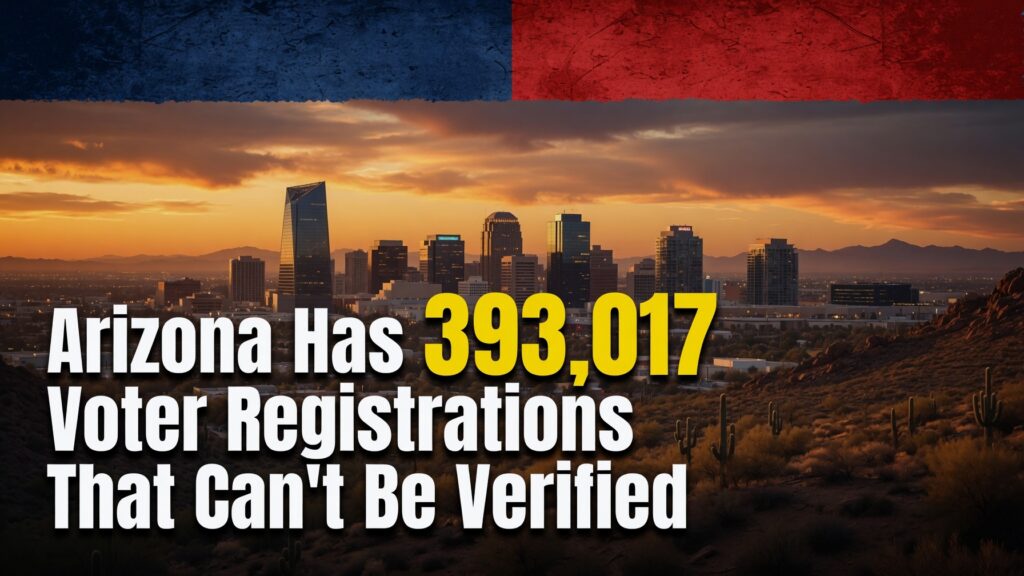
Systemic Failure to Verify Voter Identities – 393,017 Unverifiable Registrants (AZ)

Disputed Fact A study cross-referencing 673,560 registered Arizona voters against Arizona Motor Vehicle Division (MVD) driver’s license data and federal Social Security Administration records found that 58% – or 393,017 individuals – could not be positively identified as real human beings through either database. The methodology and verification standards underlying this study have not been

Systemic Failure to Verify Voter Identities – 393,017 Unverifiable Registrants (AZ) Read More »

Machine-Based Vote Manipulation

Suspicious Vote Tally Anomalies Machine-Based Vote Manipulation Electronic voting systems have several potential vulnerabilities not found with hand counts. If these vulnerabilities were exploited, the election results could be manipulated resulting in certification of fraudulent results. In order to secure our elections from such exploits, significant security rigor is required.  If election officials have insufficient

Machine-Based Vote Manipulation Read More »

Election System Risks

CISA Cyber Risk Summary Election Infrastructure Cyber Risk Assessment CISA’s National Risk Management Center (NRMC) assessed multiple criteria that quantify the scale of election infrastructure cyber risk, including machine preparation, device networking, and the centralization of infrastructure components. CISA NRMC also assessed additional risk criteria related to voter registration, voting machines, and electronic submission of

Election System Risks Read More »

Georgia’s Risk Limiting Audit Contained 6,691 Fictitious Votes — and the State Certified Anyway

During Georgia’s post-election Risk Limiting Audit, Fulton County auditors submitted batch tally sheets that were ‘wildly inconsistent’ with the underlying ballots. The Governor’s office verified 36 specific batch discrepancies, resulting in 6,691 fictitious votes identified in the audit record — 5,618 for Biden, 1,025 for Trump. The State Election Board formally referred the matter for

Georgia’s Risk Limiting Audit Contained 6,691 Fictitious Votes — and the State Certified Anyway Read More »