Reasonable Inference

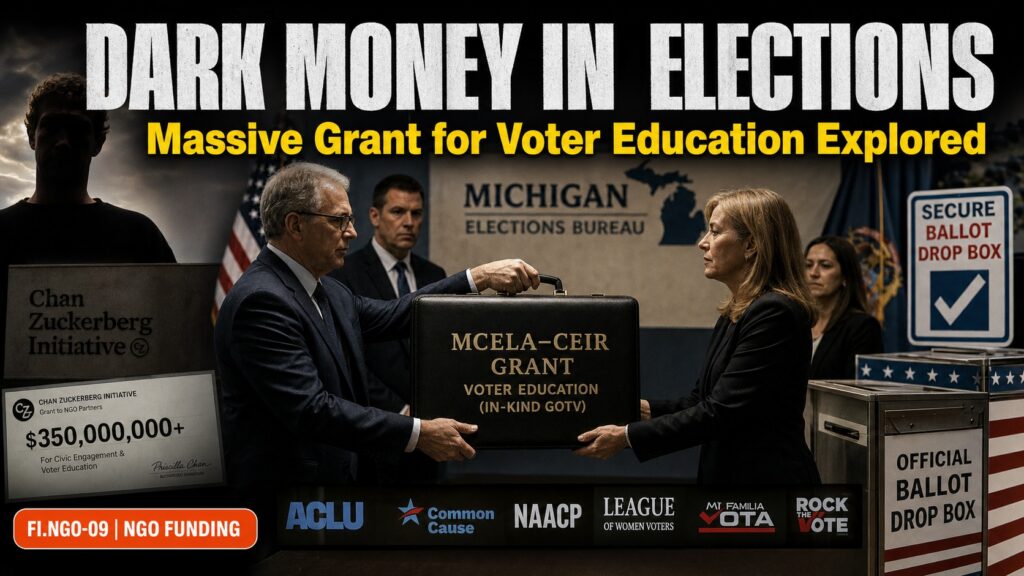
MCELA–CEIR Grant for “Voter Education” as In‑Kind GOTV (MI)

Reasonable Inference Jocelyn Benson founded the Michigan Center for Election Law and Administration (MCELA), a nonprofit that received no material revenue until September 2020, when it was awarded an $11.9 million grant from CEIR — the Zuckerberg-funded Center for Election Innovation and Research — nominally for “voter education.” MCELA directed 99% of those funds — […]

MCELA–CEIR Grant for “Voter Education” as In‑Kind GOTV (MI) Read More »

Conflict of Interest pertinent to financial transactions featuring MI SoS Jocelyn Benson and Silicon Valley Community Foundations (MI)

Reasonable Inference The financial relationship between SVCF and Michigan Secretary of State Jocelyn Benson warrants scrutiny as a structural conflict of interest facilitated through multiple layers of nonprofit intermediaries. SVCF, as the donor-advised fund custodian for the Chan Zuckerberg Initiative, disbursed $69.5 million to the Center for Election Innovation and Research (CEIR). CEIR in turn

Conflict of Interest pertinent to financial transactions featuring MI SoS Jocelyn Benson and Silicon Valley Community Foundations (MI) Read More »

FinCEN SAR Records — Potential Evidentiary Gap Requiring Database Query (US)

Reasonable Inference Suspicious Activity Reports (SARs) filed by financial institutions with FinCEN in connection with ActBlue transactions may corroborate fraud patterns already identified through FEC data analysis. In September 2024, House Oversight Chairman James Comer and Republican colleagues formally requested from Treasury Secretary Yellen all SARs related to ActBlue, citing concerns about potential money laundering,

FinCEN SAR Records — Potential Evidentiary Gap Requiring Database Query (US) Read More »

Conspiracy Exposure — 18 U.S.C. § 371 (Up to 5 Years) (US)

Reasonable Inference If two or more persons coordinated to submit fraudulent contributions through ActBlue — whether through straw donor schemes, identity misappropriation, or foreign contribution routing — each is subject to conspiracy liability under 18 U.S.C. § 371, independent of whether the underlying offense was completed or whether each participant personally committed every element of

Conspiracy Exposure — 18 U.S.C. § 371 (Up to 5 Years) (US) Read More »

Identity Fraud Exposure — 18 U.S.C. § 1028 (Up to 15 Years) (US)

Reasonable Inference Where perpetrators used real individuals’ personal identifying information (name, address, card number) to make contributions without authorization, each instance constitutes potential identity fraud under 18 U.S.C. § 1028, carrying up to 15 years imprisonment. Citations 18 U.S.C. § 1028(a)(7), (b)(1)(D), “Whoever, in a circumstance described in subsection (c) of this section— (7) knowingly

Identity Fraud Exposure — 18 U.S.C. § 1028 (Up to 15 Years) (US) Read More »

Money Laundering Exposure — 18 U.S.C. §§ 1956–1957 (US)

Reasonable Inference Where criminally derived funds (proceeds of straw donor violations or identity fraud) are transmitted through ActBlue to candidate accounts, laundering charges under 18 U.S.C. § 1956 are available. FECA violations are listed as specified unlawful activity under § 1956(c)(7)(D), enabling this theory. Citations Presidential Memorandum, “Investigation into Unlawful ‘Straw Donor’ and Foreign Contributions

Money Laundering Exposure — 18 U.S.C. §§ 1956–1957 (US) Read More »

Wire Fraud Exposure — 18 U.S.C. § 1343 (Up to 20 Years Per Count) (US)

Reasonable Inference Where fraudulent contributions are submitted via ActBlue’s internet platform, each electronic transmission constitutes a potential wire fraud predicate under 18 U.S.C. § 1343, which broadly covers any scheme to obtain money or property by false pretenses transmitted “by means of wire . . . communication in interstate or foreign commerce.” Wire fraud carries

Wire Fraud Exposure — 18 U.S.C. § 1343 (Up to 20 Years Per Count) (US) Read More »

CVV/AVS Gap as Potential Foreign Contribution Vector (US)

Reasonable Inference Security researchers contend ActBlue’s relaxed CVV and Address Verification System (AVS) configuration would have reduced technical barriers to foreign-based actors using prepaid cards or VPNs to submit contributions without triggering identity mismatch rejections. Citations Logan Washburn, ‘Amid Chaos At ActBlue, House Republicans Seek Answers About ‘Potentially Fraudulent And Illicit Financial Activity,’ The Federalist,

CVV/AVS Gap as Potential Foreign Contribution Vector (US) Read More »

ActBlue Enables Illegal Foreign National Contributions

Reasonable Inference ActBlue security negligence enables illegal foreign national contributions. 52 U.S.C. § 30121 law prohibits foreign nationals from making any direct or indirect contribution in connection with any U.S. election. Receiving committees are also prohibited from soliciting, accepting, or receiving such contributions. Felony threshold: >$25,000/year. Citations John Solomon, ‘Questions mount about ActBlue’s security,’ Just

ActBlue Enables Illegal Foreign National Contributions Read More »

ActBlue Leverages FEC Reporting Loophole By Using Straw Donors Used (US)

Reasonable Inference Where a coordinating actor directs multiple nominal donors to make contributions earmarked for a common recipient, those contributions are attributed to the original source — not the nominal donor — and aggregate against that source’s individual contribution limits. The conduit or intermediary is required to report the original source and intended recipient to

ActBlue Leverages FEC Reporting Loophole By Using Straw Donors Used (US) Read More »