Disputed Fact

Voting System’s Encryption Keys Provided to Counties Unprotected in Plain Text (GA)

Disputed Fact Encryption is used to protect the voting system configuration files, programming, election results, and functions. With the cryptographic encryption keys, the programming, results, and functions can be easily manipulated without detection. Citations Fulton County, GA 2020 General Election Report for Georgia State Election Board, Election Oversight Group, LLC https://drive.google.com/file/d/1UzJ4qX6iBSrFMtkoRnOGIe3q8pzGjkVx/view?usp=drive_link

Voting System’s Encryption Keys Provided to Counties Unprotected in Plain Text (GA) Read More »

EAC security rigor insufficient to secure election systems as critical infrastructure (US)

Disputed Fact On December 7, 2025, the Chair of the Election Assistance Commission, Donald Palmer, issued a statement designed to give a false sense of security that our electronic voting systems are secure. The Election Crime Bureau responded with a report supported by evidence that asserts that the security safeguards in place for election systems

EAC security rigor insufficient to secure election systems as critical infrastructure (US) Read More »

Exploitation of Dominion Democracy Suite 5.5 Deployed with Open SQL Server Port 1433 – Direct Database Modification Possible from Any Internet-Connected Device (PA)

Disputed Fact [Disputed Fact – As to whether vulnerability was exploited] Forensic analysis of Dominion’s Democracy Suite in multiple jurisdictions established that SQL Server port 1433 was configured to accept connections from any IP address worldwide. Port 1433 is the standard network port for Microsoft SQL Server – the database engine underlying the Democracy Suite.

Exploitation of Dominion Democracy Suite 5.5 Deployed with Open SQL Server Port 1433 – Direct Database Modification Possible from Any Internet-Connected Device (PA) Read More »

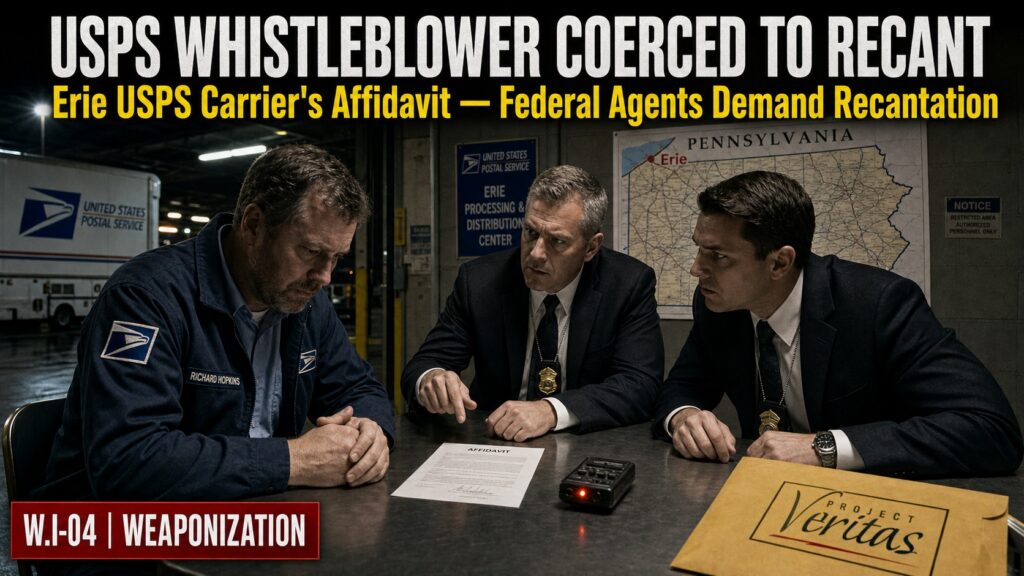
USPS OIG Coercive Interrogation of Whistleblower Richard Hopkins – Alleged Forced Recantation (PA)

Disputed Fact Erie, PA postal worker Richard Hopkins signed a sworn affidavit alleging that a supervisor ordered the backdating of late-arriving mail-in ballots to appear timely. Following his public disclosure, he was subjected to questioning by federal investigators (USPS OIG) in a manner that Hopkins and his counsel characterized as coercive, producing a heavily publicized

USPS OIG Coercive Interrogation of Whistleblower Richard Hopkins – Alleged Forced Recantation (PA) Read More »

Erie USPS Whistleblower Richard Hopkins – Federal Agent Coercion to Recant (PA)

Disputed Fact Following the election, Richard Hopkins, an Erie, Pennsylvania, U.S. Postal Service carrier who had signed a sworn affidavit alleging that supervisors directed him to collect and backdate late-arriving mail-in ballots to November 3, 2020, was aggressively interrogated by federal postal inspectors until he recanted his affidavit. The interrogation and recantation were captured in

Erie USPS Whistleblower Richard Hopkins – Federal Agent Coercion to Recant (PA) Read More »

Coordinated Use of Standing Dismissals, Rule 11 Sanctions Threats, and Attorney Discipline to Deter Election Integrity Litigation (MI)

Disputed Fact Multiple attorneys who filed election integrity challenges in Michigan faced concurrent financial and professional consequences initiated or recommended by federal and state officials. In August 2021, U.S. District Judge Linda V. Parker sanctioned Sidney Powell, Lin Wood, Stefanie Lambert, and six other attorneys for the King v. Whitmer challenge, ordering monetary payment of

Coordinated Use of Standing Dismissals, Rule 11 Sanctions Threats, and Attorney Discipline to Deter Election Integrity Litigation (MI) Read More »

Civil Coercion of Alternate Electors – Forced Political Confessions (WI)

Disputed Fact Activist legal organizations Law Forward and Georgetown University’s Institute for Constitutional Advocacy and Protection (ICAP) weaponized civil litigation against Wisconsin’s alternate electors and their attorneys, eventually forcing settlements that required defendants to publicly acknowledge Joe Biden’s victory and legally agree not to serve as presidential electors for Donald Trump in any future election.

Civil Coercion of Alternate Electors – Forced Political Confessions (WI) Read More »

Prohibition of evidence introduction in Coomer v Lindell (CO)

Disputed Fact Defense counsel advocated for the admission of a broad range of evidence that Lindell relied on in forming his beliefs, including documentary films, news clips, expert reports, and social media posts about election security vulnerabilities—not just regarding Dr. Coomer, but also general warnings from public officials and election security experts. The defense specifically

Prohibition of evidence introduction in Coomer v Lindell (CO) Read More »

Prejudiced Jury Instructions in Coomer v Lindell (CO)

Disputed Fact At trial in Coomer v. Lindell, the defense preserved multiple objections to the jury instructions as issued by Judge Wang. The defense objected that the adverse inference instruction regarding Tina Peters’ invocation of the Fifth Amendment improperly attributed inferences from a non-agent third party to Lindell, potentially prejudicing the jury’s view of him.

Prejudiced Jury Instructions in Coomer v Lindell (CO) Read More »

Prohibition of evidence introduction in Tina Peters Prosecution (CO)

Disputed Fact At trial, the court excluded evidence of Tina Peters’ asserted statutory duty to preserve federal election records under 52 U.S.C. § 20701, her claimed belief that the May 2021 “Trusted Build” software installation would destroy those records, and her motive for arranging the forensic imaging of Mesa County’s Dominion election equipment server. The

Prohibition of evidence introduction in Tina Peters Prosecution (CO) Read More »