Disputed Fact

Prejudiced Jury Instructions in Tina Peters Prosecution (CO)

Disputed Fact In People v. Peters, the Colorado Court of Appeals identified a constitutional error in Tina Peters’ sentencing: the trial court had imposed a lengthier sentence based in part on Peters’ post-offense public statements about election fraud rather than solely on her criminal conduct, violating the First Amendment principle that “a sentence based to

Prejudiced Jury Instructions in Tina Peters Prosecution (CO) Read More »
Near-Universal Denial of Discovery in Technically Complex Election Cases (US)

Disputed Fact In the vast majority of cases characterized as merits decisions, plaintiffs operated without access to any meaningful discovery process-unable to subpoena election records, machine logs, chain-of-custody documentation, or tabulation data. Plaintiffs were limited to affidavits, expert reports, and publicly available statistics, which courts then found insufficient. The structural asymmetry-election officials testifying how elections

Near-Universal Denial of Discovery in Technically Complex Election Cases (US) Read More »

Disparate Pleading Standards and Punitive Page Limits in King v. Whitmer (MI)

Disputed Fact While plaintiffs faced extreme judicial hostility for technical pleading errors and affidavits deemed hearsay without the benefit of any discovery to prove them, the court accommodated defendants’ aggressive litigation tactics-allowing the City of Detroit to file a 38-page brief explicitly seeking sanctions and disbarment against plaintiffs’ attorneys, prioritizing punitive procedural action over evidentiary

Disparate Pleading Standards and Punitive Page Limits in King v. Whitmer (MI) Read More »

Prevention of discovery limited access to information necessary to prove election fraud (US)

Disputed Fact Only 3 of the “64 lawsuits” featured any discovery that would provide plaintiffs with access to materials otherwise not available to the general public. Of those 3, only 1 (Bailey v Antrim County) offered any substantive discovery. Notably, in his oral opinion that closed the case, Judge Kevin Elsenheimer specifically stated: “By deciding

Prevention of discovery limited access to information necessary to prove election fraud (US) Read More »

Attorney Sanctions Used to Deter Election Integrity Litigation in Pennsylvania (PA)

Disputed Fact Following the 2020 election, attorneys who pursued election-challenge litigation in Pennsylvania and other states faced sanctions motions and bar discipline that created documented deterrent effects on future filings. The Rule 11 safe-harbor provision — which permits withdrawal within 21 days of a sanctions motion to avoid liability — provides a structural mechanism under

Attorney Sanctions Used to Deter Election Integrity Litigation in Pennsylvania (PA) Read More »

Attorney Sanctions Used to Deter Election Integrity Litigation in California (CA)

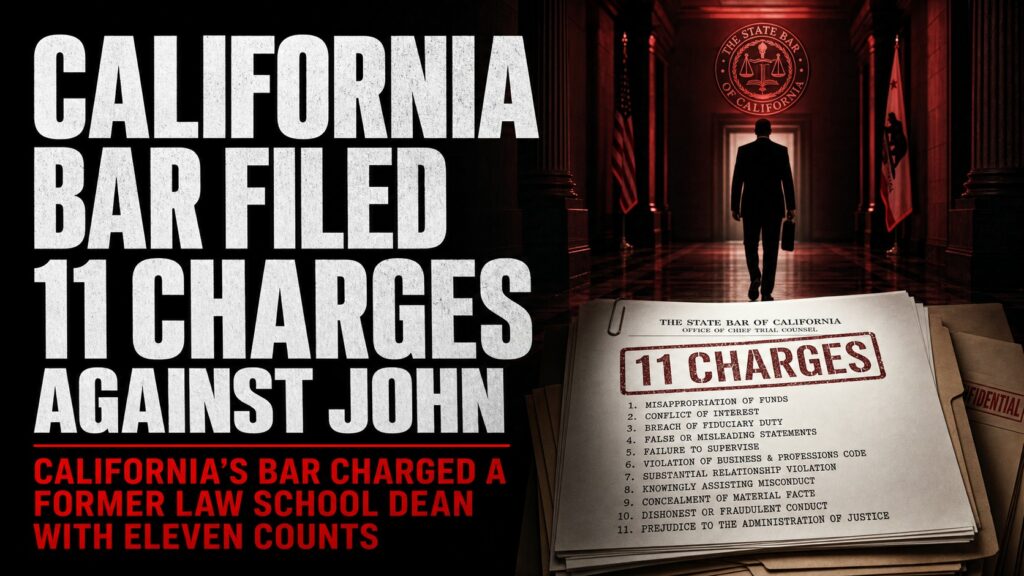
Disputed Fact John Eastman — a former law school dean, constitutional scholar, and attorney for Donald Trump — has been the subject of California State Bar disciplinary proceedings arising from his role in the effort to challenge the 2020 presidential election results. On January 26, 2023, the California Bar filed a Notice of Disciplinary Charges

Attorney Sanctions Used to Deter Election Integrity Litigation in California (CA) Read More »

Malicious Prosecution of Attorneys for Election Integrity Litigation in Michigan (MI)

Disputed Fact Attorney Matt DePerno and attorney Stefanie Lambert Junttila — both active in 2020 election-challenge litigation and forensic investigations of electronic voting systems — were charged with felonies arising from their involvement in unauthorized access to and testing of voting tabulators. On August 1–2, 2023, Michigan special prosecutor D.J. Hilson — appointed by Attorney

Malicious Prosecution of Attorneys for Election Integrity Litigation in Michigan (MI) Read More »

Attorney Sanctions Used to Deter election Integrity Litigation in Michigan (MI)

Disputed Fact In King v. Whitmer, Judge Linda V. Parker sanctioned all nine pro-Trump attorneys — including Sidney Powell and L. Lin Wood — ordering $175,250 in fee-shifting, twelve hours of mandatory legal education on pleading standards and election law, and referrals to their home bars for possible suspension or disbarment. Parker described the suit

Attorney Sanctions Used to Deter election Integrity Litigation in Michigan (MI) Read More »

Attorney Plea Agreements – Coerced Admissions Under Financial Duress (GA)

Disputed Fact Attorneys Jenna Ellis, Kenneth Chesebro, and Sidney Powell each pleaded guilty in October 2023 to reduced charges — with the RICO count dropped in every instance in exchange for probation and cooperation obligations. Ellis stated in open court that she had “failed to do my due diligence” and that “if I knew then

Attorney Plea Agreements – Coerced Admissions Under Financial Duress (GA) Read More »

Malicious Prosecution of Attorneys for Providing Legal Advice Regarding Elections (GA)

Disputed Fact Fulton County District Attorney Fani Willis used Georgia’s RICO statute to indict five lawyers who had provided legal advice to the Trump campaign — Giuliani, Powell, Eastman, Chesebro, and Ellis — charging specific legal-service activities, including the drafting of legal memoranda and the filing of a federal court complaint, as predicate criminal acts.[1]

Malicious Prosecution of Attorneys for Providing Legal Advice Regarding Elections (GA) Read More »