System Certification

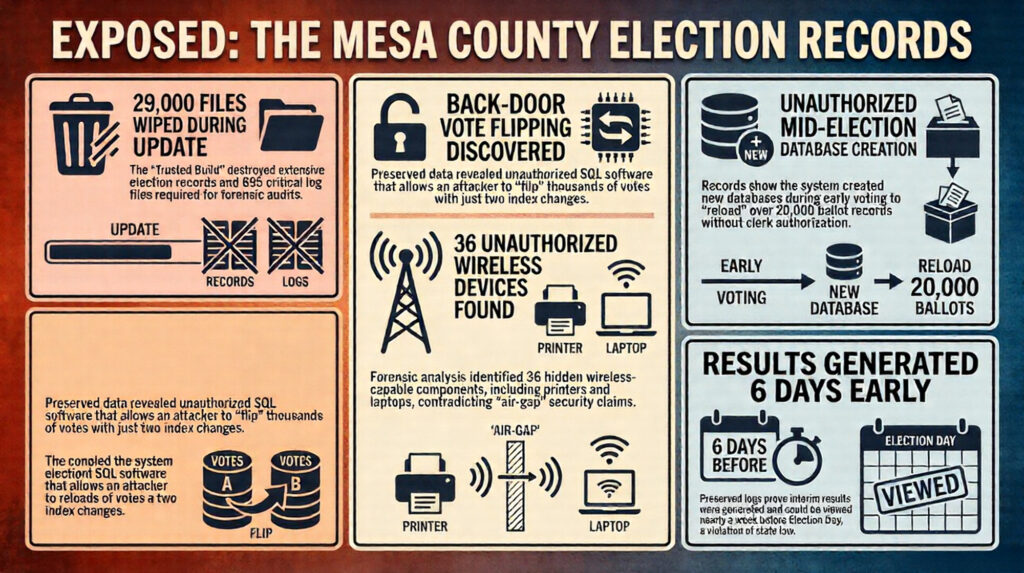
Mesa County, CO Election System Discoveries Made Possible by Tina Peters

Established Fact Tina Peters is the former Mesa County, CO clerk who was sentenced to nine years in prison for making forensic copies of her Dominion Election Management System (EMS) server in the wake of the 2020 election cycle.  In so doing, Tina prevented the destruction of election records for both the 2020 and 2021 […]

Mesa County, CO Election System Discoveries Made Possible by Tina Peters Read More »

Secretary of Commonwealth Decertified Fulton County Voting Machines in Retaliation for Commissioning Independent Forensic Audit (PA)

Established Fact After Fulton County, Pennsylvania commissioned an independent forensic examination of its Dominion voting equipment – an audit it was authorized to conduct under Pennsylvania law – the Pennsylvania Secretary of the Commonwealth decertified Fulton County’s voting machines on the stated basis that the county had permitted an independent inspector to access them. Fulton

Secretary of Commonwealth Decertified Fulton County Voting Machines in Retaliation for Commissioning Independent Forensic Audit (PA) Read More »

EAC Certification Does Not Require Disclosure of Foreign Ownership, Supply Chain Provenance, or Remote Access Capabilities (US)

Established Fact The EAC’s certification program, as documented by the Brennan Center’s November 2019 report, certifies voting systems against technical performance standards but does not require vendors to disclose: foreign connections or ownership structures; supply chain provenance of components; or embedded remote-access capabilities. This structural gap enabled ESS and Dominion to pass through the federal

EAC Certification Does Not Require Disclosure of Foreign Ownership, Supply Chain Provenance, or Remote Access Capabilities (US) Read More »

EAC’s Own Investigation Found Tabulation Discrepancies in 7 of 18 Dominion ICP Tabulators (TN)

Established Fact The EAC’s own investigation of Dominion Democracy Suite 5.5-B deployment in Williamson County, Tennessee documented anomalies in which close poll reports from 7 of 18 ICP tabulators did not match the number of ballots scanned – requiring correction through central count scanner re-tabulation. This is not a finding by election integrity advocates; it

EAC’s Own Investigation Found Tabulation Discrepancies in 7 of 18 Dominion ICP Tabulators (TN) Read More »

Retaliatory Decertification – State Punishes County for Exercising Audit Rights (PA)

Disputed Fact The Pennsylvania Secretary of the Commonwealth’s decertification of Fulton County’s Dominion machines, triggered solely by Fulton County’s exercise of its audit rights, effectively inverted the relationship between state oversight and local accountability. Under Pennsylvania election law, counties retain statutory authority to verify the integrity of election equipment under their custody. If the state

Retaliatory Decertification – State Punishes County for Exercising Audit Rights (PA) Read More »

Electronic voting systems lack the transparency needed to promote public trust in election outcomes (US)

Disputed Fact Together, illusory contracts, FOIA obstruction, and denials of access create a structural environment in which grave technical weaknesses can persist indefinitely without detection or remediation. Mesa County’s case demonstrates that unauthorized software (SSMS), global SQL exposure, disabled logging, and mass deletion of audit trails can coexist with EAC/VSTL “certification” and state assurances precisely

Electronic voting systems lack the transparency needed to promote public trust in election outcomes (US) Read More »

EAC governance system is an insulated “circle of trust” that lacks independent oversight needed for the security of critical infrastructure (US)

Disputed Fact CISA’s Cyber Risk Assessment depicts U.S. election infrastructure as a highly networked, variably secured critical infrastructure ecosystem with persistent, exploitable weaknesses, while the EAC’s election system oversight is narrowly product centric, episodic, and largely detached from those systemic cyber risk realities. Unlike other critical infrastructure systems, there are no failure modes and effects

EAC governance system is an insulated “circle of trust” that lacks independent oversight needed for the security of critical infrastructure (US) Read More »

EAC lacks analysis rigor sufficient for critical infrastructure (US)

Disputed Fact CISA’s Cyber Risk Assessment depicts U.S. election infrastructure as a highly networked, variably secured critical infrastructure ecosystem with persistent, exploitable weaknesses, while the EAC’s election system oversight is narrowly product centric, episodic, and largely detached from those systemic cyber risk realities. Unlike other critical infrastructure systems, there are no failure modes and effects

EAC lacks analysis rigor sufficient for critical infrastructure (US) Read More »

EAC features significant security gaps (US)

Disputed Fact The latest VVSG 2.0 standard features the following security gaps: • System boundary: focuses on the voting device and EMS, not the full enterprise and vendor environments.• Operational security: limited guidance on continuous monitoring, vulnerability management, and incident response.• Identity and access: no full RBAC requirement and constrained, fragmented MFA implementation relative to

EAC features significant security gaps (US) Read More »