United States

Disproportionate CTCL Drop Box Funding and Chain-of-Custody Breakdown (AZ)

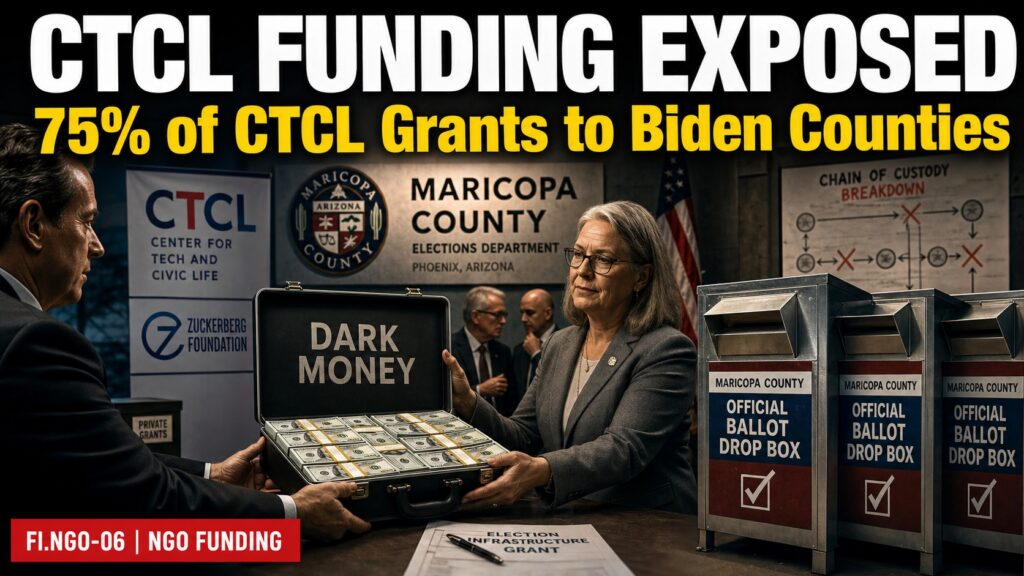
Established Fact CTCL distributed approximately $5.1 million across Arizona jurisdictions for the 2020 election, with the vast majority flowing to counties carried by Joe Biden. Biden-won counties received approximately $3.9 million — roughly 75% of all CTCL grants in the state — while Trump-won counties received just under $671,000, or approximately 13% of the total.

Disproportionate CTCL Drop Box Funding and Chain-of-Custody Breakdown (AZ) Read More »
CTCL Clawback Provisions Created Ongoing Private Control Over Governmental Election Administration (US)

Established Fact Across CTCL grant jurisdictions for which agreements have been made publicly available, grant documents included enforceable contractual clawback provisions authorizing CTCL to discontinue, modify, withhold, or request the return of all or part of grant funds upon CTCL’s determination that grant conditions had not been met. The standard CTCL grant form used in

CTCL Clawback Provisions Created Ongoing Private Control Over Governmental Election Administration (US) Read More »

Extortive Clawback Clauses Dictating Election Operations as Condition of $10 Million Private Grant (PA)

Established Fact “Philadelphia accepted a $10,016,074 CTCL grant that contractually required the city to ‘work to secure 800 or more in-person polling places on Election Day’ and to pay election judges and poll workers using private grant funds — $851,500 in hazard pay for 8,515 poll workers was budgeted directly within the grant agreement. The

Extortive Clawback Clauses Dictating Election Operations as Condition of $10 Million Private Grant (PA) Read More »

Bureau of Elections Promoted Private CTCL Grants via Official State Communications Infrastructure (MI)

Established Fact The Michigan Bureau of Elections used its official government email infrastructure — the Bureau’s statewide News Update system, which automatically delivered communications to every municipal clerk and deputy clerk in the state — to relay CTCL grant application information directly to local election officials in September 2020. The Bureau’s News Update of September

Bureau of Elections Promoted Private CTCL Grants via Official State Communications Infrastructure (MI) Read More »

Misappropriation of COVID Safety Grant Funds for Partisan Operational Enhancement (GA)

Established Fact Despite CTCL grants being publicly marketed as “COVID-19 Response Grants,” Fulton, Cobb, and DeKalb counties — the three largest recipients in Georgia — spent only approximately 1.3 percent of their CTCL grants on personal protective equipment. The remaining funds were applied to operational expenditures including administrative salaries, laptop computers, vehicle rentals, attorney fees,

Misappropriation of COVID Safety Grant Funds for Partisan Operational Enhancement (GA) Read More »

Third-Party NGO Voter Registration Operations Connected to National Private Funding Networks (AZ)

Established Fact The Yuma County Sheriff’s Office and Yuma County Recorder’s Office jointly confirmed sixteen open criminal investigations as of March 2022 into a pattern of election-related fraud spanning the 2020 General Election and continuing into the 2022 primary cycle. Categories of fraud documented in the Sheriff’s Office press release included impersonation fraud, false voter

Third-Party NGO Voter Registration Operations Connected to National Private Funding Networks (AZ) Read More »

Conflict of Interest pertinent to financial transactions featuring MI SoS Jocelyn Benson and Silicon Valley Community Foundations (MI)

Reasonable Inference The financial relationship between SVCF and Michigan Secretary of State Jocelyn Benson warrants scrutiny as a structural conflict of interest facilitated through multiple layers of nonprofit intermediaries. SVCF, as the donor-advised fund custodian for the Chan Zuckerberg Initiative, disbursed $69.5 million to the Center for Election Innovation and Research (CEIR). CEIR in turn

Conflict of Interest pertinent to financial transactions featuring MI SoS Jocelyn Benson and Silicon Valley Community Foundations (MI) Read More »

FinCEN SAR Records — Potential Evidentiary Gap Requiring Database Query (US)

Reasonable Inference Suspicious Activity Reports (SARs) filed by financial institutions with FinCEN in connection with ActBlue transactions may corroborate fraud patterns already identified through FEC data analysis. In September 2024, House Oversight Chairman James Comer and Republican colleagues formally requested from Treasury Secretary Yellen all SARs related to ActBlue, citing concerns about potential money laundering,

FinCEN SAR Records — Potential Evidentiary Gap Requiring Database Query (US) Read More »

Conspiracy Exposure — 18 U.S.C. § 371 (Up to 5 Years) (US)

Reasonable Inference If two or more persons coordinated to submit fraudulent contributions through ActBlue — whether through straw donor schemes, identity misappropriation, or foreign contribution routing — each is subject to conspiracy liability under 18 U.S.C. § 371, independent of whether the underlying offense was completed or whether each participant personally committed every element of

Conspiracy Exposure — 18 U.S.C. § 371 (Up to 5 Years) (US) Read More »

Identity Fraud Exposure — 18 U.S.C. § 1028 (Up to 15 Years) (US)

Reasonable Inference Where perpetrators used real individuals’ personal identifying information (name, address, card number) to make contributions without authorization, each instance constitutes potential identity fraud under 18 U.S.C. § 1028, carrying up to 15 years imprisonment. Citations 18 U.S.C. § 1028(a)(7), (b)(1)(D), “Whoever, in a circumstance described in subsection (c) of this section— (7) knowingly

Identity Fraud Exposure — 18 U.S.C. § 1028 (Up to 15 Years) (US) Read More »