Patrick Colbeck

Fulton County ‘s Official Records Include 22,534 More Ballots Cast than Voters Credited with Casting a Ballot (GA)

Established Fact According to Fulton County and the State’s own records, 148,319 absentee ballots were counted for the 2020 General Election, but only 125,784 voters were recorded as casting a ballot. Therefore, 25,534 more ballots were counted than voters given credit for voting. Citations Fulton County 2020 General Election Report for Georgia State Election Board,
Fulton County ‘s Official Records Include 22,534 More Ballots Cast than Voters Credited with Casting a Ballot (GA) Read More »

Fulton County Failed to Create, Maintain, Preserve, or Produce a Numbered List of Voters for All of Advance Voting (GA)

Established Fact Fulton County failed to contemporaneously maintain a record of the voters who checked-in and cast ballots (“Numbered List of Voters”) for the 2020 General Election as explicitly required by Georgia law. Not just the official record identifying who voted, but the same is the metric to which statute requires the number of ballots

Fulton County Failed to Create, Maintain, Preserve, or Produce a Numbered List of Voters for All of Advance Voting (GA) Read More »

Fulton County Willfully Failed to Perform Absentee Ballot Signature Verification (GA)

Established Fact Fulton County failed to perform signature verification of absentee ballot envelopes for the 2020 General Election in accordance with Georgia law, and in contravention of the terms of a Consent Order to which Fulton County voluntarily agreed. Evidence establishes that Fulton County’s failure was willful and intentional. Citations Fulton County 2020 General Election

Fulton County Willfully Failed to Perform Absentee Ballot Signature Verification (GA) Read More »

Pre-Election Filings and Post-Election Rulings (MI)

Established Fact Allegan County Clerk Robert Genetski and the Michigan Republican Party filed a complaint against new signature verification guidelines issued by MI SoS the same day the guidance was issued — October 6, 2020 — and amended it on December 30, 2020 to argue the directive was unlawful. Court issued a ruling in favor

Pre-Election Filings and Post-Election Rulings (MI) Read More »

WisVote and BadgerBooks Real-Time API Access Granted to Private CTCL Partners – Unauthorized Private Access to Voter History Data (WI)

Established Fact At least one Zuckerberg 5 city provided CTCL and its private partner organizations with a real-time Application Programming Interface (API) connection to both the WisVote statewide voter registration database and the BadgerBooks electronic poll book system. BadgerBooks is the electronic poll book used by Wisconsin municipalities on Election Day; it records voter check-ins

WisVote and BadgerBooks Real-Time API Access Granted to Private CTCL Partners – Unauthorized Private Access to Voter History Data (WI) Read More »

WisVote FIDO Key Proliferation – WEC Cannot Account for All Database Access Credentials (WI)

Established Fact The Wisconsin Legislative Audit Bureau (LAB) determined that WEC issued 3,137 FIDO Keys – multi-factor authentication tokens for WisVote access – and “apparently does not know how many FIDO Keys they have actually issued.” At least one county received 15 FIDO Keys when it requested 2 and was told to retain unused keys

WisVote FIDO Key Proliferation – WEC Cannot Account for All Database Access Credentials (WI) Read More »

Exploitation of MyVote WI Database Security Vulnerability – Unauthorized Remote Alteration of Voter Histories Without Detection (WI)

Reasonable Inference [Reasonable Inference – Exploitation uninvestigated] Investigators identified a documented security vulnerability in Wisconsin’s MyVote WI public-facing voter registration portal that created the capability for anyone obtaining remote access to the voter rolls to change voter information – including voting history – without the change being detected or logged in any auditable way. MyVote

Exploitation of MyVote WI Database Security Vulnerability – Unauthorized Remote Alteration of Voter Histories Without Detection (WI) Read More »

MyVote WI Database Security Vulnerability – Unauthorized Remote Alteration of Voter Histories Without Detection (WI)

Established Fact [Established Fact – Vulnerability confirmed] Investigators identified a documented security vulnerability in Wisconsin’s MyVote WI public-facing voter registration portal that created the capability for anyone obtaining remote access to the voter rolls to change voter information – including voting history – without the change being detected or logged in any auditable way. MyVote

MyVote WI Database Security Vulnerability – Unauthorized Remote Alteration of Voter Histories Without Detection (WI) Read More »

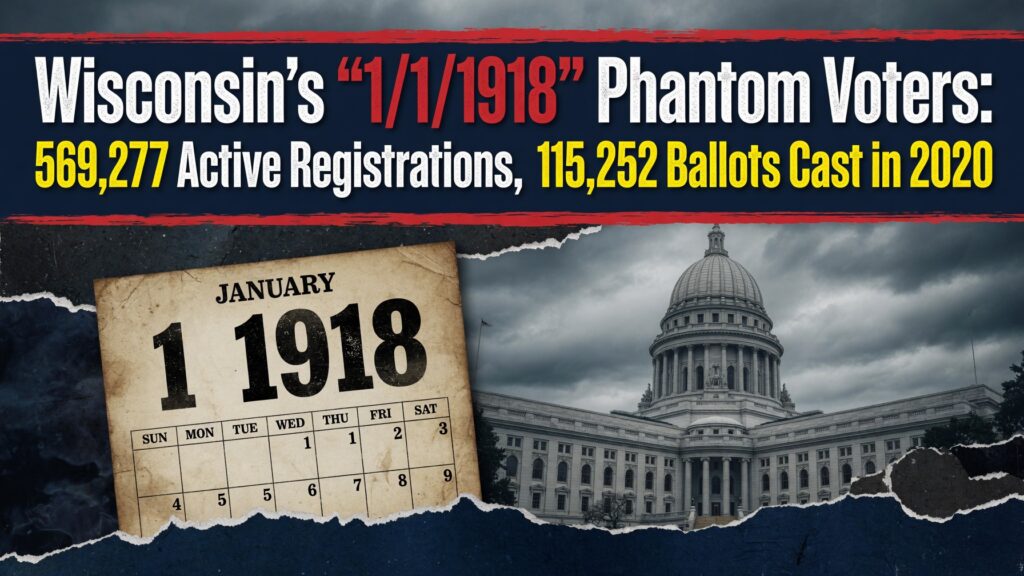
“1/1/1918” WisVote Placeholder Registration Date – 569,277 Active Voters; 115,252 Voted in 2020 (WI)

Established Fact Wisconsin’s WisVote statewide voter registration database contained 569,277 active voter registrations with an identical placeholder application date of January 1, 1918 – a date assigned, in many systems, to records where the actual registration date is unknown, missing, or was not properly recorded. Of these 569,277 registrations with the suspicious uniform placeholder date,

“1/1/1918” WisVote Placeholder Registration Date – 569,277 Active Voters; 115,252 Voted in 2020 (WI) Read More »

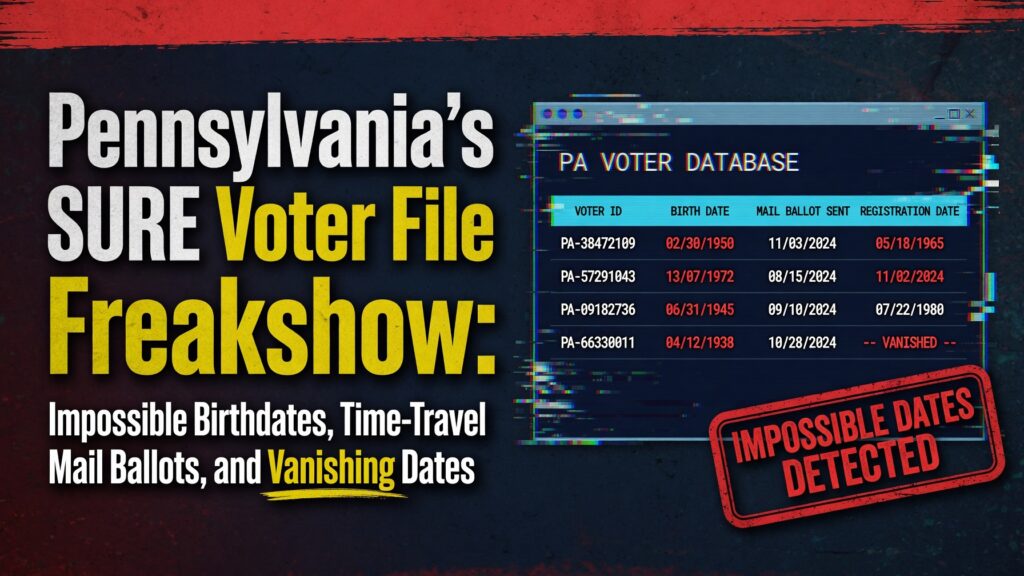
Fraudulent SURE System Voter Roll Anomalies – Impossible Birthdates, Pre-Return Mail Dates, and Missing Dates (PA)

Disputed Fact [Disputed Fact – As to whether anomalies reflect fraud or systemic data error] Official Pennsylvania legislative correspondence documented the following anomalies in the SURE voter history file: 1,573 mail ballots cast by voters listed as over 100 years old; 41 Allegheny County ballots mailed to persons with a date of birth of January

Fraudulent SURE System Voter Roll Anomalies – Impossible Birthdates, Pre-Return Mail Dates, and Missing Dates (PA) Read More »