Patrick Colbeck

CTCL Claw-Back Leverage Over Philadelphia Operations (PA)

Established Fact Philadelphia accepted millions in CTCL funds under agreements with claw-back provisions that, in practical effect, made noncompliance with CTCL’s specified operational model (including drop-box deployment, staffing, and outreach) “not an option.” Local officials described the terms as binding, and the grant documents empowered CTCL to demand repayment for deviations, granting a Chicago-based NGO

CTCL Claw-Back Leverage Over Philadelphia Operations (PA) Read More »
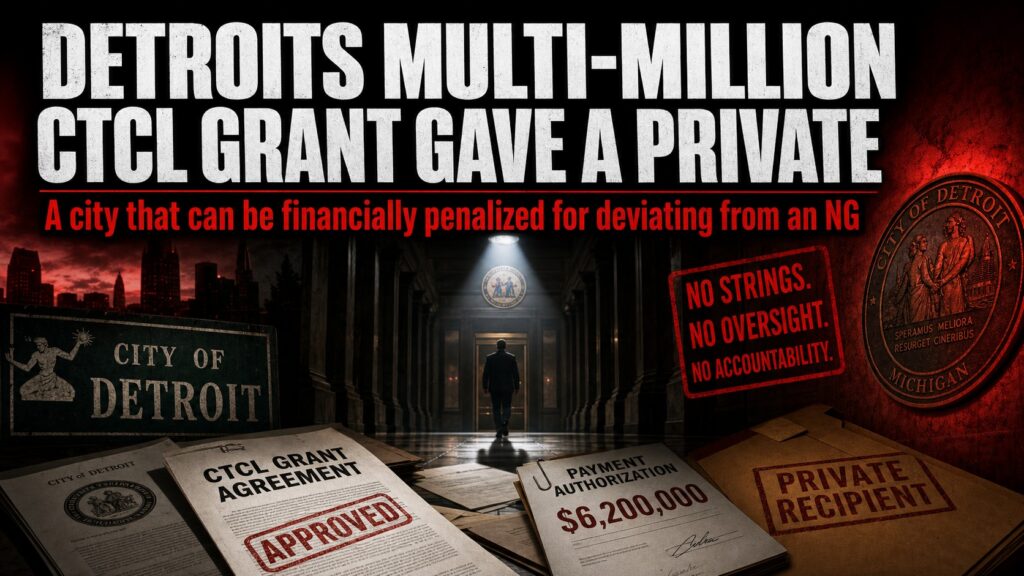
CTCL Detroit Grant with Unilateral Claw-Back Authority (MI)

Established Fact Detroit’s CTCL grant (approx. 3.5-7.4 million dollars depending on tranche) included a clause granting CTCL the right, “in its sole judgment,” to demand return of funds if Detroit did not adhere to the grant’s conditions (e.g., implementing specified satellite offices, drop boxes, and staffing models). This placed core questions of compliance with election-administration

CTCL Detroit Grant with Unilateral Claw-Back Authority (MI) Read More »

CTCL Grant Claw-Backs Nullifying County Independence (GA)

Established Fact Georgia counties including Fulton and DeKalb accepted multi-million-dollar CTCL grants in 2020 — Fulton County $6,309,436 and DeKalb County approximately $4.7 million for the general election plus an additional $4.6 million for the December runoff — and used the funds to operate voting locations, hire election staff, purchase processing equipment, and deploy drop

CTCL Grant Claw-Backs Nullifying County Independence (GA) Read More »

Judicial Remedy Arrives Post-Certification; Drop Box Legality Unresolved at Time of Election (AZ)

Reasonable Inference Unlike Wisconsin, Arizona courts did not issue a definitive pre-certification ruling on the legality of drop box placement and operational standards under CTCL-funded plans. The election was thus administered under unverified private-grant-driven drop box protocols while no judicial or statutory framework governed collection schedules, two-person collection requirements, or surveillance coverage mandates. Citations Arizona

Judicial Remedy Arrives Post-Certification; Drop Box Legality Unresolved at Time of Election (AZ) Read More »

Hatch Act Concerns Raised by CTCL Clawback Provisions Created Ongoing Private Control Over Governmental Election Administration (US)

Disputed Fact [Disputed Fact – As to Hatch Act nexus] Across CTCL grant jurisdictions reviewed, grant agreements included enforceable contractual clawback provisions authorizing CTCL, in its sole judgement, to demand the return of all or part of disbursed funds if recipients failed to comply with the grant’s conditions. In the Wisconsin five-city agreement, this provision

Hatch Act Concerns Raised by CTCL Clawback Provisions Created Ongoing Private Control Over Governmental Election Administration (US) Read More »

CTCL Clawback Provisions Created Ongoing Private Control Over Governmental Election Administration (US)

Reasonable Inference [Reasonable Inference – As to functional governmental subordination] Across all CTCL grant jurisdictions reviewed, grant agreements included enforceable contractual clawback provisions authorizing CTCL, in its sole discretion, to demand the full return of disbursed funds if recipients failed to comply with CTCL’s programmatic directives. This financial penalty regime – operating over duly sworn

CTCL Clawback Provisions Created Ongoing Private Control Over Governmental Election Administration (US) Read More »

Swiss Business Contracted by National Institute for Health to Develop a Patent for Injection of Fake Voters into Election Systems (Switzerland)

Established Fact Patent US 7,549,049 proves that some of the greatest threats to election integrity aren’t software bugs—they are intentional design features. Internet-based voting systems that lack a verifiable, physical paper trail continue to represent an unacceptable risk to secure elections. It is concerning for the following reasons: It Provides a Built-In Blueprint for Ballot

Swiss Business Contracted by National Institute for Health to Develop a Patent for Injection of Fake Voters into Election Systems (Switzerland) Read More »

COVID-19 Released from Lab in Wuhan, China Encouraged Mail-In Voting (China)

Disputed Fact Multiple U.S. government investigations have concluded that SARS-CoV-2 most likely emerged from a laboratory in Wuhan, China. The House Select Subcommittee on the Coronavirus Pandemic’s December 2024 final report — the product of a two-year investigation — concluded that “COVID-19 most likely emerged from a laboratory in Wuhan, China” and that “a lab-related

COVID-19 Released from Lab in Wuhan, China Encouraged Mail-In Voting (China) Read More »

CCP University Partnerships Established with US Universities (China)

Established Fact Partnerships were formed between Wayne State University Law School and Beijing Normal University and the China University of Political Science and Law following a June 2013 trip to China by Wayne Law Interim Dean Jocelyn Benson, and a subsequent December 2013 visit by Wayne Law Associate Professor Paul Dubinsky, who served as director

CCP University Partnerships Established with US Universities (China) Read More »

Iranian Nationals Charged for Cyber-Enabled Disinformation and Threat Campaign Designed to Influence the 2020 U.S. Presidential Election (Iran)

Established Fact Seyyed Mohammad Hosein Musa Kazemi (سید محمد حسین موسی کاظمی), aka Mohammad Hosein Musa Kazem, aka Hosein Zamani, 24, and Sajjad Kashian (سجاد کاشیان), aka Kiarash Nabavi, 27, both of Iran, obtained confidential U.S. voter information from at least one state election website; sent threatening email messages to intimidate and interfere with voters;

Iranian Nationals Charged for Cyber-Enabled Disinformation and Threat Campaign Designed to Influence the 2020 U.S. Presidential Election (Iran) Read More »